
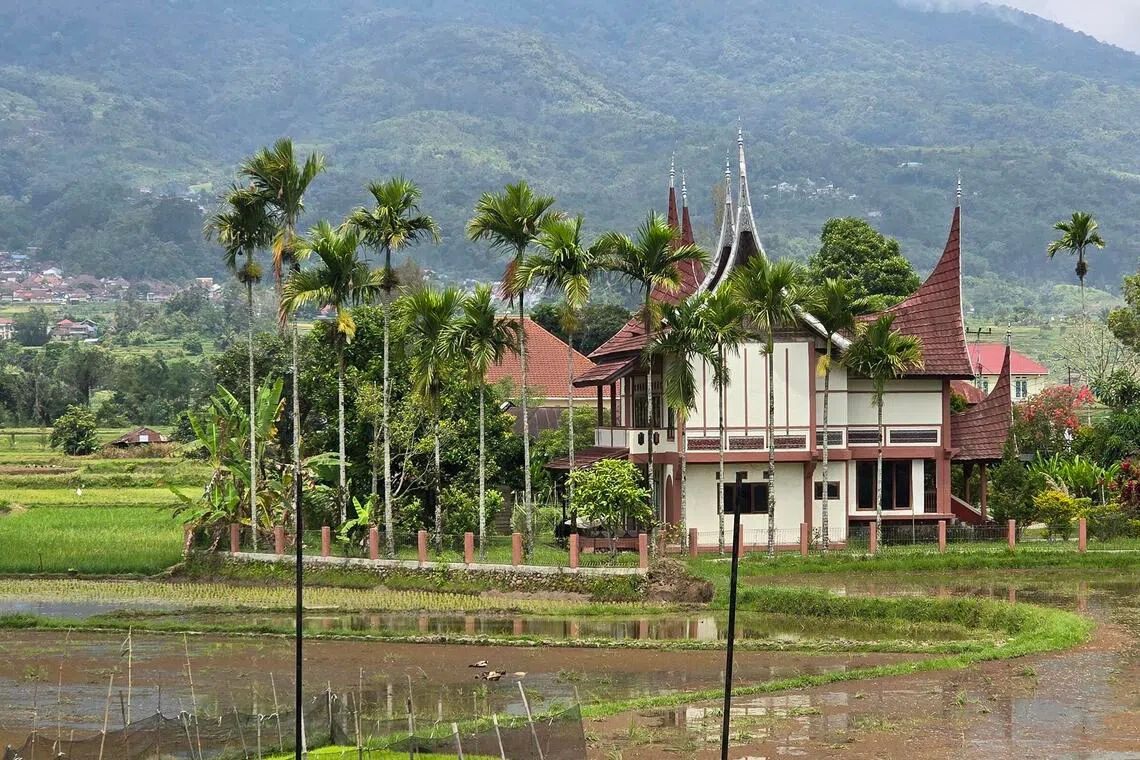
The first thing I noticed about West Sumatra were the horns.They point skywards from the traditional communal Minangkabau houses, known as rumah gadang, and are repeated across the layered roofs of Istano Basa Pagaruyung, the reconstructed royal palace.These roofs mimic the horns of an animal that is commonly found here: the buffalo. A few days later, I went looking for one.A traditional rumah gadang stands amid rice fields in West Sumatra. The house is built largely from wood and topped by the distinctive gonjong, upward-curving roof peaks associated with Minangkabau architecture. ST PHOTO: ARLINA ARSHADMy guide Habibie, who goes by one name, and I were looking across Sianok Canyon near Bukittinggi, a highland city about a two-hour drive from the capital Padang, when we spotted several buffaloes grazing below.“Should we go down and look for them?” I asked. “Let’s.”We found them behind a gate, chewing grass and entirely uninterested in our photo shoot.“Mokkk! Mokkk!” Habibie called out, drawing out a long, throaty moo.That, he explained, was how buffaloes sounded. One slowly raised its head and stared straight at my camera. Supermodel.The steep cliffs of Sianok Canyon rise above a lush valley near Bukittinggi in West Sumatra. It is one of the province’s best-known natural attractions, with visitors coming for trekking and panoramic views of the roughly 15km-long gorge. ST PHOTO: ARLINA ARSHADOne of the “supermodel” buffaloes grazing below Sianok Canyon turns for the camera. Buffaloes are closely woven into Minangkabau culture and cuisine. Their milk is used to make dadih, a local fermented speciality, while buffalo meat has traditionally been used for rendang. ST PHOTO: ARLINA ARSHADThe animal is at the heart of the Minangkabau people’s best-known origin story. Their ancestors, the story goes, defeated a powerful rival by sending a hungry calf fitted with pointed iron against a much larger buffalo. The calf went underneath it looking for milk and fatally wounded it.In the popular telling, the victory gave the Minangkabau their name, from manang kabau – the victorious buffalo.By then, I thought I had buffaloes figured out. Then I went to watch pacu jawi, West Sumatra’s famous muddy race traditionally staged after the rice harvest. It is still largely a local affair, held weekly in different villages.To my surprise, they were actually cows.In this race, the track is a flooded sawah, or rice field. Pairs of cows, more used to steady ploughing than high-speed charging, are yoked together, with a barefoot jockey balancing on a wooden plough and clinging to their tails. A good pair is supposed to run together over 60m to 250m, but they do not always cooperate.Some spectators, mainly tourists including myself, had planted themselves at the front for what looked like the best vantage point. We were wrong. Skittish cows veered left and right, and twice, a pair came towards me. On both occasions, I jumped aside and straight into the mud.Rendang, at home in PadangDirect flights between Singapore and Padang returned in January 2025, after an earlier service ended in 2018 because of low passenger numbers. Scoot, currently the only airline flying the route non-stop, operates several flights a week.At Muaro, Padang’s old river port, ageing shophouses and warehouses recall the days before air travel, when ships connected this coast with Singapore and the wider Malay world.For a deeper look at West Sumatra’s history, I headed to Museum Adityawarman, housed in a striking rumah gadang-style building. What I found there was unexpected: broken plates.Statues of a Minangkabau man and woman in traditional dress stand outside Museum Adityawarman in Padang, with the woman holding a carano, a vessel traditionally used to hold betel leaves. ST PHOTO: ARLINA ARSHADOn Sept 30, 2009, a powerful earthquake struck West Sumatra, damaging 320 pieces in the museum’s ceramic collection.Staff salvaged the fragments and reassembled some, intentionally leaving their cracks visible. The exhibition is called Retakan Yang Bertutur, or cracks that tell a story.One panel carries a simpler message: Yang Pecah Tak Selalu Hilang – what is broken is not always lost.Broken ceramics on display at Museum Adityawarman in Padang. The museum’s collection numbers more than 6,000 objects, ranging from ethnographic and archaeological artefacts to manuscripts, coins and traditional art. ST PHOTO: ARLINA ARSHADElsewhere in the museum, a display indicated that an account from 1827 recorded Minangkabau traders carrying dried, dark meat on journeys towards Singapore and Malaysia.Some historians believe the meat may have been rendang. Cooked in spices and coconut milk until dry, rendang could last long journeys. It would support the Minangkabau tradition of merantau – leaving home to trade, study or seek opportunities elsewhere.Habibie told me rendang was traditionally made with buffalo meat and reserved for feasts and important occasions. Today, it is commonly made with beef, although buffalo rendang can still be found. It is one of West Sumatra’s best-known dishes, alongside soto Padang, a beef soup.Nearly two centuries later, Singaporeans hardly need an introduction to West Sumatran food. We know rendang and nasi padang.At Lamun Ombak, a popular Padang restaurant, nearly two dozen little plates arrived at my table without my ordering them individually. Diners simply eat what they want and pay for the dishes they touch. Beef rendang was the star of my spread.Elsewhere in West Sumatra, I tried itiak lado mudo (duck smothered in green chilli); warm bika talago, a charcoal-baked coconut and rice flour cake; and kawa daun, a drink brewed from coffee leaves rather than beans.Singapore? No, Sungai PuaAfter a night of hard rain, Gunung Marapi – not to be confused with Central Java’s Merapi – finally emerged from the clouds.Gunung Marapi forms a dramatic backdrop to life in West Sumatra’s highlands. But the scenery comes with danger: Marapi is the most active volcano on Sumatra, with more than 50 recorded eruptions since the late 18th century. An eruption in 2023 killed 23 climbers. ST PHOTO: ARLINA ARSHADIn the centre of Bukittinggi, West Sumatra’s third-largest city and a busy highland trading hub, there were moments when I wondered whether I had wandered into Geylang Serai. Women in hijabs and makciks went about their day amid the bustle of the wet market and a nearby mosque. The scene felt immediately familiar.Then a bendi, one of Bukittinggi’s horse-drawn carriages, clip-clopped past. The cool highland air was yet another indication. Towering above the crowds stood Jam Gadang, the city’s landmark clock tower.No, I was definitely in Sumatra.A row of bendi waits for passengers in central Bukittinggi. The horse-drawn carriages, once an important form of everyday transport in West Sumatra, are now a popular way for visitors to tour the city. ST PHOTO: ARLINA ARSHADJam Gadang has kept watch over central Bukittinggi since 1926. The 26m-tall clock tower remains the city’s landmark and, according to the Bukittinggi Tourism Office, its most visited attraction. ST PHOTO: ARLINA ARSHADThen, I discovered West Sumatra apparently has its own version of Singapore.Sungai Pua is a village near Bukittinggi. Its name sounds enough like “Singapore” that, Habibie said, villagers sometimes joke that they are Singaporeans.In Bukittinggi, an elderly man asked where I’m from.“Singapore,” Habibie told him.The man wanted to know exactly where in Sungai Pua. I almost blurted out the name of my own, also rather famous, Singapore neighbourhood – Yishun.At Pandai Sikek, a village between Padang and Bukittinggi renowned for its traditional weaving, I watched women weave intricate patterns of gold and coloured threads into songket cloth on wooden looms – painstaking work that can take weeks for a single piece.The handwoven cloth, I was told, is finding new fans among young people, who wear songket to parties and other special occasions.Then an elderly woman walked in wearing a tengkuluk, the distinctive Minangkabau women’s headdress. At formal occasions, the headdress is often styled to curve upwards like buffalo horns – there they were again. Hers was a simpler, everyday version.An elderly woman wearing a tengkuluk, a traditional Minangkabau women’s head covering. Made by folding and shaping cloth rather than using a fixed form, tengkuluk come in numerous styles, with designs differing between communities and occasions. ST PHOTO: ARLINA ARSHADI showed her pictures of cats that had gone viral on TikTok wearing tiny tengkuluk. Her face lit up. Soon, we were laughing together.Tunnel visionBeneath Bukittinggi lies Lubang Jepang, a network of tunnels built during the Japanese Occupation using forced labour.The entrance to Lubang Jepang, an underground complex built by the Japanese during World War II using romusha, or forced labour. It runs for about 1.47km and reaches depths of up to 40m, and included spaces for meetings and ammunition storage. ST PHOTO: ARLINA ARSHADI followed my guide underground, past chambers once used for ammunition, cooking and prisoners, and a chute where soil – and, he said, the bodies of dead labourers – were dumped into the valley.His phone rang and he wandered off in search of a signal, leaving me alone.I walked into an unlit passage, pointed my camera into the darkness and waited five seconds for the exposure.The image appeared. A red splotch hovered to my right. To my left was an unsettling figure that resembled Michael Jackson.I tried another shot. The red reappeared. I decided not to zoom in. What if somebody were to tap me on the shoulder?So I fled – only to find the sound of my own footsteps following me through the tunnel even scarier.From Bukittinggi, Habibie took me on one final excursion, about an hour’s drive away, to Harau Valley. There, enormous cliffs emerge from rice fields and villages, drawing rock climbers from around the world.A cyclist passes through rice fields beneath the towering cliffs of Harau Valley.The forest echoed with the “oo-oo” calls of black-crested gibbons. A look at Sarasah Murai waterfall turned into a little trek to reach it.I was hot and sweaty by then. I caught my breath in the refreshing spray of the waterfall.Still, people kept telling me I had barely seen West Sumatra. There were the Mentawai Islands, with their surf and indigenous culture, and Alahan Panjang, with its lakes and cool mountain landscape. Clearly, I will have to come back.Next time, I will know how to get a buffalo’s attention.Produced by: Chang May Choon, Zurairi A.R, Siow Wong, Kelly Pang, Philip Cheong
West Sumatra, where you find buffalo supermodels and a village called ‘Singapore’
Full Article
Original Source
Read the full article at Straitstimes →KhanList aggregates and links to publicly available news content. We do not host full articles from third-party sources. Always verify important information with original sources.