
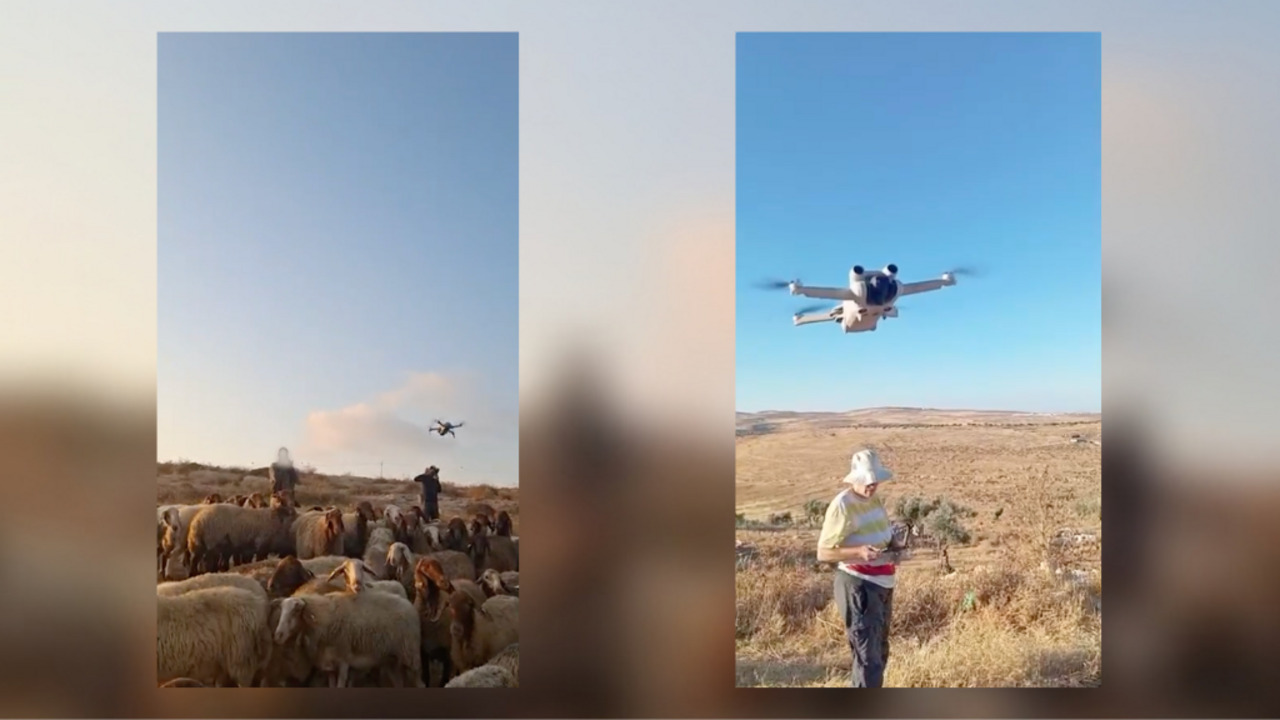
Four men strike a pose, each holding a drone and smiling at the camera. This photo was posted on X on September 3, 2026 by Israeli settler Elisha Yered, a member of the Frontline Hills Administration, a settler organisation in the occupied West Bank whose aim is to establish and strengthen illegal settlements. In the caption, he claims to have distributed the drones to four settlements in the West Bank – a territory occupied by Israel since 1967. “Drones are an essential tool on the ground: both for monitoring attacks and arson in real time, and for documenting events and refuting blood libel allegations,” he writes. He adds: “And above all: a huge thank you to the Jewish people who contributed to the purchase of this security equipment and who have enabled us to support our activists.” In this September 3, 2026 tweet, Israeli settler Elisha Yered says his Front Hills Administration group had delivered drones to four illegal settlements in the West Bank that day. To display this content from X (Twitter), you must enable advertisement tracking and audience measurement. Elisha Yered is also a member of the “Hilltop Youth”, a movement of young settlers who regularly commit acts of violence against Palestinians and their villages in the occupied West Bank. He is accused of being part of a group of armed settlers who killed a 19-year-old Palestinian, Qusai Jammal Mi’tan, in August 2023 in the Palestinian village of Burqa. He has been under European sanctions since April 2024. On June 19, 2026, in Taybeh, a village north-east of Ramallah, an activist filmed his colleague sitting on the ground while a drone flew overhead. The drone moves closer to the camera, then flies away. According to him, this surveillance is a recurring occurrence: settlers send drones to identify the presence of activists so that they can report them to the Israeli army. To display this content from , you must enable advertisement tracking and audience measurement. 'They started sending drones over us at night, during the day, in the morning – at any time' The use of drones by the Frontline Hills group is symptomatic of a policy of increasingly widespread use of these devices by various actors in the occupied West Bank. The drones are sent to fly over Palestinian homes and crops. This harassment is all too familiar to Abdel (an alias), a Bedouin cattle farmer who lives near Jericho, northwest of the Dead Sea. He says he and his family were forced to leave their village of Shalal al-Auja in January 2026 following numerous attacks by settlers. He attests that the same settlers followed them to their new home and are prolonging their suffering. He and his wife sent us several videos of drones flying overhead, usually late in the evening. He says intimidation attempts occur almost daily: "I was displaced from Shalal al-Auja; my family and I settled 10 kilometres away. Two and a half months after I arrived, they [the settlers] set up an outpost about 500 metres from my home. This outpost has nothing; it simply launches drones to harass people. After that, they started sending drones over us at night, during the day, in the morning, at any time… At first, it was every day, but recently it’s been two or three days a week. Every time a car drives into your property, or if you go out to feed the sheep or do anything else, they immediately send a drone after you. And then, one day, they came right up to my house. They were the same settlers who had driven me out of my first home in Shalal al-Auja. They followed me all the way home and beat me up in my new house. They attacked me right in the heart of my home and beat me up." In a video sent by our Observer Abdel’s wife on September 16, 2026, a loud humming noise can be heard. The camera tries to locate the source of the noise and then pans up towards the sky. A drone, illuminated by a torch, can be seen flying over her home. After several seconds, the drone flies off. To display this content from , you must enable advertisement tracking and audience measurement. 'Drones are used to monitor whether new buildings are constructed' Shai Gortler is a research associate at the Centre for Humanities Research at the University of the Western Cape in Cape Town. He specialises in surveillance, incarceration and colonisation. Shai states that four entities use drones in the occupied West Bank, for various reasons: "The first group are the settlers. They use drones to intimidate and gather information. Next, there are the regional councils [government bodies in the occupied West Bank comprising several illegal settlements] which monitor new construction [by Palestinians]. The third group consists of NGOs. The most significant is Regavim, which means ‘clods of earth’ in Hebrew [an Israeli NGO subject to European sanctions, co-founded by the Israeli Finance Minister, the Jewish supremacist Bezalel Smotrich]. It uses drones for the same reasons as the regional councils: to monitor the presence of new constructions. It then calls on the Civil Administration [an Israeli government body in the occupied West Bank] to have them demolished. Finally, the last group is the Israeli army, which uses its drones for surveillance and demolition. There is one final major use that has been documented in the West Bank, which involves scaring away Palestinians’ flocks of sheep or goats.” 'They even infringe on your privacy, right inside your own home.' Faris (an alias) is a farmer in the village of Burqa in the Ramallah Governorate. According to the NGO Peace Now, Burqa is situated near 12 Israeli settlements. Faris says he has witnessed drones flying over the area to scatter the sheep. “Some shepherds who were grazing their sheep on the outskirts of the village have encountered drones. The settlers use drones to scare the sheep away: they fly them very close to the flock and the noise disturbs the animals immensely, causing them to scatter in all directions. The aim is notably to create a situation that makes it easier to steal the sheep. We had already noticed the presence of drones after October 7, 2023, but not with this frequency. Those who used them most were mainly the army or the police. The problem with drones is serious. They even infringe on your privacy, right inside your own home. Sometimes, you only spot the drone when it’s already close to your window. We’ve gone from seeing them once a month, or even less frequently, to an almost constant presence. The drones hardly ever seem to leave the village skies, day or night.” On August 19, 2026, in Khirbet Ghuwein, south of Hebron, a drone flew over four shepherds and their flock of sheep. To display this content from , you must enable advertisement tracking and audience measurement. “Generally speaking, when settlers want to launch an attack or carry out a robbery without being spotted by the locals — who might try to stop them — they send up a drone. The drone can then quietly survey the whole area, identifying the routes they can use to enter and those they can use to leave. In this way, they map out their itinerary and plan their operation.” In this video filmed on August 31, 2026, in the West Bank village of Burqa, Israeli settlers are seen at the village entrance and appear to be throwing projectiles, while a drone is flying over the village. Our observer explains that the settlers hide among trees, while the drones provide cover and monitor the movements of the villagers. To display this content from , you must enable advertisement tracking and audience measurement. Government support Since its formation in 2022, Israeli Prime Minister Benjamin Netanyahu’s government has accelerated the establishment of new settlements in the occupied West Bank, and has approved the creation of 103 of them. In 2026, the Israeli government allocated 50 million shekels (more than €14 million) to fund “security equipment”, including drones, and infrastructure for outposts and illegal settlements in the West Bank. Nonetheless, the government and the Ministry of Settlement and National Missions do not confine themselves to providing financial and legislative support: they personally deliver supplies to the colonies and take part in “security equipment” handover ceremonies. Photos posted on Facebook by Orit Strook, Minister of Settlements and National Missions, taken on July 6 2026 during the equipment handover ceremony at the illegal settlement known as the “Zarzir Farm”. She is accompanied by the Minister of Finance, Bezalel Smotrich, and the Chairman of the Jordan Valley Regional Council, David Elhayani. In the caption, she states that she is getting ready to approve a five-year plan with a budget of several billion shekels. To display this content from Facebook, you must enable advertisement tracking and audience measurement. Finance Minister Bezalel Smotrich published a video on Instagram during an equipment handover ceremony in July 2026 at the “Zarzir farm”, an illegal settlement established in 2025. He can be seen standing next to a table displaying drones, first-aid kits and other equipment, before personally handing over supplies to the man who established the settlement, Mol Yessa. In this video posted on Instaram July 8, 2026, Israeli Finance Minister Bezalel Smotrich speaks during a ceremony to deliver "security eqiopment" to an illegal settlement knwon as Zarzir. Drones and first-aid equipment are visible on a table. To display this content from Instagram, you must enable advertisement tracking and audience measurement. The previous year, in July 2025, the Benyamin Regional Council, which comprises 17 illegal settlements in the West Bank, had welcomed the latest distribution of equipment, which it claimed included 20 off-road vehicles, night-vision devices and drones. Israeli Finance Minister Bezalel Smotrich hands over a bag of first-aid supplies during a ceremony to hand out “safety equipment” in the illegal settlement of Zarzir Farm on July 6, 2026. © The Observers / Olam Katan In its report “The Elimination Project”, B’Tselem, an Israeli organisation fighting for Palestinian rights, notes that the Ministry of Settlements had allocated 20 million shekels (equivalent to over €5 million) to regional councils in the West Bank so that they could monitor the construction of new Palestinian buildings. These councils could therefore apply to the Ministry for funds to purchase surveillance equipment and aerial photography, including drones. The Israeli army’s use of drones in the West Bank has also been documented since that same year. Israeli settlements and outposts in the West Bank are considered illegal by the United Nations. In March of 2026, the UN High Commissioner for Human Rights expressed concern about “ethnic cleansing” in the West Bank following “the intensification of attacks, the systematic destruction of entire neighbourhoods, the denial of humanitarian aid and forced transfers”. It considered that the “illegal transfer” of Palestinians “constitutes a war crime” and, in some cases, may “amount to a crime against humanity”.
West Bank: Palestinians ‘harassed’ by settlers’ increasing use of drones
Full Article
Original Source
Read the full article at France24 →KhanList aggregates and links to publicly available news content. We do not host full articles from third-party sources. Always verify important information with original sources.