
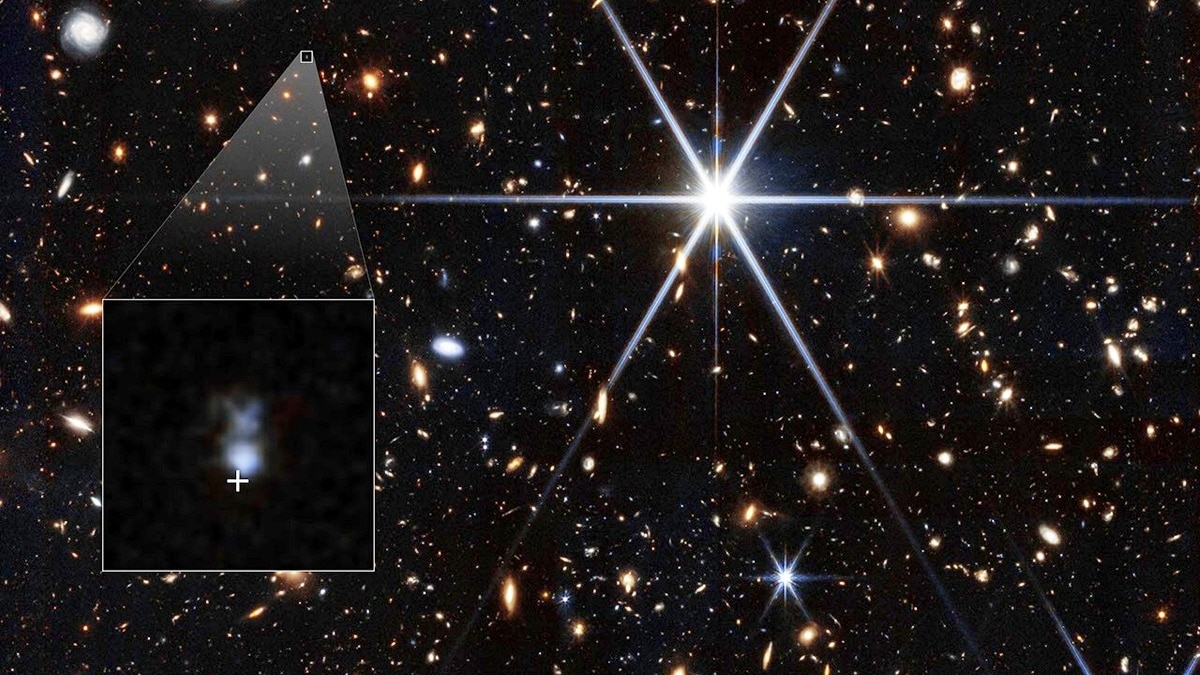
Astronomers used the James Webb Space Telescope to identify the tiny host galaxy of FRB 20240304B. The finding links the record-distant burst to a young star-forming system and sharpens clues about its origin.The discovery also allowed scientists to investigate the otherwise invisible material between Earth and the distant burst. (Photo: Nasa)New Delhi,Oct 9, 2026 11:10 ISTAstronomers have traced the most distant fast radio burst ever detected to a tiny galaxy billions of light-years away, offering new clues about the mysterious cosmic flashes that have puzzled scientists since their discovery in 2007.Using Nasa’s James Webb Space Telescope, researchers identified the host galaxy of a radio burst detected in March 2024.The discovery, published in the journal Science, could help scientists understand what produces these powerful millisecond-long flashes of radio emission from the distant universe.The burst, designated FRB 20240304B, was first detected by the MeerTRAP team using South Africa’s MeerKAT radio telescope on March 4, 2024. Initial observations suggested that it originated at an extraordinary distance. However, confirming its distance required identifying the galaxy from which the signal came. Although astronomers had precisely determined the burst’s position, even the world’s largest ground-based telescopes could not detect a galaxy at that location. The team therefore turned to Webb, whose powerful infrared instruments revealed the elusive host galaxy.Webb’s Near-Infrared Camera (NIRCam) detected the galaxy, while its Near-Infrared Spectrograph (NIRSpec) measured its redshift at 2.148. This places the galaxy at a time when the universe was only about three billion years old, during a period known as “cosmic noon”, when star formation was at its peak.A TINY GALAXY CHALLENGES EXISTING THEORIES The discovery surprised researchers because the host galaxy was far smaller than expected. Most previously identified FRB host galaxies are massive, star-forming systems.In contrast, the galaxy associated with FRB 20240304B was about 1,000 times less massive than astronomers had anticipated, despite actively forming stars. The world’s largest ground-based telescopes could not see any galaxy at that spot in the sky. As a result, the team turned to the Webb telescope. (Photo: Nasa) “What makes fast radio bursts interesting is that we don't know what generates them. We have theories for what objects produce them, but we don't have conclusive proof,” said Manisha Caleb of the University of Sydney, lead author of the study.One leading theory suggests that FRBs can originate when two neutron stars, the extremely dense remnants of massive stars, spiral towards each other and merge. Such mergers can take billions of years, making them more likely to occur in older stellar populations.Another theory points to magnetars — highly magnetic neutron stars that can produce powerful bursts of energy. These objects can form following the explosive deaths of massive stars, potentially producing FRBs much sooner.The young, actively star-forming host galaxy supports the possibility of a magnetar origin.“Our work suggests that it’s very unlikely that this FRB was produced by a merger,” Caleb said.A COSMIC FLASHLIGHTThe discovery also allowed scientists to investigate the otherwise invisible material between Earth and the distant burst.As radio waves travel through space, they interact with matter along their path, leaving detectable signatures. Researchers identified evidence of two cosmic structures in the signal: a previously unknown galaxy cluster about 3.5 billion light-years away and the nearby Virgo Cluster, around 54 million light-years from Earth.These observations demonstrate how FRBs can act as cosmic probes, helping astronomers map matter that conventional observations may struggle to detect.Researchers expect MeerKAT to identify several FRBs each year at redshifts greater than one, opening a window into the universe's distant past. Webb will remain crucial for identifying their host galaxies and investigating the origins of these enigmatic signals.`- Ends
Webb Telescope discovers location of most distant alien signal to hit Earth
Full Article
Original Source
Read the full article at Indiatoday →KhanList aggregates and links to publicly available news content. We do not host full articles from third-party sources. Always verify important information with original sources.