
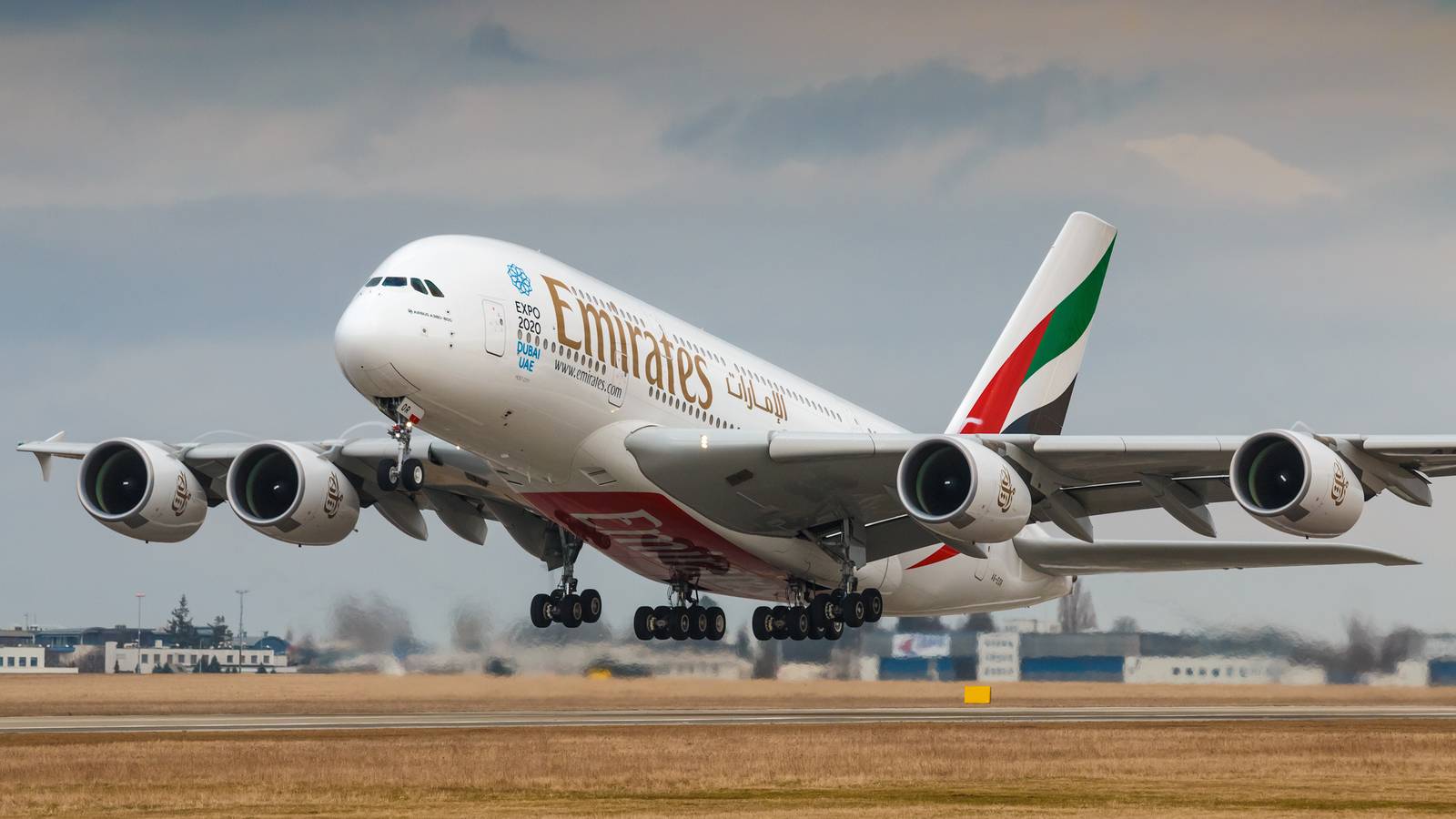
Published Nov 23, 2026, 12:00 PM EST Aaron is an aviation enthusiast and world traveler with a deep interest in aerospace history and technology. He has traveled around the world numerous times, often incorporating visits to aviation museums and historic aircraft collections into his journeys. A native of New Zealand, he is an expert in aviation and maintains a broad interest in a variety of other subjects. Emirates is generally said to have the oldest Airbus A380-800 Superjumbo remaining in service today. While that is defensible when measured from MSN sequence and year of manufacture, it is not without its challengers. Airbus is (still) flying its first Superjumbo, built as a testbed, and Qantas' oldest A380s were delivered before Emirates' oldest aircraft. In fact, by the time Emirates started operating the world's 'oldest' A380, Qantas had been flying three of its Superjumbos that remain in service today for months. To cover all bases, this article will provide the latest flight-tracking data for all three claimants to the world's oldest in-service Superjumbo accolade. Even if Emirates isn't deemed to have the oldest examples in service, it likely will in the next few years as other airlines phase out their A380s and Emirates doubles down on plans to operate them through the 2030s. Emirates Has Oldest A380 By Year Of Manufacture Credit: Michael Derrer Fuchs l Shutterstock The Emirates Airbus A380 is the oldest commercial passenger Superjumbo still operating in the world as of the time of writing. This is the oldest by year of manufacture. The aircraft (registered A6-EDF) bears MSN 007 and was built in 2006. The massive aircraft was delivered to Emirates in December 2009 but was later mothballed during COVID-19. The aircraft was pulled out of storage and returned to service in April 2025, five years later. As suggested by its MSN, A6-EDF is far from the oldest A380 actually built. It is technically also not the oldest remaining in service (more about F-WWOW below). The older aircraft include the Airbus MSN 101 (F-WWOW) testbed, the Airbus MSN 002 prototype (now preserved at Toulouse), and the units with MSNs 003 through 006. Of those four older aircraft, two are scrapped, one is preserved at Le Bourget in Paris, and one is stored in Tarbes. The three examples are older than Emirates' A6-EDF, which flew for Singapore Airlines. It's also worth noting that all six of the next production aircraft (MSN 008 through MSN 013) are also scrapped, parked, or stored. The next oldest pair of Superjumbos in active commercial use are Qantas' VH-OQA and VH-OQB (MSN 014, MSN 015). The catch is that these aircraft were built later, but delivered sooner (in 2008). Emirates' Oldest A380 Flight's Latest Flights Credit: Abdul N Quraishi - Abs l Shutterstock The date of writing is November 17, and so the last week stretches back to November 10 or 9, depending on how the dates are counted. Flight data for the 17th is not yet available. A6-EDF's most recent flight was the three-hour hop from Egypt's Cairo back to Dubai, returning from the same-day three-hour and 40-minute flight. Yesterday (16) was a busy day for the aircraft as it flew back from Bangkok to Dubai that morning (a six-hour flight). Starting at the beginning of the week (November 9), the aging A380 flew from Dubai to Mauritius and back again the same day as Flights EK702 and EK19, respectively. On the 10th, it flew from Dubai to Manchester and back. The next day, it flew to London and back, and then to Manchester and back the following day. On the 13th, it flew as EK362 to Guangzhou in China and returned as Flight EK363 the following day. Date Flight number (outbound/inbound) Route Flight duration (outbound/inbound) November 16 EK923/EK924 Dubai—Cairo 3:40/2:59 November 15–16 EK374/EK375 Dubai—Bangkok 5:35/6:01 November 14-15 EK925/EK926 Dubai-Cairo 3:16/2:47 November 13–14 EK362/EK363 Dubai—Guangzhou 6:42/8:05 November 12 EK19/EK20 Dubai-Manchester 7:38/6:25 November 11 EK31/EK32 Dubai—London 7:26/6:37 November 10 EK19/EK20 Dubai-Manchester 7:28/6:30 November 9 EK701/EK702 Dubai—Mauritius 6:02/5:53 Arriving in the early hours of the morning, it took off for Cairo that evening, then returned in the early morning hours that night (the 15th). This set the stage for it to fly later on the 15th to Bangkok, before returning as mentioned above. Notably, none of these flights are ultra-long haul. The longest flight in the last week has been the eight-hour return flight from Guangzhou, although most flights have been between five and eight hours. Future Of Emirates' A380s Credit: Michael Derrer Fuchs l Shutterstock Emirates entered 2026 planning to expand its active Airbus A380 fleet from around 95–96 aircraft to up to 110 by the end of the year. However, then Operation Epic Fury happened; Emirates was forced to grapple with all the flight disruptions, closed airspace, and higher fuel prices that came with it. As of October, Emirates' earlier plan has been more or less inverted. While Emirates still has a total of 116 A380s in inventory, only around 84 are in active service. 24 are listed as being parked or in reserve/maintenance, and the remaining seven are in long-term storage. Emirates President Sir Tim Clark has said that a major reason for the shortfall is engine overhaul bottlenecks, with contracted 85-day engine shop visits dragging on for over 350 days, as well as the airline's ongoing cabin retrofit program, which can ground them for up to a month. Making matters worse, the regional conflict has decreased passenger traffic, reducing the need for more capacity. High fuel costs have also been contributing to prioritizing more fuel-efficient twin-engined aircraft. Still, over the longer term, Emirates is doubling down on extending the A380's service, something more important with 777-9 delays. In October, Clark once again pitched his idea for an 'A380neo', promising to buy a minimum of 100 aircraft. Qantas Has Oldest A380 By Year Of Delivery Credit: Robin Guess l Shutterstock. If the oldest A380 is defined as the one with the earliest delivery date to the airline, then Qantas can claim to have the oldest Airbus A380 Superjumbo flying today. VH-OQA (called Nancy-Bird Walton) was delivered in September 2008, over a year before the Emirates A380 discussed above. This is the aircraft that suffered an engine #2 failure after takeoff while en route to Sydney in November 2010. The aircraft lost part of its engine, but the crew managed to shut it down and safely land in Singapore after dumping fuel. The aircraft was returned to service in 2012 and later placed into storage during the pandemic. It returned to service in 2024. While Qantas claims to have the oldest commercial A380 flying, it won't keep it. In 2026, Qantas announced it will bring forward the retirement of its Superjumbos by four years, starting in 2028. The decision is partly due to increased confidence in its pending A350-1000ULR deliveries. Regarding its name, Qantas wrote in 2008, "And on September 30 2008, in a very special ceremony, we named our first A380 after Nancy-Bird Walton – an inspiring Australian who overcame the same challenges as her peers, while overcoming the sexism of her times." Qantas' Oldest A380 Flight's Latest Flights Credit: Duc Huy Nguyen l Shutterstock Over the last week, VH-OQA has been dedicated to its Sydney to Los Angeles route, although it was also operating the Sydney to Dallas route the week before and the Sydney to Singapore route before that. In October, some of its flights took it all the way to London, via the refueling stopover in Singapore. In the last week, it has been operating as Flight QF11 outbound to Los Angeles and Flight QF12 inbound from Los Angeles. These ultra-long-haul transpacific routes take between 13 hours and 13 hours and 30 minutes outbound and around 14 hours and 15 minutes return. All of Qantas' A380s are based in Sydney and fly flagship long-haul routes. The route to Dallas stands out, as it's better understood as a trunk route connecting to Qantas' partner, American Airlines' major hub, than as a destination. Qantas configures its Superjumbos with 14 first class seats, 70 business class seats, 60 premium economy seats, and 341 economy class seats. This gives the aircraft a total seat count of 485 seats. The primary aircraft set to replace the A380 in Qantas service is the fleet of 12 specially modified A350-1000ULRs being built for Qantas. These are to provide the range needed to directly link Sydney with London and New York without intermediate refueling stops. The Oldest A380 Still In Operation Credit: Bjoern Wylezich l Shutterstock It should be noted that Emirates' A6-EDF is the oldest Superjumbo remaining in commercial passenger use, but it is not the oldest example of the A380 flying, and neither is the Qantas jet. That is the testbed aircraft Airbus operates, registered F-WWOW (MSN 001). F-WWOW is the first Superjumbo ever built, having made its maiden flight in April 2005, two years before the A380 entered commercial service. F-WWOW remains active, although, as a testbed, its flying is patchy. Its most recent flight took place on October 28, 2026, from its base at Toulouse. It flew for one hour and 36 minutes before returning to Toulouse. It also flew on October 22 for two hours and 43 minutes. Before that, it flew twice in July, 17 times in June, three times in May, 11 times each in March and April, twice in February, and nothing before that since July 2025. But time is running out for the original A380. Airbus is in the process of replacing F-WWOW with a former Malaysia Airlines Airbus A380 (MSN 114). The aircraft, now registered as 2-JAYN, has been acquired by Airbus and has been in storage since 2020 after completing seven years of commercial service. It is unclear when F-WWOW will be permanently retired.
We Tracked The World’s Oldest Airbus A380 For A Week
Full Article
Original Source
Read the full article at Simpleflying →KhanList aggregates and links to publicly available news content. We do not host full articles from third-party sources. Always verify important information with original sources.