
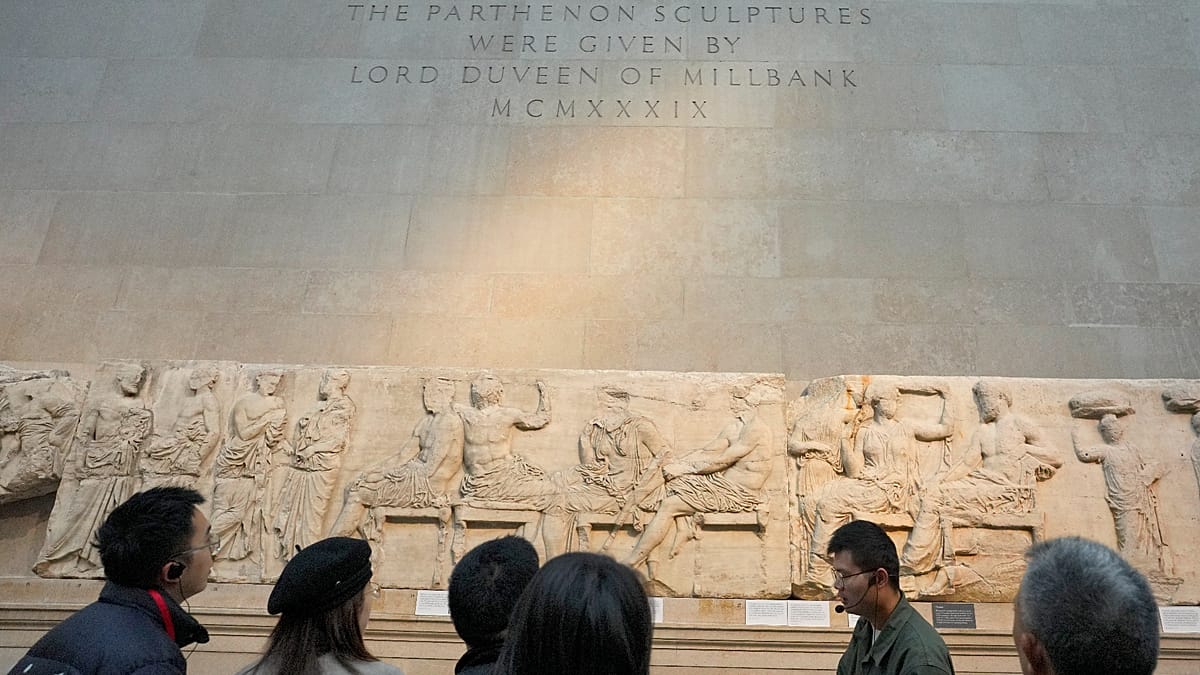
Discussions between Britain and Greece over the return of the Parthenon Sculptures have apparently reached a dead-end. ADVERTISEMENT ADVERTISEMENT According to reports in The Telegraph, talks have effectively been broken off with Athens expressing its strong disappointment over the lack of progress. At present no negotiations are under way and there appears to be no plan for their resumption, the British paper adds. However, the Greek Prime Minister Kyriakos Mitsotakis has penned an article for The Guardian in which he argues forcefully for a return to the talks table, making the permanent reunification of the Sculptures in Athens his key condition. Greece revived negotiations with the British Museum in 2021, as part of its effort to secure the return of the archaeological sculptures that were taken to Britain in the early 19th century. The latest intervention by Mitsotakis The Guardian takes on particular significance, coming in the wake of the British Museum's suggestion that the agreement on the loan of the Bayeux Tapestry could serve as a possible model for the Parthenon Sculptures as well. Mitsotakis: "We cannot borrow parts of our own monument" In his article, the Greek prime minister rejects any comparison between the two cases. He notes that the Bayeux Tapestry remains a single work of art, which France lent to Britain and which is to be returned to its country of origin. By contrast, he argues that the Parthenon Sculptures are parts of a single monument which were removed and scattered between London and Athens. According to the Greek position, therefore, the issue is not only about the possession or ownership of the works, but about restoring the "physical, aesthetic and conceptual integrity" of the monument. Mitsotakis stresses that the surviving Sculptures should be displayed together and at the same time maintain a visual relationship with the Parthenon, pointing out that the Acropolis Museum was designed precisely with that prospect in mind. As he reiterates, Athens cannot accept any agreement that would require Greece to recognise the British Museum's ownership of the Sculptures or to treat them as works that Greece is "borrowing". The deadlock over a long-term loan This issue lies precisely at the heart of the disagreement. The British Museum argues that, under the current legal framework, it can lend the Sculptures but cannot permanently transfer them. A loan agreement would require, according to the British side, recognition of the museum's ownership. The Greek side rejects this condition and insists on the permanent reunification of the Sculptures with the other parts of the monument in Athens. Mitsotakis notes that his government has held "detailed discussions" in recent years with the British Museum's leadership on how reunification could be achieved. For that reason, he says, he was surprised by the museum's recent proposal to use the agreement on the Bayeux Tapestry as a template for the Sculptures. The Greek position on the Bayeux Tapestry The comparison between the two works is a central argument for the Greek prime minister. The nearly 70-metre-long Tapestry narrates, as a single work, the events leading up to the Norman conquest of England, the Battle of Hastings and the death of Harold. Mitsotakis argues that it is precisely this unity that allows the viewer to grasp the story it tells. In the same way, the Parthenon Sculptures were created as integral parts of a single architectural and artistic ensemble. The Greek argument is that no one would consider it reasonable to cut up the Bayeux Tapestry and exhibit one part of it in London and the rest in France. Athens maintains that the Parthenon Sculptures should be treated in the same way. "It is not about emptying museums" The Greek prime minister also seeks to distinguish Greece's claim from a broader demand for the mass return of objects from major museums. He argues that the Parthenon case is unique, because "what is at stake is not simply a change in the custody of an archaeological object, but the restoration of the unity of a monument of global significance." Greece, he adds, hopes that the reunification of the Sculptures will become the starting point for broader cultural cooperation with Britain, opening up new opportunities for exhibitions, scientific research, conservation of works and exchanges between Greek and British museums. In his article, Mitsotakis also cites a poll published last year, according to which a majority of Britons support the return of the Sculptures to Greece. He pays particular attention to the 72% who, according to the same survey, agreed that the Sculptures are better understood as part of a single entity together with the Parthenon. UNESCO and the row over ownership Greece's claim to the Sculptures has also been restated within UNESCO, where the Intergovernmental Committee has repeatedly called on the United Kingdom to engage in dialogue with Greece. The British government and the British Museum maintain that Thomas Bruce, 7th Earl of Elgin, obtained a lawful permit from the Ottoman authorities to remove the works from the Parthenon. Greece disputes that there was any valid permit that could justify their removal. In 2024, Turkey intervened in the debate, expressing support for the Greek position. Turkish representatives at UNESCO said that research in the Ottoman archives had found no evidence documenting the existence of the contested "firman". The "political will" Athens is calling for Concluding his article, Mitsotakis argues that the reunification of the Sculptures could serve as a new model of cultural cooperation between Greece and Britain. He also refers to a statement by Andy Burnham from 2023, before he became mayor of Manchester, in favour of the return of the Sculptures "without conditions". The prime minister finally links the issue to the Parthenon's longstanding symbolic association with democracy. He argues that restoring the unity of a monument so closely tied to the birth of democracy could send a broader message of cultural cooperation. Athens, he concludes, declares itself ready to move forward. What is now required, according to the prime minister, is the political will for the decisive step: the reunification of the Parthenon Sculptures and the transformation of a long-running dispute into a new relationship of cultural cooperation between Greece and Britain.
We need to talk: Greek PM says efforts to return Parthenon Marbles must be revived
Full Article
Original Source
Read the full article at Euronews →KhanList aggregates and links to publicly available news content. We do not host full articles from third-party sources. Always verify important information with original sources.