
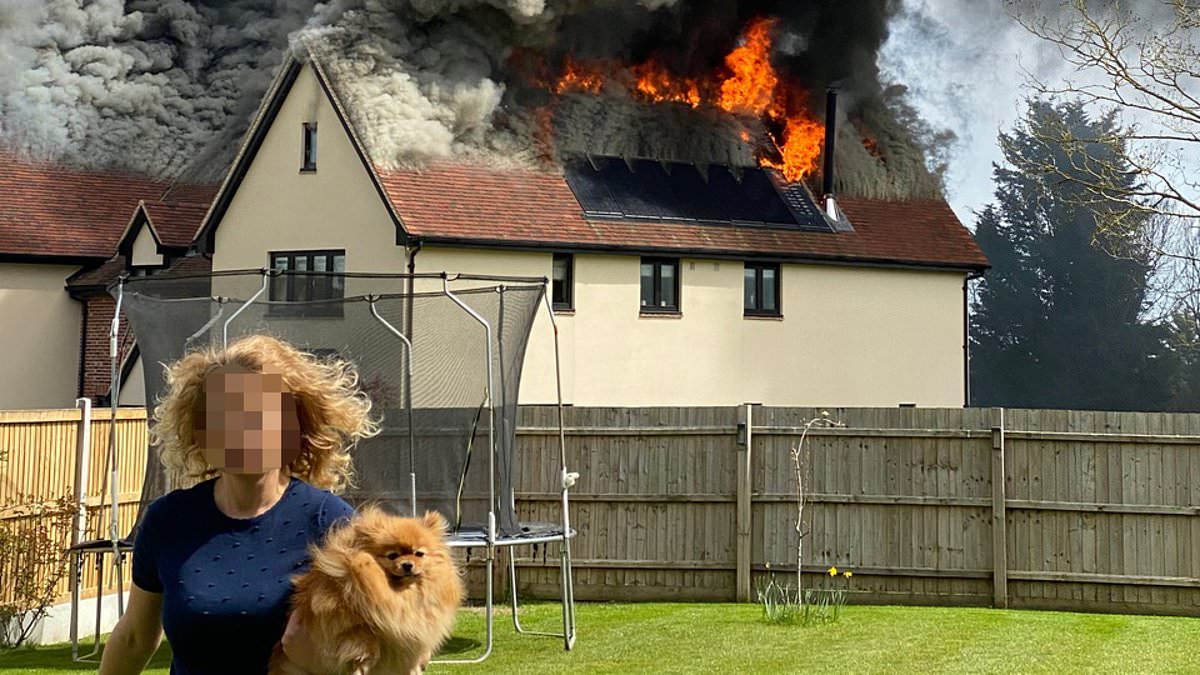
Mark Evans had barely stepped over the threshold of his home on a sunny afternoon after returning from watching his sons play rugby when a neighbour hammered on his door. ‘Your solar panels are on fire,’ he shouted.Racing back outside, Mark was confronted by a sight he will never forget: Flames and thick black smoke shooting from the roof of the house he had spent years planning and building.Within five minutes, the entire roof was ablaze.By then the fire service had arrived, but despite their valiant efforts, the flames tore through the 5,500 sq ft property with terrifying speed until the entire building was an inferno.‘We literally lost everything,’ father-of-two Mark, 58, says quietly. ‘It was the worst moment of my life.’And perhaps what made the devastation harder to bear was that this was not just any house. After three decades working in property development and building multiple homes of his own, Mark had drawn on everything he knew to create Evershot Hall, situated in the charming Essex hamlet of Tolleshunt Knights.Completed in 2018, it was his seventh build –and, he believed, his last. A forever home for wife Sarah, 49, and their two children Jack, now 22 and 19-year-old Harry.‘It’s a house that took me decades of experience to build,’ he says. ‘We were in our dream home.’ What’s more, the imposing property was designed to be not only beautiful but energy efficient. With no gas supply to the site, installing solar panels on its roof had seemed an obvious choice. ‘Everything was electric, so it was a no-brainer,’ Mark recalls. Mark Evans had barely stepped over the threshold of his home when a neighbour hammered on his door. ‘Your solar panels are on fire,’ he shouted ‘We literally lost everything,’ father-of-two Mark, 58, says quietly. ‘It was the worst moment of my life’Three years later, on an otherwise unremarkable April day in 2021, he stood outside and watched all of it – the dreams, the plans, and everything his family owned – go up in smoke.‘We were left with just the clothes we were standing in,’ Mark says now. ‘And while some things you can replace, other stuff is gone forever – photo albums and christening gowns. The locket with your kids’ first piece of hair. I wouldn’t wish it on my worst enemy.’A freak accident? Perhaps. But it seems the Evanses are far from alone.This month, alarming new data revealed that fires involving solar panels in the UK rose by 133 per cent between 2022 and 2025, climbing from 91 incidents to 212 and significantly outstripping the 52 per cent growth in total UK solar installations over the same period.Those 212 rooftop fires – up 37 per cent on the previous year – damaged 102 homes and commercial buildings, schools and hospitals.The true figure could be higher still, as the statistics are based on Freedom of Information requests to fire services, and only 37 of the 49 approached provided data.The findings inevitably raise questions about whether fire safety has kept pace with the extraordinary speed of Britain’s attempted transition to solar power under the Government’s drive towards Net Zero.Under the Clean Power Action Plan, the UK aims to generate enough clean electricity to meet its annual demand by 2030, with former Energy Secretary Ed Miliband aggressively pushing for a huge expansion of solar energy.The result has been record levels of solar installation: as of August 2025, there were 1,834,584 solar installations across the country.Yet there remain striking gaps in our understanding of the risks. As the Building Research Establishment (BRE) – a research-based building science centre that provides testing, certification, and standards for the construction sector – points out: ‘At present, there is a lack of evidence-based information on how often fires involve solar panel systems, which parts of the system may be responsible, or how these fires develop.’The National Fire Chiefs Council, meanwhile, has said it is ‘concerned’ that the Government is trying to make it easier to implement these types of technologies ‘without considering the risk to building and fire safety’. Mark Evans and his family don’t need reminding of what those risks look like – and nor are they the only ones. In the last three months, two separate properties have been engulfed in flames which, photos show, started on the roofs where solar panels are situated.In early July, 54-year-old Tammi Atherton was also alerted to a fire at her Bristol home by the frantic knocking of a neighbour.Racing outside with her son Ben, she discovered that the roof of her home – completed just two years earlier – was ablaze, flames tearing across it. Last October about 250 people were evacuated from an Ikea store in Wembley, north-west London, when a fire broke out on the building’s roof at about 10.30amSo ferocious was the blaze that although fire fighters arrived within minutes, it raged for four hours, with thick plumes of smoke billowing down the residential street as the family watched helplessly. The fire service told the family that the solar panels on the roof were likely to blame.Six weeks before the Athertons’ home went up in smoke the roof of a home in Wellingborough, worth about £600,000, burst into flames after solar panels apparently exploded. The incident left residents looking anxiously at the identical panels on their own roofs and wondering whether, as one put it, they were ‘sat in tinderboxes’.Northamptonshire Fire and Rescue Service said its investigator had concluded the fire had most likely started due to an electrical fault in the loft area.With solar panels adorning the majority of houses in the neighbourhood, one resident, who asked not to be named, told the Daily Mail this week: ‘Solar panels are supposed to draw heat from the sun and create power. How has that gone wrong?’ That is the million-dollar question.According to Adrian Simmonds, risk manager at insurer QBE, the answer frequently lies not with solar technology itself, but with the way it has been installed. ‘It’s clear installation quality and fire safety are not keeping pace with the speed of deployment,’ he says.‘Poor cabling and connectors are the leading cause, with fires often spreading to the wider building. Faulty installations, substandard fittings and poor electrical connections all heighten risks.’There is another emerging concern. Mr Simmonds points out that many new solar panel systems now incorporate battery storage –designed to retain surplus electricity generated by the panels so that it can be used later, rather than immediately exported back to the grid.While they can potentially make solar power more efficient, batteries introduce another layer of fire risk, particularly when units are installed in lofts, airing cupboards or upper-floor spaces which can be difficult for firemen to access.Nor is the problem confined to private homes. On July 8, solar panels were believed to have been involved in a devastating fire at a North Yorkshire hospital after a unit at Malton Hospital, which provides mental health services for older people, went up in flames, destroying the building.A month later came another incident, this time at a village primary school in Suffolk, when a fire started at East Bergholt Primary School – thankfully unoccupied, as it was the school holidays. Solar panels were to blame.Last October about 250 people were evacuated from an Ikea store in Wembley, north-west London, when a fire broke out on the building’s roof at about 10.30am on a weekday morning. It emerged that some 100 solar panels were alight at the premises. In early July, 54-year-old Tammi Atherton was also alerted to a fire at her Bristol home by the frantic knocking of a neighbourTaken individually, incidents such as these seem rare. Collectively, however, they are prompting urgent questions about whether installation, inspection and maintenance standards are keeping pace with Britain’s enthusiasm for installing solar panels.QBE’s criticism of installation standards is echoed by the Association of British Insurers (ABI), which warns that poorly installed or inadequately maintained solar systems could invalidate insurance policies.Yet none of these concerns appears to have dampened the Government’s enthusiasm for solar. The next stage of the revolution is about to bring the technology even closer to millions.From Thursday, we will be able to buy plug-in solar panels after the Government changed the law to enable major retailers to sell them for the first time.The idea is simple – on paper at least, but unlike conventional solar installations, which are hard-wired on to roofs by installers and designed to supply an entire house, these smaller DIY systems can plug directly into a standard three-pin wall socket.Kits are expected to be stocked by retailers including Currys, B&Q and Asda, with prices about £350 - £400. Their output is modest, generating roughly 0.5 to 2.5kWh daily and helping offset the background electricity used by fridges and other devices left on standby.Nonetheless, their imminent arrival in British homes has prompted fresh concern among electrical contractors.However, the solar industry insists it is important to keep the risks in perspective.This week, a spokesman for trade body Solar Energy UK said: ‘The UK has over two million rooftop solar installations – around 1.7million on homes – and the majority operate safely throughout their lifetime.‘As deployment increases, the number of incidents may also increase, but this does not indicate that solar is becoming less safe.’Statistically, that may be true. Yet for Sarah and Mark Evans a tiny percentage risk can still mean catastrophic consequences.It took nearly two years, and huge amounts of stress as they dealt with complex and labyrinthine insurance issues, for their home to be rebuilt – this time without solar panels.And while the fire brigade put the catastrophic event down to an unknown cause, Mark is clear what was to blame.‘I know what happened, I know what my neighbour saw and what I saw,’ he says.Today, the traumatic legacy of that April day runs deep – although he is grateful for one thing: ‘We could have been upstairs at the time and that might have been a different outcome,’ he says. ‘I’m just very glad we’re all still here.’
'We lost everything... I'm just glad we're still here.' Mark lost his home to an inferno caused by his SOLAR PANELS - and he's just one of many worrying Labour's Net Zero drive has left them living in a tinder box
Full Article
Original Source
Read the full article at Dailymail →KhanList aggregates and links to publicly available news content. We do not host full articles from third-party sources. Always verify important information with original sources.