
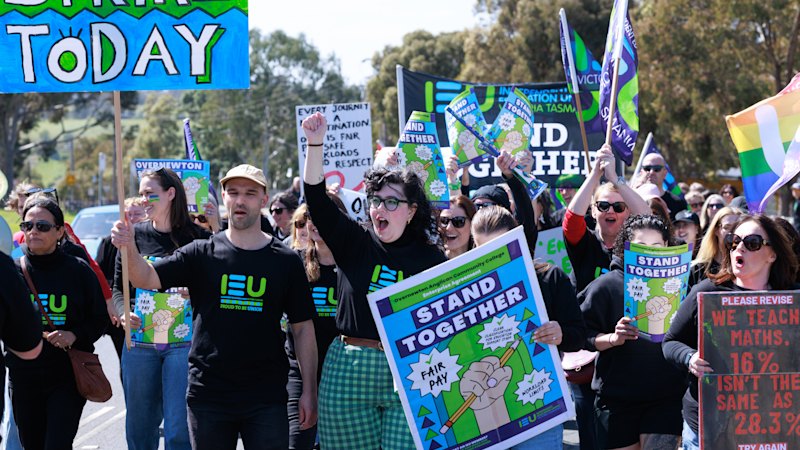
September 18, 2026 — 7:00pmTeacher wages at some of Melbourne’s private schools are expected to dip below increases for experienced teachers at public schools, with school leaders foreshadowing further pressure on private school budgets.Teachers walked off the job at an independent school in Melbourne’s west on Thursday, arguing the school’s pay offer falls well short of the public school teachers’ 28.3 per cent increase over the next four years.The Age has analysed the total remuneration of staff at more than 40 private schools, finding the average total package to be worth $119,976 in 2024-25. However, the figures include both teachers and non-teaching staff.Total remuneration for all staff has risen the most at Xavier College. Eddie JimXavier College’s total remuneration for all staff increased the most among private schools between 2023-24 and 2024-25, rising from $112,000 to $145,000.Principal Lee MacMaster said the school “must always try to attract and retain the very best teachers for our students and their families”.“We know the quality of teaching has the greatest impact on a student’s learning experience. Our competitive employment conditions and strong professional culture enable us to attract and retain highly skilled educators.”Melbourne Grammar School’s total remuneration averaged across all staff – which includes 214 teaching staff and 378 non-teaching staff – was $116,000 that year. But it offers experienced teachers $143,823 to join the school, the top of its available range.Headmaster Philip Grutzner agreed that rising government school wages would put further pressure on the private school sector to increase pay.Melbourne Grammar’s teachers received pay increases of between 3 and 3.25 per cent each year for the past three years.“We are committed to providing our staff with the culture, resources, and environment they need to do their best work. Because of our exceptional staff, we are able to offer a holistic education,” Grutzner said.“The school’s budget for 2027 has not yet been finalised; however our priority remains to attract, support, and retain exceptional staff, and remuneration is part of this.”Scott Doran, vice principal of community engagement at Haileybury, where average remuneration for its total workforce is $124,000, said: “There is strong competition for brilliant teachers, and we want to be a school where the very best people can build their careers, so it is imperative that our pay and conditions are competitive.”On Thursday, the state government revealed 93.1 per cent of public school workers who participated in a ballot had backed a new pay deal, which will increase wages by at least 13 per cent by October next year, and by between 28.3 and 32.4 per cent over four years.Top salaries for experienced teachers will go from $129,544 to $166,150 over the course of the deal.Teachers from the Overnewton Anglican Community College Yirramboi Campus in Keilor go on strike over pay and conditions. Simon SchluterThe same day, unionised teachers at Keilor private school Overnewton Anglican Community College went on strike after refusing a pay offer from school management of 16 per cent over three years.The Independent Education Union (IEU) argues acknowledges teachers at the college currently earn more than equivalent government school teachers – around $120,000 compared with $118,000 – but under the new offer, they would fall behind.However, Overnewton Anglican Community College principal Emily FitzSimons said the 16 per cent increase over three years would be the largest in the school’s history.“Negotiations continue across both pay and conditions,” FitzSimons said. “As a standalone not-for-profit school, we remain committed to reaching an outcome that recognises the contribution of our staff, protects the college’s future and keeps fees as affordable as possible.”Industrial action is uncommon at independent schools – which each negotiate their own agreements with staff, rather than being covered by a single, sector-wide agreement.However, Laureston Girls’ School teachers in Armadale went on strike earlier this year. Last year, Strathcona Baptist Girls Grammar School teachers were due to take protected action until the school tabled an offer that staff accepted and called it off.“IEU members in independent schools just won’t accept wages and conditions that leave them worse off than their colleagues in government schools – and it’s not just about pay,” said the union’s Victorian and Tasmanian general secretary David Brear.“There have been several significant improvements achieved around workload in government and Catholic schools that many independent schools aren’t matching.”Independent Schools Victoria chief Rachel Holthouse said private schools were facing financial pressure from rising operating costs, declining government funding and cost-of-living increases affecting families’ capacity to absorb rising school fees.Independent Schools Victoria chief executive Rachel Holthouse.Joe Armao“Ultimately, independent schools are committed to ensuring their staff are fairly rewarded through a balance of salary and conditions, their schools remain sustainable, and the communities they serve continue to have access to the quality education they expect,” she said.The Catholic school sector is also currently in negotiations over its pay and conditions, with the Victorian Catholic Education Authority having a long-standing commitment to pay teachers on par with the government sector.“We will match the increases of up to 32.4 per cent over four years to be provided under the Victorian Government Schools Agreement,” said VCEA chief executive officer Elizabeth Labone.However, she said raising wages were more challenging for Catholic schools than for government schools.“While the Victorian government will fund the EBA for state schools, Catholic schools need to cover the changes through budget and planning process,” Labone said.“About 90 per cent of Catholic schools charge less than $5000 in annual school fees. We know many of our families are already experiencing financial pressures and we’re focused on ensuring we minimise the impact on fees while maintaining a high-quality Catholic education for every student.”Get the day’s breaking news, entertainment ideas and a long read to enjoy. Sign up to receive our Evening Edition newsletter.From our partners
We looked at staff salaries at 40 private schools. These pay the most
Full Article
Original Source
Read the full article at Smh →KhanList aggregates and links to publicly available news content. We do not host full articles from third-party sources. Always verify important information with original sources.