
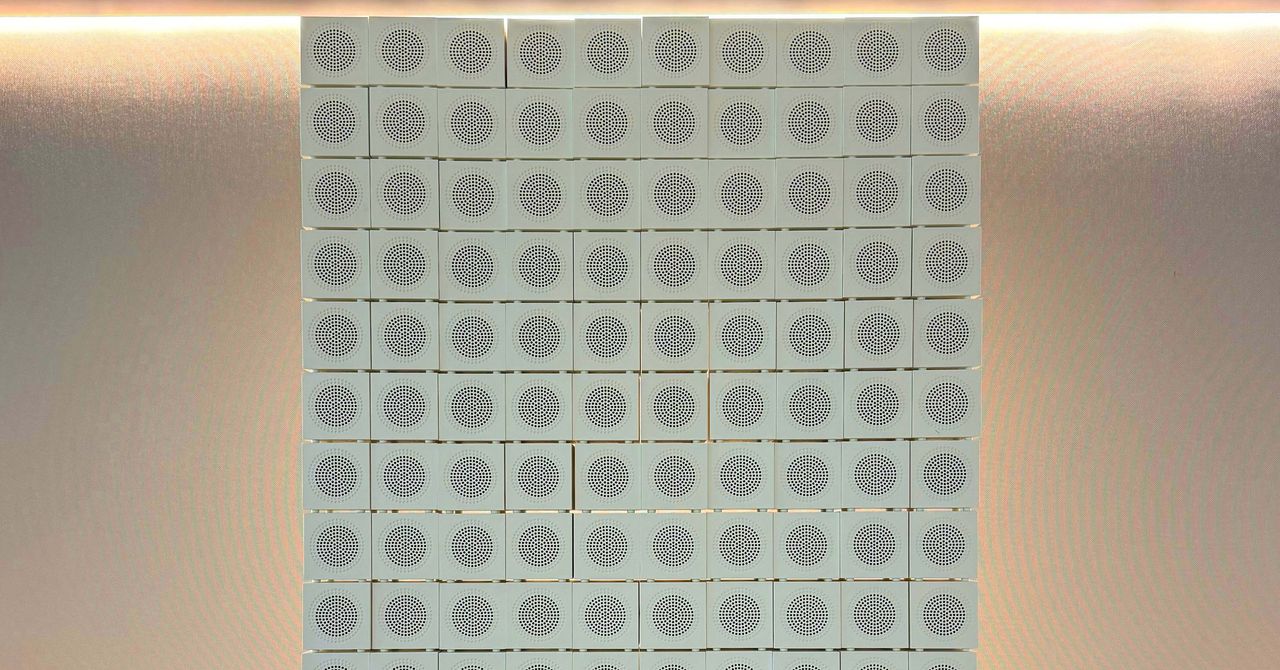
When Ikea launched its super-cheap $10 Bluetooth Kallsup speakers in April, aside from the rock-bottom price and bright, white/green/pink colors, the claim that really caught WIRED’s ear was that the Swedish furniture brand said it was possible to chain 100 of these 2.75-inch sonic cubes together, should you so wish.Now, because it’s highly unlikely any one household will ever own more than a handful of mini Bluetooth speakers, this is one of those consumer-tech statements that rarely gets tested. So we asked the good folks at Älmhult in Ikea headquarters if they’d let us do just this. To our surprise, Ikea not only agreed, but it also upped the ante, saying it might be possible to link up to 150 without breaking the connection, so that’s exactly how many it sent us. “No one has ever tried this, though,” an Ikea spokesperson said. “We haven’t.”That is how we ended up building a literal wall of sound at our London office, stacking 150 Kallsups carefully on top of one another to test how many would chain-play from a smartphone. Sadly, one casualty during shipping from Sweden—a single Kallsup—despite lighting up correctly and looking ready to chain, made an ominous rattling sound as if its innards weren’t entirely secure. Sure enough, it refused to play ball (or anything else), so we ended up with 149 speakers.The chain process itself is simple. Once you have paired a single Kallsup with your music device—in our case, an iPhone 16 Pro—and it’s up and running, simply power on another cube while playing and hold down the Play button until a chime tells you it’s in “multi-speaker” mode. It should then immediately start playing whatever the Bluetooth-connected Kallsup is playing.Thanks to this near-effortless chaining process, linking up all these Kallsups took much less time than we'd expected, about 30 minutes. We stopped at 100 to test how loud the “system” sounded at that stage before resuming the build and moving on to the maximum amount. As the music continued while we chained the speakers, it would be obvious when the collective refused to add more cubes. But this didn’t happen, and the plucky Kallsups joined forces without grumbling right up to the full 149.It Might Get LoudPhotograph: Courtesy of IkeaPhotograph: Courtesy of IkeaIt’s tempting to preface the next few paragraphs with the phrase “for a $10 speaker,” because, despite Ikea’s vast buying power, experienced research and development team, and global presence, the ability to produce a tiny speaker that doesn’t sound absolutely horrible for less than a pint of half-decent craft beer is pretty incredible.Each Kallsup has a single 1.8-inch, full-range driver powered by a 3-watt amplifier, with Bluetooth 5.3 support. No separate tweeter or woofer, just the one tiny driver.On its own, the Kallsup speaker sounds fine. Yes, it lacks anything resembling the deep rumbling bass people talk about in audio reviews, but did we mention it’s a $10 speaker? It is a bit tinny, and you won’t want to push the volume very hard, but as a little desktop speaker, one by the side of the bed, or to throw in a suitcase, the Kallsup does the job. It doesn’t match the performance of one of our best Bluetooth speaker recommendations, but keep the cost in mind, and it’s hard to be disappointed.Even at low background volumes, the Kallsups worked surprisingly well together, especially playing acoustic tracks. As we paired more speakers, the sound gradually grew nicely in scale. Nothing was overpowering or dominating, just the cumulative effect of all those tiny drivers moving small amounts of air.With 149 individual 1.8-inch drivers, the combined surface area is roughly equivalent to one enormous 22-inch driver. Each Kallsup also has its own 3-watt amplifier, giving our wall a combined rated output of 447 watts. That doesn’t mean it behaves like a giant subwoofer or a conventional 447-watt speaker, but it explains why things got so loud.But before we turned these up, if you will, to 149, we listened at 100, and when we pushed the volume, the collective Kallsups were seriously loud. But for the record, loud like a fire alarm, not a hi-fi system. With the wall complete, we worried the collective vibrations might send the whole thing crashing down. Disappointingly for the socials, it stayed resolute. Instead, we played Trans Lunar by Twin Dimensions (WIRED director of consumer tech and culture Mike Calore’s excellent band) and slowly increased the volume to maximum.We almost wish we hadn’t. The noise was brain-numbingly loud as we blasted, somewhat appropriately, Richard Strauss’ Also Sprach Zarathustra. We couldn’t hear each other speak, and we could feel our internal organs vibrating. Any sense of fidelity disappeared, but—all power to the Kallsups—it worked. We’d successfully linked 149 Bluetooth speakers, though sadly we’re well short of the world record of 1,500 speakers set by Majority Audio in March 2026.At more modest, realistic volumes, everything sounded considerably more composed, even if the music lacked levels of depth and detail. The overall lack of clarity could also be due to minor timing differences between the individual drivers.At $1,490, a wall of Kallsups is quite an investment, and not one we’re recommending, but it is extremely impressive that we managed to sync and play music wirelessly through so many small, cheap speakers.We also tested the wall alongside WIRED’s choice for best overall party speaker, the $500 LG Xboom Stage 501. Cranked up, both reached similarly ear-splitting, frankly uncomfortable volumes. But with two 5.25-inch woofers, two 2.5-inch full-range drivers, and clever digital signal processing, the LG delivered understandably fuller, deeper bass and a considerably more musical experience, as expected.Powering DownPhotograph: Jeremy WhitePhotograph: Jeremy WhiteWhat’s remarkable about this experiment is that so little went wrong. Only one of the 150 speakers shipped didn’t work, clearly broken in transit. We managed to get all 149 sound cubes chained easily and quickly. And when we weren’t blasting the wall of sound at max volume, instead keeping levels moderate, the speakers sounded surprisingly competent as a collective.However, there were hints of the Kallsup chaining capacity reaching its limit, as Ikea suspected. As we got beyond 100 units linked together, the incidence of failing to chain on the first try increased. Still, no speaker refused more than twice as we got toward the end of the build.We also would have preferred indentations on the tops of the speakers, which would have given us a bit more confidence that the whole stack wasn’t going to collapse in a heap as volume ramped up (which it didn’t). Such a simple design feature would help whether you’re dealing with just a couple placed on top of each other, let alone 149—but this is splitting hairs.Lastly, although this setup was impressively loud, no one in their right mind would do this in their own home. Ikea has been a good sport letting us try this out, but the ultimate, unsurprising lesson is: If you want high-quality audio, spend your money on a better speaker. As for the Kallsup? Simple to use, easy to chain, with approachable sound and clean design. You really can’t ask much more for $10.
We Linked 150 of Ikea’s $10 Speakers to Make a Wall of Sound
Full Article
Original Source
Read the full article at Wired →KhanList aggregates and links to publicly available news content. We do not host full articles from third-party sources. Always verify important information with original sources.