
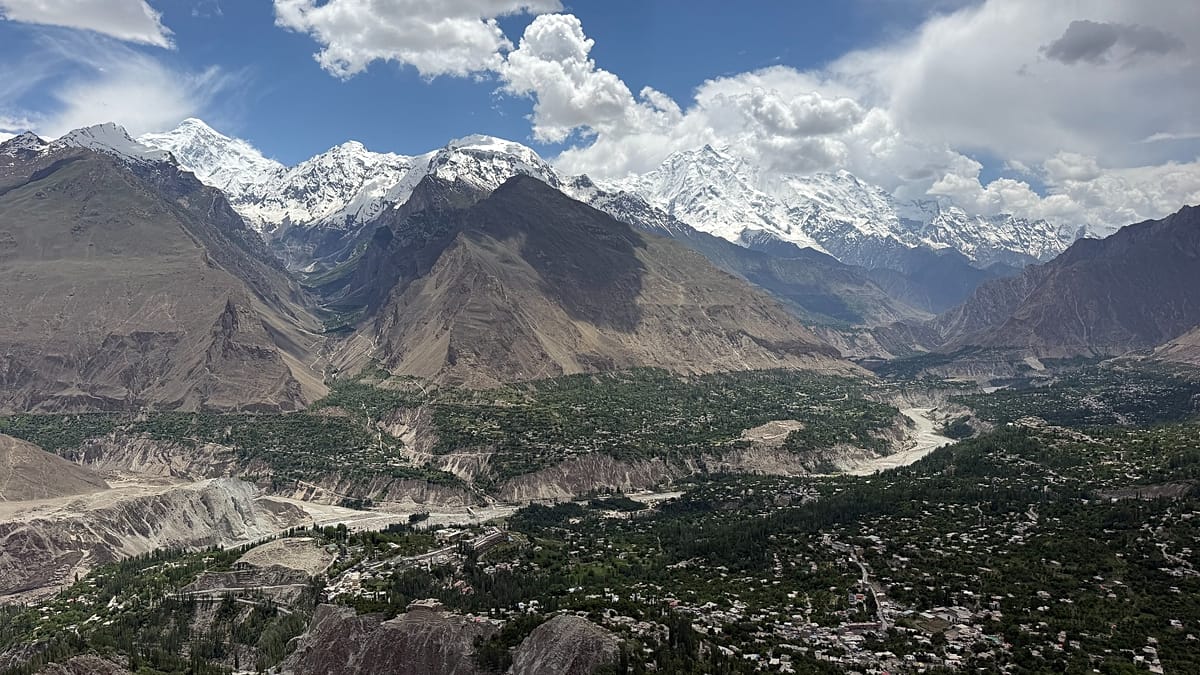
The world's highest peaks are located in the Himalaya and Karakoram mountain ranges, part of a vast mountain belt stretching across Asia. But beneath their grandeur lie some of the planet's most fragile ecosystems. ADVERTISEMENT ADVERTISEMENT As temperatures continue to rise, glaciers are melting faster, increasing the risk of glacial lake outburst floods and disrupting the natural flow of meltwater. As glaciers shrink, less water is released in spring and summer, when communities need it the most. In the Pakistan-administered Gilgit-Baltistan - an autonomous territory in the wider disputed Kashmir region - communities are turning to the Indigenous practice of glacier grafting, known locally as Gang Khswa, to combat water scarcity and adapt in the face of climate change. What is glacier grafting? Glacier grafting is a traditional method in which local communities create new, artificial glaciers in high-altitude regions to create a reliable source of water for irrigation, livestock and daily life. The technique is often referred to as a glacier marriage, when ice is collected from so-called male and female glaciers and transported to a new grafting site, chosen by the community, to create a new glacier. The male glacier is typically grey in colour and contains debris such as soil, sand and pebbles. The female glacier, by contrast, is lighter, almost transparent, clear from debris and impurities and produces more water. Dozens of porters collect pieces of ice from both male and female glaciers. They then transport the ice to the newly-selected grafting site in wooden baskets on their backs, travelling by car as far as the terrain allows and then continuing on foot. The ideal grafting site to create a new glacier needs to be at an altitude of at least 4,000 metres, have a high permafrost level, have maximum wind explosure and minimum explosure to sunlight, and ideally should be north-facing, Dr. Zakir Hussain Zakir, Director of Planning and Development at the University of Baltistan, explains to Euronews. Once at the site, locals will have either dug a well or located an existing cave to place the ice in. The male and female ice pieces are placed inside, separated by clay pots holding water from the Indus river. The ice is then covered with layers of sawdust, charcoal and apricot kernels. The process is repeated several times, creating multiple layers to protect and insulate the ice. "It is a marathon activity," Dr. Zakir continues, explaining that the process can take up to 48 hours from ice collection to planting. "From the collection of the ice pieces from the source to the destination, the ice has to be kept continuously moving," he adds, explaining that the ice is not allowed to touch the ground at any time during the journey. While the site is surveyed and preparations are carried out during summer, the actual grafting takes place in October. By then, temperatures at altitudes of at least 4,000 metres will have dropped below zero, but there will be no snowfall yet. Once the new glacier is exposed to several snow cycles, it will slowly start to expand. After about ten years, the glacier will start to root and produce water. After roughly another decade, the glacier will have grown into a reliable water source. Dr. Zakir highlighted two other techniques derived from glacier grafting: ice towering and avalanche harvesting. Ice towers, also called ice stupas as their conical shape resembles a Buddhist sanctuary, act as ice reservoirs designed to melt slower as its surface area is not fully exposed to the sun. Developed in Ladakh, the technique involves passing glacier meltwater through underground pipes and spraying it into the freezing air. Avalanche harvesting, a recent innovation, involves the installation of a mesh net in a narrow gorge to capture and store snow and ice from avalanches. An ecological practice rooted in tradition Although glacier grafting was only revived in the 1990s, the ecological practice goes back centuries and is deeply rooted in local tradition, knowledge and ancestry. "The history of glacier grafting is largely oral, not written, although some books contain references [to the craft]," Nazir Ahmed, CEO of the Baltistan Culture & Development Foundation, explains to Euronews. The history of glacier grafting is believed to date back to the 14th century. According to historical accounts, the Persian Sufi saint Mir Syed Ali Hamadani is said to have grafted the first glacier as a defence tactic to help deter invaders. The unique craft is deeply intertwined with local traditions, including reciting verses from the Quran, singing a folk lullaby to the 'baby' glacier, and performing spiritual rituals. "There are three myths," Ahmed explains. "One is that you need to carry the ice at night [...]. It is said that by carrying the ice during the day, God will not be happy, as you are bringing a new object in the territory." "Secondly, when you're carrying the ice, you cannot talk to each other, otherwise you will become mute." "And third, when the ice is buried at the top, you cannot see it for at least two years, otherwise, someone will die in your family," Ahmed concludes. While these beliefs are rooted in mythology, the culture and heritage foundation CEO explains that they also serve a practical purpose. Carrying the ice at night decreases the chance of disruptions and minimises melting because temperatures are at their lowest, while travelling in silence helps ice porters maintain a steady pace. Once buried, the newly planted ice must be left undisturbed for several years, allowing it to properly root while protecting it from being taken or disturbed by others. The Baltistan Culture & Development Foundation (BCDF) is a local organisation formed by the people of Baltistan, dedicated to preserving and restoring heritage, promoting local culture and traditions, and protecting the region's environment. In 2025, the BCDF received funding from the United Kingdom's Foreign, Commonwealth & Development Office (FCDO), allowing the foundation to expand its projects. "Through the project, we grafted ten glaciers in different villages in Baltistan, six ice towers in different villages and one botanical garden in the University of Baltistan," Ahmed explains. Prior to the funding, the foundation could only undertake smaller-scale projects, transporting up to 200 kilograms of ice. But it's now able to transport more than 1,000 kilograms of ice at a time. The foundation has not yet received funding from either the provincial or federal government, although efforts are underway to have glacier grafting recognised by UNESCO as Intangible Cultural Heritage. 'How can the life giver itself be lifeless?' From start to finish, the community plays a key role in the practice. No glacier can be seeded without the community's consent first, and once the grafting is complete, locals take on the responsibility of caring for the 'baby' glacier. They monitor its progress, report on its development and add snow when necessary to help it grow. "We have to contribute to nature, to the climate, to the environment," Dr. Zakir says. "Because we are consuming snowmelt water for our entire life, and if we don't contribute something, it would be unjust". He explained that this responsibility is rooted in the region's ancient civilisation and its spiritual foundation. "In Bonism, we consider that all forms of water are sentient beings," he said. "Water is a life giver, so how can the life giver itself be lifeless?" Young people are needed to continue the glacier grafting tradition With community at the heart of the practice, youth engagement is crucial to keeping the tradition alive, especially as the region faces the growing impacts of climate change. But Nazir Ahmed points out a growing challenge: many young people leave their communities to move to urban cities. "If we talk about Skardu district, almost over 90 per cent of people are in school. And then after graduation, they usually go to cities like Karachi, Lahore or Islamabad for further study," the BCDF CEO explains, adding that grafting is also a labour and time intensive practice. "I don't see this as a decline in environmental concern," Zeeshan Abbas, team leader at the youth-led initiative Siachen Sherpa, points out to Euronews. He says that alongside climate change, young people are increasingly concerned about issues such as education, employment, economic security and migration. "Many young people understand that glaciers are changing and that climate change is affecting the region, but few have the resources, opportunities or institutional support to participate in field projects". Abbas also believes the way climate action is presented needs to change. "If we tell young people that climate change is a crisis, they can become overwhelmed," he said. Instead, he argues, younger generations should be empowered to see themselves as capable of developing solutions. According to the 19-year-old, his generation holds a powerful and unique position in society. "We inherit Indigenous knowledge from our communities, but we also have access to modern science, digital tools and technology, and global networks," Abbas says, highlighting how Siachen Sherpa aims to bridge these two forms of knowledge. "Local communities understand the landscape through generations of experience - where water flows, how the terrain behaves, where freezing occurs and how seasonal conditions change. Technology helps us complement that knowledge through satellite information, GPS, terrain and altitude data and field observations," he added. "Young people should not be treated as only victims of climate change, they should be given the opportunity to become researchers, innovators, field practitioners and decision-makers," Abbas concluded. Countries contributing less to global emissions often suffer more Pakistan's Third Pole glaciers irrigate 90 per cent of agricultural land and sustain more than 220 million people, according to the World Economic Forum. The Third Pole, or the Hindu Kush, Karakoram and Himalaya mountain range contains the world’s largest volume of frozen freshwater outside the Arctic and Antarctic polar regions. Experts warn that human-caused global warming is placing unprecedented pressure on these regions, with floods, landslides, avalanches and droughts increasing in frequency and intensity. "In Northern Pakistan, the melting of the Hindu Kush, Karakoram, and Himalayan glaciers due to rising temperatures have created 3,044 glacial lakes in the federally-administered territory of Gilgit-Baltistan and province of Khyber Pakhtunkhwa," the United Nations Development Programme (UNDP), the leading UN organisation fighting to end the injustice of poverty, inequality and climate change, wrote in a statement. "It is estimated that 33 of these glacial lakes are hazardous and likely to result in glacial lake outburst floods," the statement further read, adding that such flooding can release millions of cubic metres of water and debris in just a few hours. Last week, a glacial collapse sent large amounts of rock, ice and meltwater into valleys below, triggering a tsunami-like flood in Nepal and Tibet. There are several causes of glacier collapses. On the one hand they can be normal, cyclical processes. Increasingly, though, they are being driven by human-induced climate change. Despite contributing less than 1 per cent of global emissions annually, Pakistan is one of the countries most vulnerable to climate change. Meanwhile, a 2025 study revealed that the world's wealthiest 10 per cent are responsible for two-thirds of global warming since 1990.
'We have to contribute to nature': Meet the communities 'marrying glaciers' to bring new water to life
Full Article
Original Source
Read the full article at Euronews →KhanList aggregates and links to publicly available news content. We do not host full articles from third-party sources. Always verify important information with original sources.