
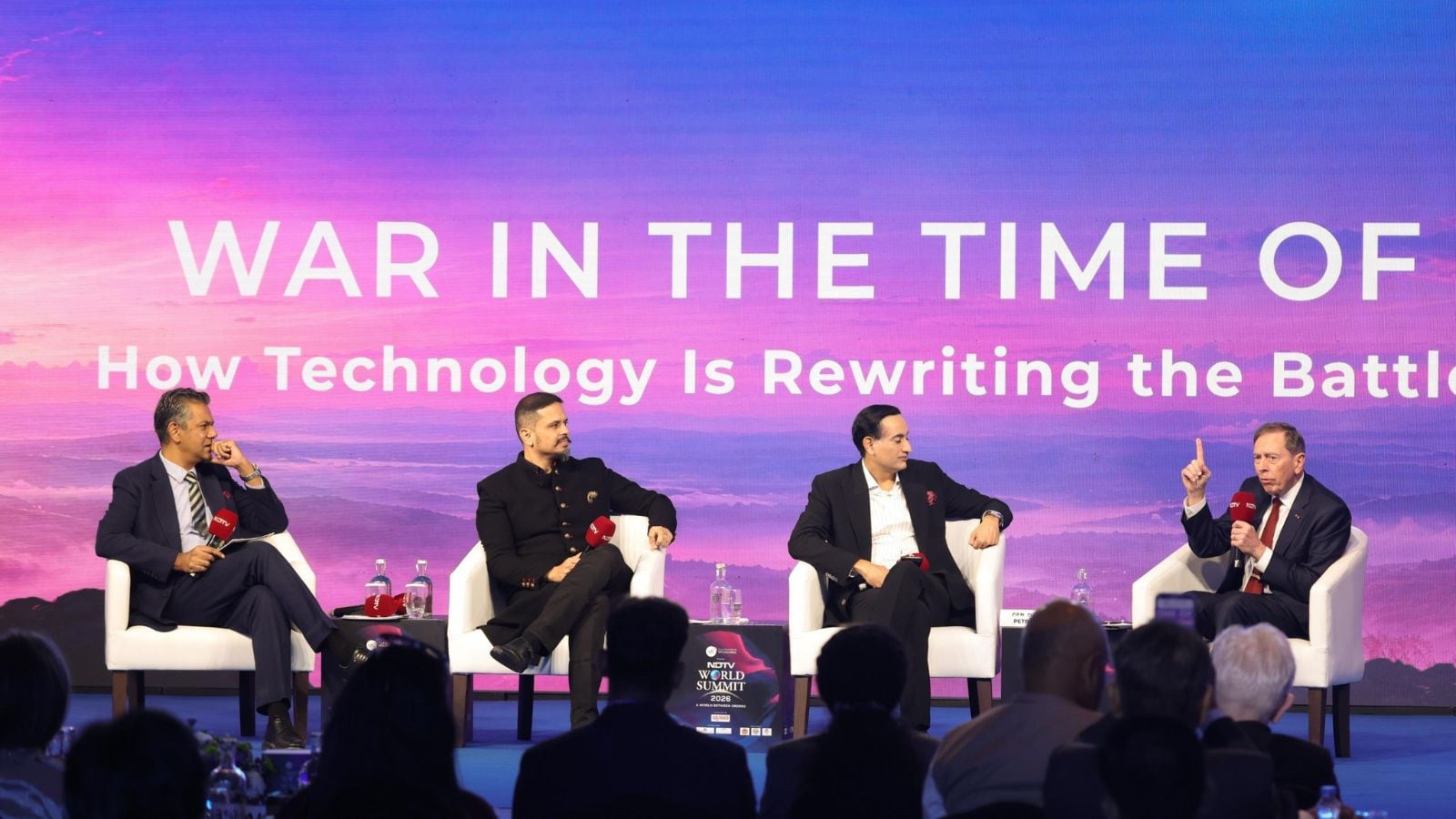
A small red light flickers on a screen in a Ukrainian operations centre. A Russian soldier has broken cover, trying to dash across a street to the next building.Within moments, the image is thrown up on the big screen and the soldier is tracked until the end. "It does not end well for a Russian soldier, I can tell you," says a man who has spent hours watching it happen. Advertisement - Scroll to continue This is what war looks like now. And militaries that do not evolve immediately, he warns, will be overtaken by technology that is already on the battlefield.That was the message from General David Petraeus at the NDTV World Summit in New Delhi. A former Director of the CIA, Petraeus commanded US-led coalition forces in Iraq and Afghanistan and headed US Central Command, which oversees American military operations from Egypt to Pakistan.Advertisement - Scroll to continueThe high-tech drone war between Russia and Ukraine, he said, marks "the most profound period of change in warfare in our lifetimes. Every military in the world needs to recognise the urgent need for revolutionary institutional change."Drones and smart weapons have transformed how infantry and armoured forces operate on the Russia-Ukraine front. Drones flown by both sides can now pick off individual soldiers and tanks almost at will. As a result, troops along the Line of Contact in eastern Ukraine live largely underground, watching the world outside through observation devices.Increasingly, they are resupplied not by trucks but by remotely driven ground vehicles and drones. Forward-deployed soldiers stay at the front for as long as 60 days at a stretch, because the journey in and out is the most dangerous part of the deployment.Traditional military manoeuvre itself is now obsolete. "Traditional manoeuvre warfare, tanks, infantry, engineers, air defence, electronic warfare, all of that. It can't survive," Petraeus said. "If you have trenches, you can fly a drone into a trench. Anything that is exposed will be seen."'We don't have five years'The lessons of the Russia-Ukraine front cannot be ignored by militaries around the world. "There are no countries outside of Ukraine and Russia that truly are undertaking this at the pace that is called for," Petraeus said.For militaries to remain viable, change has to begin now. Asked what he would do if given five years to redesign a modern military, he said: "The first thing I'd do is say that this is going to be done in a year, not five years, because we don't have five years."This means more than procuring drones of different classes. The software that runs these systems, and the hardware itself, must be updated constantly. "You have to be able to do software changes every week, hardware changes every few weeks," he said. That is a pace far removed from procurement in countries such as India, where deciding on a weapon system can take years.When machines decideAutonomous drones, programmed to operate on their own, will soon be able to decide who lives and who dies on the battlefield. Petraeus said truly autonomous systems are still experimental, but expects them in greater numbers by the end of this year or next.Asked whether he was comfortable with machines making such choices, the General was clear. "I would trust a machine to observe the rules of engagement if properly programmed. And that 'if properly programmed' is a big if."His reasoning is that soldiers are swayed by emotion in a way a machine is not. "Humans have emotions and I've seen those emotions get carried away on battlefields," he said. A properly programmed machine, in his view, will stay within the rules of engagement "better than will an emotional soldier." Humans would still set the targeting criteria, he added, and a commander at the top would still answer for any mistakes.From spotters to swarmsDrones have been part of this war since it began in 2014, eight years before Russia's full-scale invasion. In the fighting in Donbas, Russia used its Orlan-10 reconnaissance drones to spot targets for its artillery. Ukraine received its first Turkish-made Bayraktar TB2 combat drones in 2019, and in the early weeks of the 2022 invasion the TB2 became famous for destroying Russian armour and supply columns.Since then, the war has moved from a handful of expensive drones to millions of cheap ones. Petraeus said Ukraine now uses more than 10,000 drones a day, and Russia about the same.The main classes now in use are:Reconnaissance drones, from fixed-wing spotters to commercial quadcopters, which find targets and direct fire.FPV (first-person view) attack drones, cheap racing-style drones carrying an explosive charge, flown by a pilot wearing a headset straight into a trench, soldier or vehicle.Bomber drones, heavier multicopters that drop munitions, often at night.Loitering munitions, which circle over an area before diving onto a target, such as Russia's Lancet.Long-range attack drones, such as the Iranian-designed Shahed, which Russia builds as the Geran, and Ukraine's own long-range drones that strike refineries deep inside Russia.Maritime drones, unmanned explosive boats that hunt warships.Unmanned ground vehicles, used for resupply, casualty evacuation, mine-laying and as remotely operated gun platforms.Interceptor drones, built to hunt down other drones.Drone-hunting drones.The newest front is drones fighting drones. Ukraine began using interceptor drones at scale in 2024, and in January 2026 President Volodymyr Zelensky said the country was producing about 1,000 a day. In February 2026 alone, army chief Oleksandr Syrskyi said, interceptors destroyed more than 1,500 Russian drones, including 70 per cent of the Shaheds launched at Kyiv.Nationwide, interceptors were bringing down about 40 per cent of Russia's Shahed-type drones by April, up from about 25 per cent in the winter, according to Reuters.The economics explain the shift. Petraeus pointed out that some militaries have fired $2 million Patriot missiles at $50,000 Shahed drones, a trade no army can sustain for long.Russia has since moved again, with jet-powered Shaheds too fast for most propeller-driven interceptors. Ukrainian officials said Russia's use of jet Shaheds rose from about 1,500 to more than 2,500 in a single month this summer. "The Ukrainians do not yet have jet-powered interceptors," Petraeus said. "They're very good with piston-powered, but not that." Kyiv is racing to close the gap: in September, its security service released what it said was the first footage of a jet Shahed, flying at about 600 km/h, being destroyed by a new interceptor drone.A navy beaten by a country without oneDrones have also redrawn the war at sea. Ukraine has almost no navy of its own, yet it has pushed Russia's Black Sea Fleet into retreat."They have sunk over a third of the Black Sea fleet, aerial drones that find the ships, maritime drones that sink them," Petraeus said. "They're all tied up in a port because they can't survive out there."He added that Ukraine has sunk at least 300 of the vessels that resupply Crimea, and has struck every refinery within 3,000 kilometres of its border.India's 88-hour drone warIndia has had its own first taste of this kind of conflict. After terrorists killed 26 people in Pahalgam on April 22, 2025, India launched Operation Sindoor in the early hours of May 7.Drones were central on both sides. Sindoor saw the combat debut of Indian loitering munitions: the Israeli-origin Harop, now built in India. Indigenous SkyStriker and Nagastra-1 drones are also reported to have been used. They were used to take out Pakistani radars and air defence systems, including the Chinese-supplied HQ-9. British-origin Banshee decoy drones were used to draw out and expose Pakistan's air defences.Pakistan responded with hundreds of drones and loitering munitions, including Turkish-made Yiha kamikaze and Songar combat drones, aimed at Indian military sites such as the air bases at Pathankot and Srinagar. Most were brought down by India's layered air defence, coordinated by the IACCS - the Indian Air Force's Integrated Air Command and Control System, an automated network that links radars, sensors, air bases and air defence weapons into one real-time air picture, so threats can be spotted and engaged quickly.Yet the number of drones used by India and Pakistan last year are dwarfed by the Ukraine-Russia war, where each side now launches more than 10,000 drones every day.Not years, but monthsPetraeus's warning for India was blunt. "What we have done in the past is not going to succeed in the future," he said. India's adversaries are studying the same battlefield. China, he noted, is "going to school on Ukraine", and has the factories to mass-produce cheap drones on a scale few can match.The answer, he said, is a new concept of warfare that reshapes everything: force structure, training, what militaries buy and how they buy it. And it needs a leader at the top who is empowered to drive it. "At the end of the day, leadership matters."On a battlefield where the hardware changes every few weeks, militaries that still measure reform in decades may find that the war has already moved on without them.
"We Don't Have 5 Years": Celebrated American General Sounds Alarm On War
Full Article
Original Source
Read the full article at Ndtv →KhanList aggregates and links to publicly available news content. We do not host full articles from third-party sources. Always verify important information with original sources.