
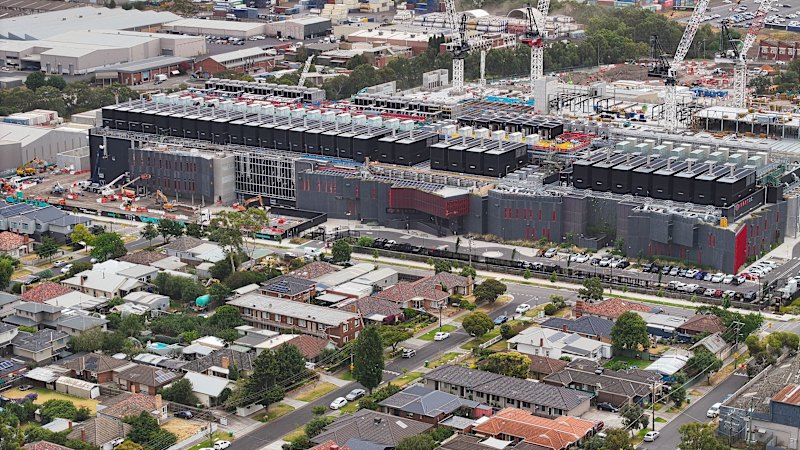
November 6, 2026 — 7:00pmIt seemed like a simple media inquiry to an electricity distributor, about a power pole rollout that had infuriated suburban residents.But it lit the fuse on a corporate convulsion that – for a time – wiped $3 billion off the value of Australian data centre giant NextDC, sparked two looming shareholder class actions against the company, and left it scrambling to defend against a takeover raid by rival predators.NextDC’s vast West Footscray data centre. Its second stage is now under construction.Joe ArmaoOn August 31, this masthead emailed power distributor Jemena a detailed list of questions regarding its installation of five-storey concrete power poles carrying 66,000 volts down quiet residential streets in Yarraville. (Typical residential power poles carry 400 volts.) The power lines – a few of which rose to eight storeys in height – were being installed to route high-voltage electricity into NextDC’s sprawling 10-hectare data centre site on Indwe Street, West Footscray.The same day that email was sent, Jemena halted work on the project following the mounting community resistance, which The Age would report on soon after. Furious residents who did not want the power poles by their homes had organised via street WhatsApp groups to mount direct-action blockades: they parked cars and heavy trucks across planned drilling sites; refused contractor door-knocks; and dumped green waste into pole foundation pits under cover of darkness.The poles Jemena was installing to transfer power to NextDC’s M3 data centre. Their rollout has now been paused until at least February.Joe ArmaoWhat was not known at the time was the financial chain reaction that Jemena freezing the power pole rollout would set off inside NextDC.On Friday, leading litigation firm Gordon Legal announced it was investigating a potential class action against the ASX-listed developer, alleging NextDC breached disclosure laws by concealing the impact those grid delays would have on its business – while continuing to raise capital from investors.The legal dispute centres on three weeks from late August, when NextDC forecast revenue in the 2027 financial year of up to $640 million, and underlying earnings of up to $410 million – specifically relying on the extra power to be provided to the West Footscray data centre proceeding on schedule.Four days after NextDC made this forecast, Jemena paused its power pole works. Yet despite the freeze on its power pipeline, NextDC launched a $1.1 billion capital raising on September 9, pitching to institutional buyers to “fund the continued delivery and expansion” of its Australian data centre network.NextDC chief executive Craig Scroggie inside one of his firm’s data centres.Louie DouvisWhile the fine print of a 34-page offering document listed generalised risks – including “growing community interest” and potential grid delays at its West Footscray data centre – it framed them as hypothetical possibilities and gave no indication that work on the high-voltage connection had already been frozen.On October 21, that changed: NextDC stunned investors by slashing about $140 million in revenue linked directly to the stalled West Footscray contracts and downgrading its underlying earnings forecasts to between $245 million and $265 million.Chief executive Craig Scroggie also announced the company would slash its construction budget by up to $1.25 billion and freeze any developments it hadn’t already signed contracts for.The disclosure sparked a brutal market sell-off, with NextDC shares crashing 42 per cent, destroying about $3 billion in shareholder value.One of the new Jemena power poles alongside an existing wooden pole that triggered the backlash.Jason SouthGordon Legal partner James Naughton said the firm was examining claims on behalf of shareholders that acquired securities between August 31 and October 21.“Many NextDC shareholders are ordinary Australians, including people investing for their retirement through self-managed super funds. They saw almost $4 wiped off the value of every share they held in a single morning,” he said. “NextDC told the market in late August what it expected to earn this financial year. Within days, the power upgrades those forecasts relied on had stopped. Our investigation is focused on whether and when NextDC knew its guidance was at risk. We also want to know why investors weren’t told until 21 October, including those who put money into the $1.1 billion notes raising in September.”Naughton said public companies had a clear statutory duty to keep investors informed. “Listed companies have a legal obligation to keep the market informed of anything that could materially affect their share price. If that didn’t happen here, investors who lost money may be entitled to compensation.”A second class action investigation has been launched by Shine Lawyers. Its class actions practice leader Jonathan Wertheim said its probe would “focus on whether the company issued financial guidance that lacked reasonable grounds, and whether the company failed to inform investors of material impacts after issuing its financial guidance”.NextDC’s sudden vulnerability following the crash has also attracted corporate opportunists. On Wednesday night, Australian warehouse giant Goodman Group and US-based investment trust Digital Realty launched an unannounced after-market raid, acquiring a 10 per cent strategic stake at $9.50 a share. The move sent NextDC’s stock rocketing by more than 50 per cent to $10.40 at close on Friday, valuing the company at $7.5 billion.NextDC’s board branded the raid an “opportunistic move” and retained defence advises at Barrenjoey and UBS.The fallout highlights the delicate economics of Australia’s artificial intelligence boom, with data centre operators borrowing heavily to construct power-hungry digital factories, relying on swift connections to the electricity grid to meet debt payments and hit commercial contracts. Community anger in Yarraville brought Jemena’s power poles to a halt – causing that multibillion-dollar financial architecture to buckle.A spokeswoman for NextDC said the company did not wish to comment on the potential class actions.Start the day with a summary of the day’s most important and interesting stories, analysis and insights. Sign up for our Morning Edition newsletter.From our partners
We asked about suburban power poles. Now a data centre behemoth is facing two class actions – and a potential takeover
Full Article
Original Source
Read the full article at Smh →KhanList aggregates and links to publicly available news content. We do not host full articles from third-party sources. Always verify important information with original sources.