
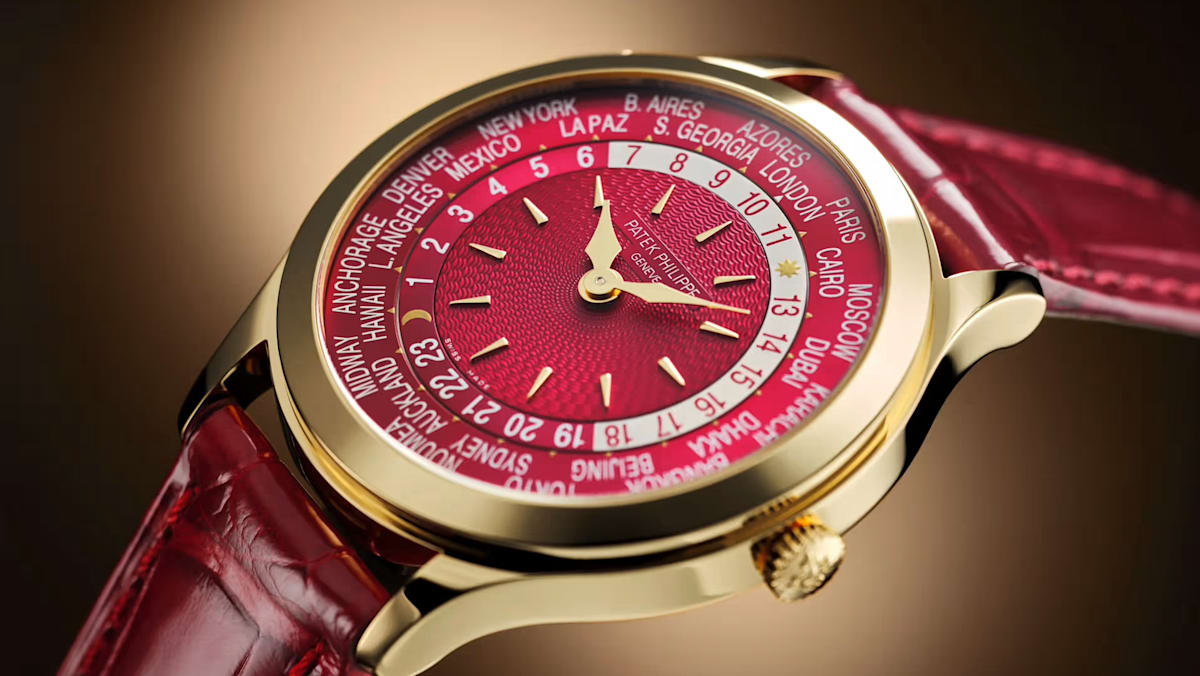
Watches are as beautiful as they are mechanically complex, and the terminology can be confusing for those new to the world of fine watchmaking, especially haute horlogerie.Fine watchmaking comes with its own vocabulary, and understanding terms like “guilloche”, “grand feu” and “chronometer” can deepen one's appreciation of the craftsmanship and expertise behind a timepiece. From the artistry of a dial to the mechanical sophistication of a complication, we break down some of the terms you might encounter and explore the maisons keeping these traditional crafts alive.WATCH MOVEMENT 101: WHAT MAKES YOUR TIMEPIECE TICKIn-house calibre The Patek Philippe Calibre 240 is an in-house, ultra-thin self-winding mechanical movement introduced in 1977. (Photo: Patek Philippe) An in-house calibre is a watch movement developed by the brand itself rather than sourced from an external supplier. Beyond demonstrating a brand's technical capabilities, in-house calibres give watchmakers greater control over the engineering, architecture and performance of a watch. They also make it easier to design movements around unusual displays or specific complications such as perpetual calendars and chronographs. Brands such as Rolex, Grand Seiko and Omega use in-house calibres, as do high watchmaking names like Patek Philippe, Audemars Piguet and Vacheron Constantin.COSC and chronometer certification The Omega Seamaster Diver 300m is COSC-certified. (Photo: Omega) COSC stands for Controle Officiel Suisse des Chronometres, the Swiss institute responsible for testing and certifying the accuracy of watch movements since 1973. Its certification provides an independent measure of a movement's precision. Watches that meet its stringent standards earn the official designation of chronometer.To earn COSC chronometer certification, mechanical movements undergo 15 consecutive days of testing across five positions and at different temperatures to simulate real-world conditions. Among the requirements is an average daily rate of between –4 and +6 seconds. Brands such as Rolex, Omega, Breitling and Tudor have COSC-certified watches, which often carry the word “chronometer” on their dials.Ebauche Manufacturers like Miyota produce ebauché movements that are used in several timepieces. (Photo: Miyota) An ebauche (pronounced ay-bosh) is an unfinished mechanical watch movement comprising basic components such as the mainplate, bridges and gear train. Also used in fine art, the French word refers to a rough draft or outline. In watchmaking, brands can purchase an ebauche before completing, finishing and regulating it to create their own calibre.Although an ebauche represents a different approach from developing an in-house calibre, it is by no means inferior. An ebauche-based movement can be just as technically accomplished while allowing brands to be more efficient in their manufacturing process.Retrograde Breguet Tradition Quantième Rétrograde 7597 has a retrograde date complication. (Photo: Breguet) Instead of travelling in a full circle, a retrograde hand moves along an arc or straight line before snapping back to its starting position when it reaches the end of the scale. This return is usually almost instantaneous, thanks to a spring mechanism that releases stored energy. Van Cleef & Arpels Lady Arpels Pont des Amoureux watch sees two lovers on a bridge that mark the hours and minutes. (Photo: Van Cleef & Arpels) Retrograde displays are commonly used to indicate the date, day or power reserve, but they also offer opportunities for creative dial design. Vacheron Constantin is particularly well known for its retrograde complications, while Breguet and Patek Philippe have also explored the mechanism. Van Cleef & Arpels' romantic Poetic Complications collection uses retrograde displays to bring scenes featuring butterflies, fairies and lovers to life on the dial.Hacking seconds The Bvlgari Aluminium Watch is a sporty number that incorporates the hacking seconds feature. (Photo: Bvlgari) Also known as “stop seconds”, this feature stops the seconds hand when the crown is pulled to the time-setting position. It allows the wearer to synchronise the watch precisely with another timekeeping source. Before this feature became widespread, synchronising watches required more careful timing and adjustment. Today, hacking seconds is common in modern movements, particularly those designed for military and aviation use. Brands that incorporate the feature include Breitling, Cartier, Montblanc and Chopard.COMPLICATIONS 101: WHAT MAKES A WATCH DO MORE THAN TELL TIMEMinute repeater Blancpain Villeret Carrousel Répétition Minutes uses cathedral gongs – their extended length optimizes sound diffusion and richness, creating a deeper and more harmonious tone. (Photo: Blancpain) A minute repeater is a relatively rare complication that uses tiny hammers to strike gongs, chiming the time on demand. Different tones indicate the hours, quarter hours and minutes. With its intricate mechanism, a minute repeater requires exceptional skill to assemble and adjust by hand. Notable examples come from Blancpain, Girard-Perregaux and Patek Philippe.Annual Calendar The A. Lange & Söhne Saxonia Annual Calendar is an elegant take on the information-heavy complication. (Photo: A. Lange & Söhne) First introduced in a wristwatch by Patek Philippe in 1996, the annual calendar is a complication that needs manual adjustment just once a year. It automatically accounts for months with 30 or 31 days but requires correction at the end of February to display March 1 correctly. Rolex, A Lange & Sohne and Blancpain have also produced notable annual calendar watches.Perpetual Calendar Patek Philippe's 5270 Perpetual Calendar Chronograph comes in a sporty red lacquered dial. (Photo: Patek Philippe) Among the most sophisticated calendar complications in watchmaking, the perpetual calendar is also known to enthusiasts as “QP”, short for the French term quantieme perpetuel. It automatically accounts for months of 28, 29, 30 and 31 days, including leap years, without requiring regular manual adjustments. Depending on the model, a perpetual calendar may also display the day, month and moon phase.The only exception to this rule is if the centurial years are not divisible by 400, which the Gregorian calendar doesn't consider a leap year, but the perpetual calendar does. In other words, the movement will consider the years 2100, 2200, and 2300 as leap years when they are actually common years. The next such adjustment will be needed on March 1, 2100.Patek Philippe, credited with creating the first perpetual calendar wristwatch in 1925, continues that legacy today, while Audemars Piguet and IWC have developed their own interpretations of the complication.World Timer The IWC Pilot’s Watch Timezoner TOP GUN Woodland takes its cues from the uniforms and flight suits of elite naval aviators. (Photo: IWC) Keeping track of time across different cities can be complicated, especially for frequent travellers. Unlike GMT watches, which typically display two time zones, world timers allow wearers to read the time across 24 standard time zones simultaneously. These watches usually feature a ring listing 24 representative cities, paired with a synchronised 24-hour disc that indicates the approximate local time and whether it is day or night.Flyback chronograph Blancpain Fifty Fathoms Bathyscaphe Chronographe Flyback features a flyback chronograph. (Photo: Blancpain) Unlike a conventional chronographs, which requires three separate pushes to start, stop and restart, a flyback chronograph instantly resets and restarts – with a single push – the elapsed-seconds hand to begin timing a new interval again. This eliminates the need to stop and reset the mechanism separately, a feature particularly useful to pilots timing successive flight legs. Notable examples include the Blancpain Fifty Fathoms Bathyscaphe Flyback Chronograph and A Lange & Sohne 1815 Chronograph.Rattrapante Chronograph The Breitling Navitimer B03 Chronograph Rattrapante is a unique take on one of watchmaking’s most elaborate complications. (Photo: Breitling) A rattrapante chronograph, also known as a “double chronograph” or “split-seconds chronograph”, features an additional seconds hand and pusher that allow the wearer to measure intermediate times without interrupting the main chronograph. Both seconds hands move together when timing begins, but pressing the additional pusher stops one hand while the other continues running. Pressing it again allows the stopped hand to catch up with the other. Despite its seemingly straightforward function, the rattrapante is one of the more technically demanding chronograph mechanisms to produce. Watchmakers such as A Lange & Sohne, Breitling and Patek Philippe have developed their own interpretations.ARTISTRY 101: THE ART OF THE DIALGuilloche The guilloché patterns on the Royal Oak collection requires a technique so well-guarded that that it's no longer taught in horology school, but passed down across generations at Audemars Piguet. (Photo: Audemars Piguet) Some of the prettiest watch dials don't rely on diamonds or precious stones to stand out. Instead, they showcase an age-old decorative art called guilloche. One of the most respected dial-finishing techniques, traditional guilloche involves skilled artisans using specialised lathes to engrave intricate geometric patterns, from Vagues (repeating waves) to Clous de Paris (small pyramids). While hand-operated engraving remains highly prized, similar decorative effects can also be achieved through stamping for mass-produced timepieces. Audemars Piguet's Royal Oak watches feature some of the most recognisable guilloche dials, distinguished by their signature Tapisserie pattern.Fume The H. Moser & Die Endeavour Perpetual Calendar Funky Blue fumé dial took more than 200 steps to produce. (Photo: H. Moser & Cie) Fume (French for “smoked”) dials are recognisable for their rich, smoky gradient finish, which creates depth and a sense of movement as light plays across the surface. Popularised in the 1970s, when bold colours were in vogue, the effect can be achieved using techniques such as lacquering or enamelling. H. Moser & Cie is particularly well known for its modern fume dials, while Glashutte Original has explored the finish in its retro-inspired Sixties collection.Grand feu enamel A storm blue grand feu enamel dial is paired with smoked sapphire counters on this Rexhep Rexhepi Chronograph Flyback. (Photo: Rexhep Rexhepi) One of the most exacting decorative arts in fine watchmaking, grand feu enamelled dials are valued for their depth, luminosity and enduring colour. The technique takes its name from the French term for “great fire” and involves applying layers of finely ground glass, which are fired at high temperatures, typically around 800°C, to create a smooth, glass-like surface. The process is laborious and unforgiving, as variations in temperature or tiny impurities can cause cracks or bubbles, sometimes forcing the artisan to start again.A well-made enamel dial can retain its colour and vibrancy for generations, making it particularly prized in watches intended to be passed down. Chopard and Hermes have used grand feu enamelling in their timepieces, as has independent watchmaker Rexhep Rexhepi.Cloisonne enamel The limited edition Hermès Arceau Jour de Casting Taco features miniature cloisonné enamel on its dial. (Photo: Hermès) Another intricate technique worth knowing is cloisonne enamelling, which involves shaping fine metal wires, often gold, into delicate compartments known as cloisons. These are then filled with coloured enamel and fired repeatedly at high temperatures. The wires form outlines around the different colours, giving the finished image definition and depth. Like grand feu enamelling, cloisonne is used to create miniature landscapes and intricate scenes on haute horlogerie dials. Notable examples can be found in watches by Vacheron Constantin, Hermes and Ulysse Nardin.
Watchmaking terms explained: From chronographs to grand feu enamel
Full Article
Original Source
Read the full article at Cnaluxury →KhanList aggregates and links to publicly available news content. We do not host full articles from third-party sources. Always verify important information with original sources.