
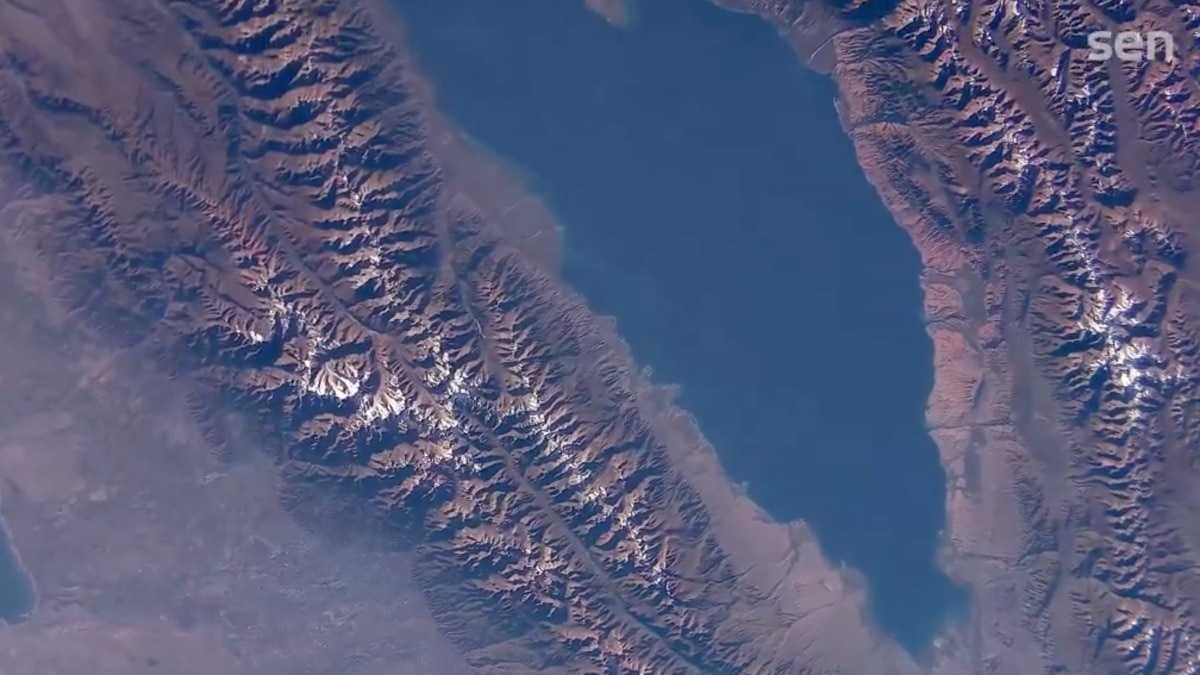
Footage from the International Space Station captured Lake Issyk-Kul in Kyrgyzstan, where more than 118 rivers flow in but none flow out. The rare closed basin offers scientists insight into glaciers, evaporation and climate shifts in the Tian Shan region.Lake Issyk-Kul seen from space shielded by massive peaks. (Photo: Sen)A stunning view from space has revealed one of Central Asia's most extraordinary natural wonders, Lake Issyk-Kul, a massive mountain lake in Kyrgyzstan where more than 118 rivers flow in, but not a single river flows out.Nestled deep within the Tian Shan mountain range, Lake Issyk-Kul sits at an altitude of about 1,607 metres above sea level. The vast lake is surrounded by towering, snow-covered peaks, creating one of the most dramatic landscapes visible from orbit.Sen captured the remarkable footage with its camera aboard the International Space Station as the orbiting laboratory passed over Kyrgyzstan.Lake Issyk-Kul is known locally as the “Warm Lake”, a name that reflects one of its most unusual characteristics. Despite its high-altitude location and the snow-covered mountains surrounding it, the lake rarely freezes during winter. Lake Issyk-Kul, the largest lake in Kyrgyzstan, sits at 1,607m above sea level in the Tian Shan mountains.Known as the “Warm Lake”, it rarely freezes despite the surrounding snow-capped peaks.More than 118 rivers flow into it, but none flow out. This makes Issyk-Kul an pic.twitter.com/9bWmlEhjgE— sen (@sen) August 31, 2026 Its vast volume, depth and slightly saline water help it retain heat, preventing the surface from freezing even when temperatures across the surrounding mountains plunge well below zero.But perhaps the lake's most fascinating feature is its unusual water system. More than 118 rivers and streams flow into Issyk-Kul, carrying water from glaciers and snowmelt across the Tian Shan mountains. Yet, unlike most major lakes, Issyk-Kul has no river flowing out of it.This makes the lake an endorheic basin, a closed drainage system where water does not reach the ocean. Instead, most of the water that enters Lake Issyk-Kul eventually leaves through evaporation.The lake stretches for around 182 kilometres and is approximately 60 kilometres wide, making it the largest lake in Kyrgyzstan and the world's second-largest alpine lake.From space, Issyk-Kul appears like a vast blue jewel enclosed by some of Central Asia's most imposing mountain ranges.Its unique geography also offers scientists a window into the interaction between glaciers, mountain rivers, evaporation and climate. Changes in water levels can reveal how shifting temperatures and precipitation patterns are affecting the Tian Shan region.With 118 rivers constantly feeding it and no river carrying water away, Lake Issyk-Kul remains one of Earth's most remarkable closed water systems, a giant mountain lake whose only escape route is into the atmosphere.- EndsPublished By: Sibu Kumar TripathiPublished On: Sep 1, 2026 11:46 IST
Watch: Lake where 118 rivers flow in but none flow out captured from space
Full Article
Original Source
Read the full article at Indiatoday →KhanList aggregates and links to publicly available news content. We do not host full articles from third-party sources. Always verify important information with original sources.