
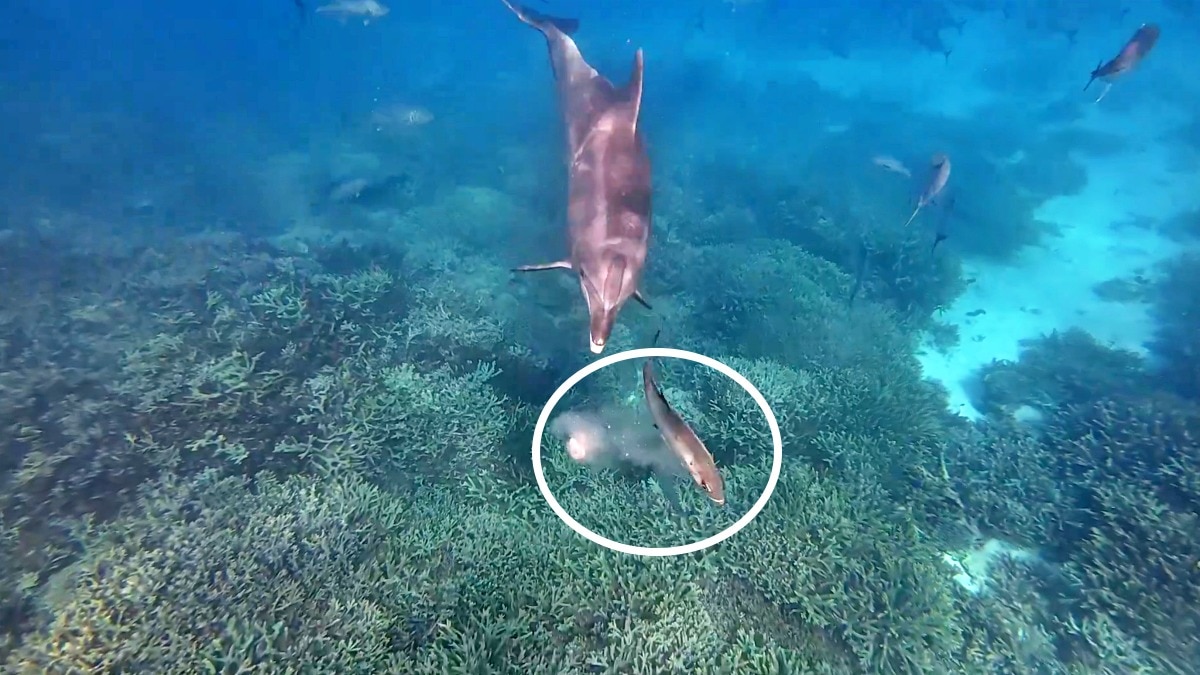
A bottlenose dolphin near Lady Elliot Island was filmed chasing trevally until they regurgitated food, then eating it. Scientists say the behaviour offers rare evidence of kleptoparasitism and may show how sound shapes hunts.The unusual tactic, documented by scientists over several years, offers a rare glimpse into how dolphins use intelligence and sound to secure an easier meal. (Photo: Michael Ingram)New Delhi,Sep 29, 2026 17:06 ISTA dolphin off Australia's east coast has been caught displaying an extraordinary feeding behaviour: chasing fish until they regurgitate their food, then swooping in to eat the vomit.The unusual tactic, documented by scientists over several years, offers a rare glimpse into how dolphins use intelligence and sound to secure an easier meal.The bottlenose dolphin, nicknamed Bubbles by locals, was first reported engaging in the behaviour in 2017 near Lady Elliot Island, in the southern Great Barrier Reef. Researchers have now documented repeated instances of the animal forcing bigeye trevally fish to throw up their recently consumed food.The findings, published this month in the journal Ecology and Evolution, provide one of the first well-documented examples of food stealing, known as kleptoparasitism, among cetaceans, the group that includes dolphins, whales and porpoises. Between June 2021 and October 2025, marine ecologist Asia Armstrong from the University of the Sunshine Coast and her colleagues used GoPro cameras to record Bubbles hunting among schools of trevally.Instead of catching and eating the fish, the dolphin would single out an individual and pursue it relentlessly, ignoring the rest of the school. The chase continued until the fish regurgitated its food and swam away. Bubbles would then consume the vomit, repeating the tactic with as many as 10 more fish within 30 minutes.HOW DOLPHINS MAY BE FORCING FISH TO VOMITScientists believe the dolphin may have initially intended to eat the trevally itself, but discovered that stealing its partially digested meal required less effort.Trevally are relatively large fish that can take time to chew and consume, making regurgitated food an easier alternative.Researchers also suspect Bubbles uses sound to identify and target suitable prey. Before approaching a school, the dolphin produced clicking sounds while moving its head from side to side. During pursuits, it emitted repetitive clicks and low-frequency sounds.Dolphins use echolocation to detect differences in the size, shape and composition of objects underwater. The researchers suggest these clicks may help Bubbles identify fish that have recently eaten, while the sounds produced during the chase could stress the fish into regurgitating.However, scientists do not yet know whether the sounds directly trigger vomiting or whether the fish regurgitate food as a defence mechanism.The discovery builds on earlier observations of dolphins stealing prey from seabirds in Australia's Shark Bay.Researchers say Bubbles' behaviour highlights the remarkable flexibility of dolphin feeding strategies, while raising new questions about how sound shapes predator-prey interactions underwater.- Ends
Watch: Dolphin forces fish to vomit, then eats its puke in bizarre behaviour
Full Article
Original Source
Read the full article at Indiatoday →KhanList aggregates and links to publicly available news content. We do not host full articles from third-party sources. Always verify important information with original sources.