
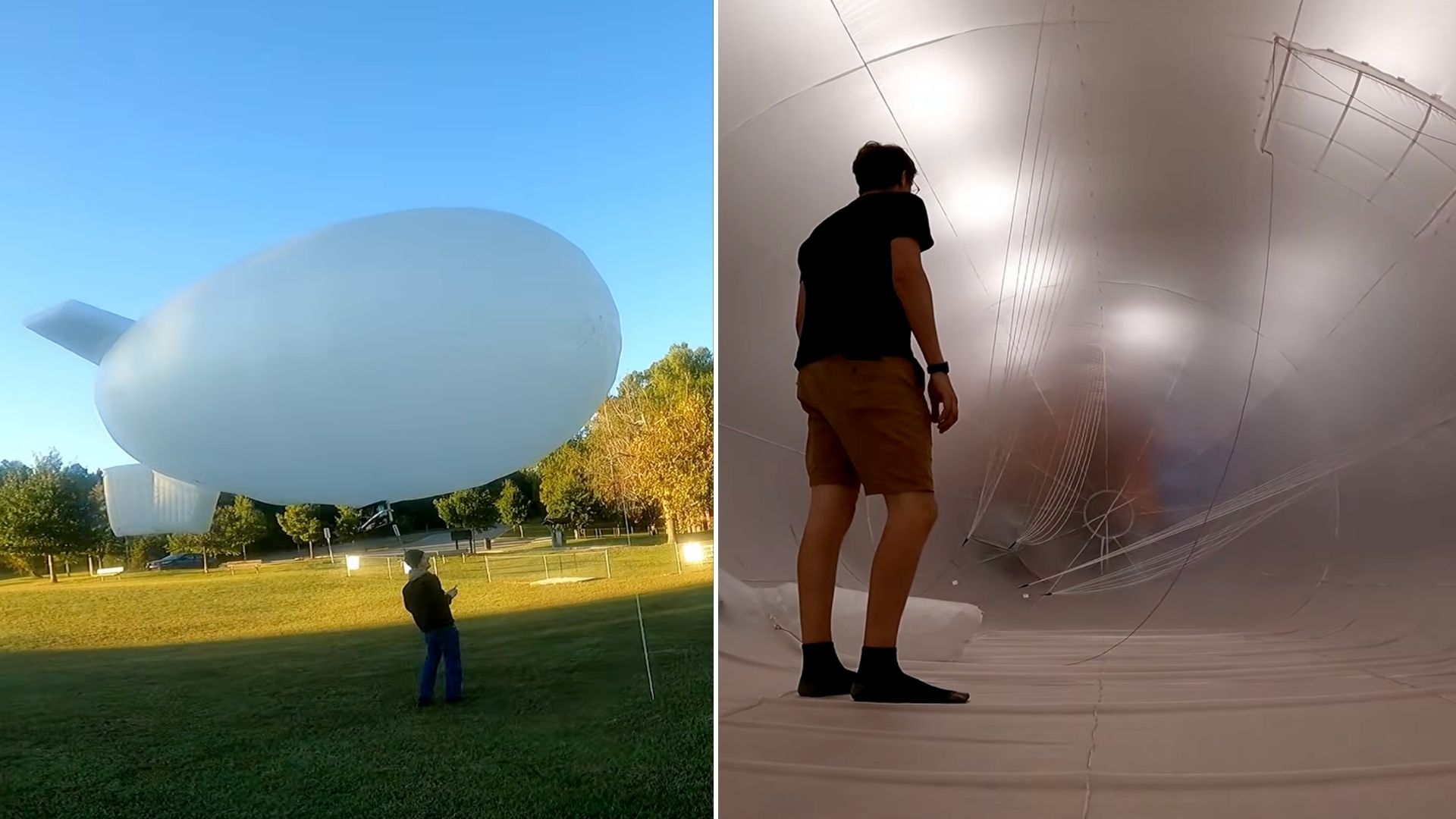
A Youtuber has built a 27-foot-long experimental blimp that uses hot air instead of helium for lift, then added an electric motor and rudder to turn the balloon-like craft into a remotely controlled airship. Called Pandora, the unusual aircraft was built by Avery Flies over months of work and eventually took to the air in September 2026. The project combines the basic principle of a hot-air balloon with the shape and propulsion of an airship, making it more accurately described as a thermal airship. The 27-foot (8.2-meter) craft is about 11.5 feet (3.5 meters) wide and contains roughly 2,100 cubic feet of air. Rather than using helium, a propane burner heats the air inside the envelope, making it less dense than the surrounding atmosphere and providing the lift needed to get Pandora off the ground. An electric motor provides forward thrust, while a fabric rudder allows the remotely controlled craft to change direction. Building a giant fabric airship Much of the challenge was simply constructing something this large. Avery based Pandora’s general shape on a Geta Flug thermal airship but simplified the design to make it buildable. The original concept used four fins, while Pandora has three arranged approximately 120 degrees apart. The envelope was made from around 108 yards of 1.1-ounce silicone-coated nylon. Avery divided the structure into 36 individual fabric sections, known as gores, before sewing them together. The fins were particularly labor-intensive. Each took roughly 20 hours to construct and contained internal baffles to prevent the inflated fabric from simply expanding into a rounded shape. These internal structures help the fins maintain their intended shape once pressurized. A fabric rudder was attached to the rear fin, while small passages allow air from the main envelope to enter the fins and keep them inflated. The completed envelope weighs about 8 pounds. Avery also built an inflation and overpressure system into the envelope. An electric fan initially fills the airship, while a valve allows excess pressure to escape. During flight, another electric fan mounted in the gondola helps maintain pressure inside the envelope and prevents the nose from sagging as the airship moves forward. Propane provides lift while an electric motor provides thrust The distinction between lift and propulsion is central to how Pandora works. The propane burner heats the air inside the envelope, making it lighter than the surrounding air. This provides the upward force that allows the craft to fly. The electric motor, meanwhile, has nothing to do with keeping Pandora airborne. It drives an 18-inch propeller to push the airship forward. The aircraft’s electrical systems are powered by a four-cell, 8,000 mAh battery pack. The burner, fuel tanks, motor, electronics, and steering system are mounted on a lightweight aluminum gondola suspended underneath the envelope. Around 40 ropes and stainless-steel cables connect the gondola to attachment points inside the envelope. The rigging distributes the gondola’s weight and helps maintain the airship’s shape, rather than letting the fabric sag around the suspended cabin. The burner itself uses propane supplied from two small bottles, with a servo-operated valve controlling the main flame. The system also includes a pilot flame and a separate fan that supplies cooling and fresh air around the burner. The first flight revealed a problem Before attempting the full-size aircraft, Avery tested the concept with smaller balloon models. The first full-scale flight eventually took place at a park on a relatively calm day, with family members helping as ground crew. Pandora successfully lifted off and demonstrated that the thermal lift, propulsion, and pressure systems could work together. But the first flight also exposed a major problem: the airship’s steering wasn’t effective enough. The fabric rudder needs airflow over it to produce a meaningful turning force. That meant Pandora had to build up forward speed before it could turn effectively, a somewhat awkward characteristic for an aircraft whose basic lifting system behaves like a balloon. Avery subsequently modified the steering system. The original model-sailboat winch servo did not provide enough travel to pull the rudder sufficiently, so he modified the servo to rotate continuously and provide substantially more movement. The change worked. In a later untethered flight, Pandora responded to rudder inputs and make a controlled turn. Avery also experimented with using the propeller and rudder together to counteract the wind and keep the airship roughly stationary. The aircraft remained somewhat slow to respond, with changes in throttle, heating, and steering affecting its attitude and movement with noticeable delays. But the tests demonstrated that the unusual combination of hot-air lift and electric propulsion could produce a controllable aircraft. A homemade thermal airship takes flight Pandora is not intended to compete with conventional blimps or passenger airships. It is an experimental, remotely controlled aircraft built around a surprisingly simple idea: heat the air inside a lightweight envelope, then add enough propulsion and control to make the resulting balloon steerable. The project nevertheless required solving problems ranging from fabric construction and internal pressure management to suspension, propulsion, thermal management, and flight control. The result is a 27-foot experimental airship that can lift itself using nothing more exotic than heated air and propane, while relying on an electric motor to move through the sky.And perhaps most importantly, the project shows how a concept that looks simple from the outside. A giant fabric balloon with a burner underneath can become a surprisingly complex engineering challenge once someone tries to make it fly under remote control.Get the latest in engineering, tech, space & science - delivered daily to your inbox.Kaif Shaikh is a journalist and writer passionate about turning complex information into clear, impactful stories. His writing covers technology, sustainability, geopolitics, and occasionally fiction. A graduate in Journalism and Mass Communication, his work has appeared in the Times of India and beyond. After a near-fatal experience, Kaif began seeing both stories and silences differently. Outside work, he juggles far too many projects and passions, but always makes time to read, reflect, and hold onto the thread of wonder.
Watch: 27-foot thermal airship built from fabric and model-aircraft parts takes flight
Full Article
Original Source
Read the full article at Interestingengineering →KhanList aggregates and links to publicly available news content. We do not host full articles from third-party sources. Always verify important information with original sources.