
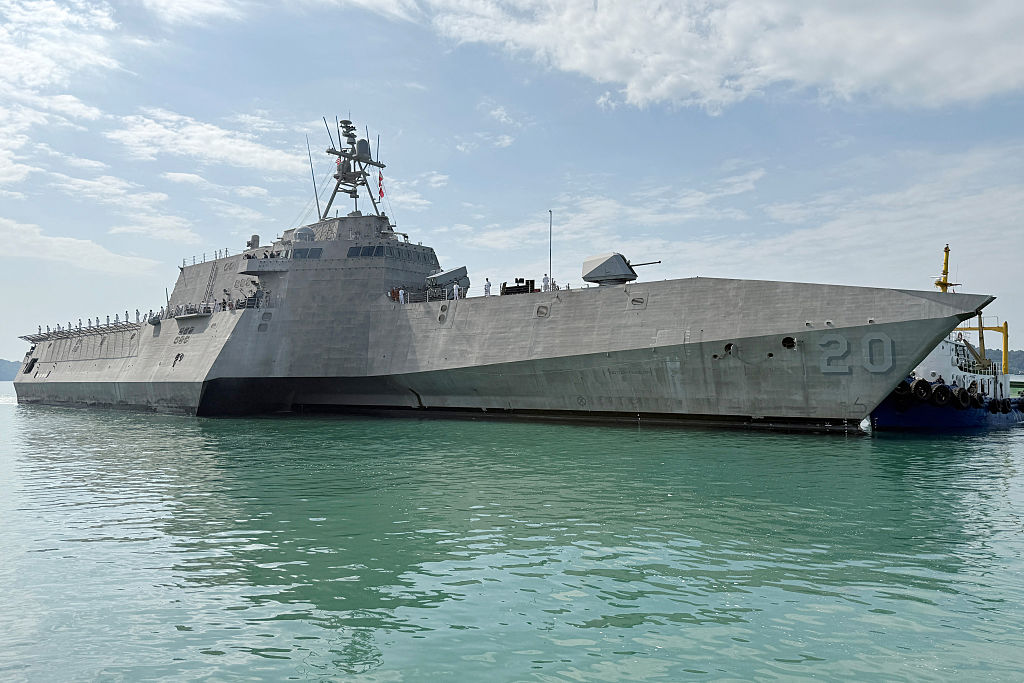
The Islamic Republic of Iran delivered a wakeup call to the U.S. Navy regarding the service’s ability to clear mines. The still-contested Strait of Hormuz demonstrates that mine clearing under fire is a slow, risky process.The mission served as a litmus test for the Navy’s capabilities. While some systems proved effective, improvement and scaling are still required. The Pentagon needs to identify and implement corrective measures or else it may pay a higher price in a future conflict with China, whose mine stockpile dwarfs Iran’s. U.S. Central Command (CENTCOM) announced in late August that it had cleared all naval mines from the Strait of Hormuz’s international shipping lanes, more than four months after the United States and Iran agreed to a ceasefire. While Tehran primarily targets ships with drones and missiles, its use of naval mines presented an asymmetric threat that the U.S. Navy is still ill-equipped to face. American mine clearing capabilities are underfunded, deprioritized, and handcuffed by systemic issues, limiting the Navy’s ability to quickly clear minefields. Worse, Iran is not the only adversary that possesses these weapons – China and Russia also have large inventories. The Pentagon should immediately raise the priority of the U.S. Navy’s mine-clearing capabilities, adapt them for modern combat, and build them at scale. For its part, Congress should require the Department of the Navy and the Government Accountability Office to identify the successes and failures of the recent mine clearing operation. Effectively assessing the threat mines pose and the issues with current mine clearing capabilities is a necessary precursor to closing the capability gap. Congress should also work with the Navy to help procure and field platforms that can clear mines in non-permissive environments. Dire Straits Attacking civilian vessels transiting the Strait of Hormuz with drones, missiles, and mines has been the primary way Iran has attempted to exert pressure on the United States and the global economy. While drones and missiles have inflicted the majority of the direct damage, Iran demonstrated that even a small number of mines can have outsize effects on freedom of navigation. Chief of Naval Operations Admiral Daryl Caudle told Bloomberg in July that Iran employs mines to “force shipping into their [Iran’s] side of the actual Strait of Hormuz.” Since even a single mine makes civilian mariners and insurers wary, shipping companies may be more inclined to pay Tehran’s toll if this threat persists. Paying the toll exposes ships’ captains and the ships’ owners to U.S. sanctions and risks legitimizing Iran’s extortion scheme. In May 2026, CENTCOM commander Admiral Brad Cooper stated that 90 percent of Iran’s prewar naval mine stockpiles had been destroyed, which implied around 200 to 800 mines remained in Iranian inventories. Then, over three months later, Admiral Cooper announced that U.S. forces had cleared mines in international shipping lanes. The amount of time, assets, and personnel required to clear the strait is concerning, especially since Iran is attempting to re-mine the cleared route. Iranian naval mines come in a variety of forms. Mines like the Maham-1 and Maham-3 are moored mines that float below the water’s surface while tethered to the seafloor. However, they can become untethered and present a new problem as they float and ride the currents, enlarging the area hazardous to maritime traffic. However, some mines are intended to be free-floating, like those that can reportedly be deployed by the Fajr-5 multiple launch rocket system. In late August, Islamic Revolutionary Guard Corps troops on Iran’s Larak island in the Strait of Hormuz likely intended to deploy free-floating mines into the strait using Fajr-5 launchers, but U.S. forces destroyed the two launchers before they had the chance to execute their mission. Other mines like the Maham-2, Maham-5, Maham-6, and Maham-7 lie on the seafloor and are optimized for employment in shallow waters. Some of these mines have the ability to detonate after a set number of ships pass over or near them. These characteristics make clearing mines from the area a complex challenge for the small U.S. minesweeping fleet. The Navy primarily relied on Avenger-class minesweepers over the past 30 years — vessels purpose-built to clear mines from vital waterways. Originally, the Navy purchased and built 14 of these ships between 1987 and 1994 but then deprioritized the minesweeping mission after the end of the Cold War. Four out of the eight Avenger-class vessels remaining were decommissioned in late 2025 before returning stateside from their Bahrain-based homeport roughly one month before Operation Epic Fury began, reducing the active fleet to only four ships. As part of a plan to fill this gap, the Navy announced in early 2025 that the Independence-class Littoral Combat Ships’ (LCS) Mine Countermeasures (MCM) packages were finally operational and deployed. These packages were intended to replace the Avenger-class vessels, but suffer from systemic issues such as unreliable unmanned vehicles, unaddressed critical single-point failures, and nonfunctioning sonar equipment. These limitations put into question the Navy’s decision to rely on unreliable equipment and platforms for such a critical mission. Further evidence of the Navy’s tacit recognition of the limitations of LCS-based mine clearing capabilities came when CENTCOM brought in at least two Avenger-class minesweepers, the USS Pioneer (MCM 9) and USS Chief (MCM 14), from U.S. Pacific Command (PACOM) to assist the LCSs in clearing mines from the Strait of Hormuz. Operation Epic Fury was a useful litmus test for the Navy’s ability to clear mines. Instead of surface ships, unmanned and underwater capabilities operating at night were the primary systems used to clear mines, according to reporting from the Financial Times. Some of these unmanned vessels, like Anduril’s Drive-LD, map the seabed and can identify mines, allowing for remote operators to mark locations and then send teams of divers to neutralize or destroy the threat. Additionally, some unmanned platforms are low cost and attritable — something which personnel are not. The significant threat of missiles and drones kept the LCSs and other large, surface capabilities that lacked the ability to either hide or defend themselves against sophisticated threats out of the fight. The limited survivability of surface ship-based mine countermeasures is a critical vulnerability that Iran has exploited and which adversaries like China or Russia can exploit in the future. Estimates of Chinese and Russian naval mine stockpiles are in the tens of thousands, significantly larger than Iranian prewar stockpiles. Both adversaries are likely to use these weapons in certain scenarios as part of anti-access area-denial strategies to deny maritime terrain – like the Irbe Strait or parts of the Taiwan Strait – to U.S. forces and degrade international shipping by saturating areas with drones, missiles, and mines. What Needs to Happen Now The Navy needs a fleet of reliable unmanned, low-profile mine hunting and clearing vessels operating both above and below the surface to effectively clear minefields. Congress should take three proactive steps, working to codify lessons learned from the current conflict and help the Navy procure the unmanned, low-profile mine hunting capabilities it needs in sufficient quantities. Congress should require the Department of Defense to produce a report detailing the nature and scope of the threat naval mines present to civilian shipping and U.S. military operations with a focus on the lessons learned from Operation Epic Fury and the potential mine threat in a conflict with China. Congress should also task the Department of the Navy and Government Accountability Office to assess the comparative effectiveness of manned and unmanned mine clearing capabilities as well as the utility of the LCS MCM packages in their recent employment in the Strait of Hormuz. This independent assessment will provide valuable information about how effectively they performed and help determine whether components of the packages should be added to other vessels. Lastly, Congress should authorize and appropriate sufficient research and development as well as procurement funds for the Navy to increase its unmanned mine clearing capabilities to a level commensurate with the threat. Decades of underinvestment in mine countermeasures contributed to Iran’s ability to significantly disrupt traffic in the Strait of Hormuz for several months. Washington must act swiftly before other adversaries exploit this capability gap in other critical chokepoints to the world economy and impose constraints on America’s freedom of action. Logan Rolleigh is a Research Assistant with the Foundation for Defense of Democracies’ Center on Military and Political Power. Ryan Brobst is Deputy Director of the Foundation for Defense of Democracies’ Center on Military and Political Power. Jordan Ross is an intern with FDD’s Middle East Research Department.
Washington’s Counter-Mine Wakeup Call
Full Article
Original Source
Read the full article at Fdd →KhanList aggregates and links to publicly available news content. We do not host full articles from third-party sources. Always verify important information with original sources.