
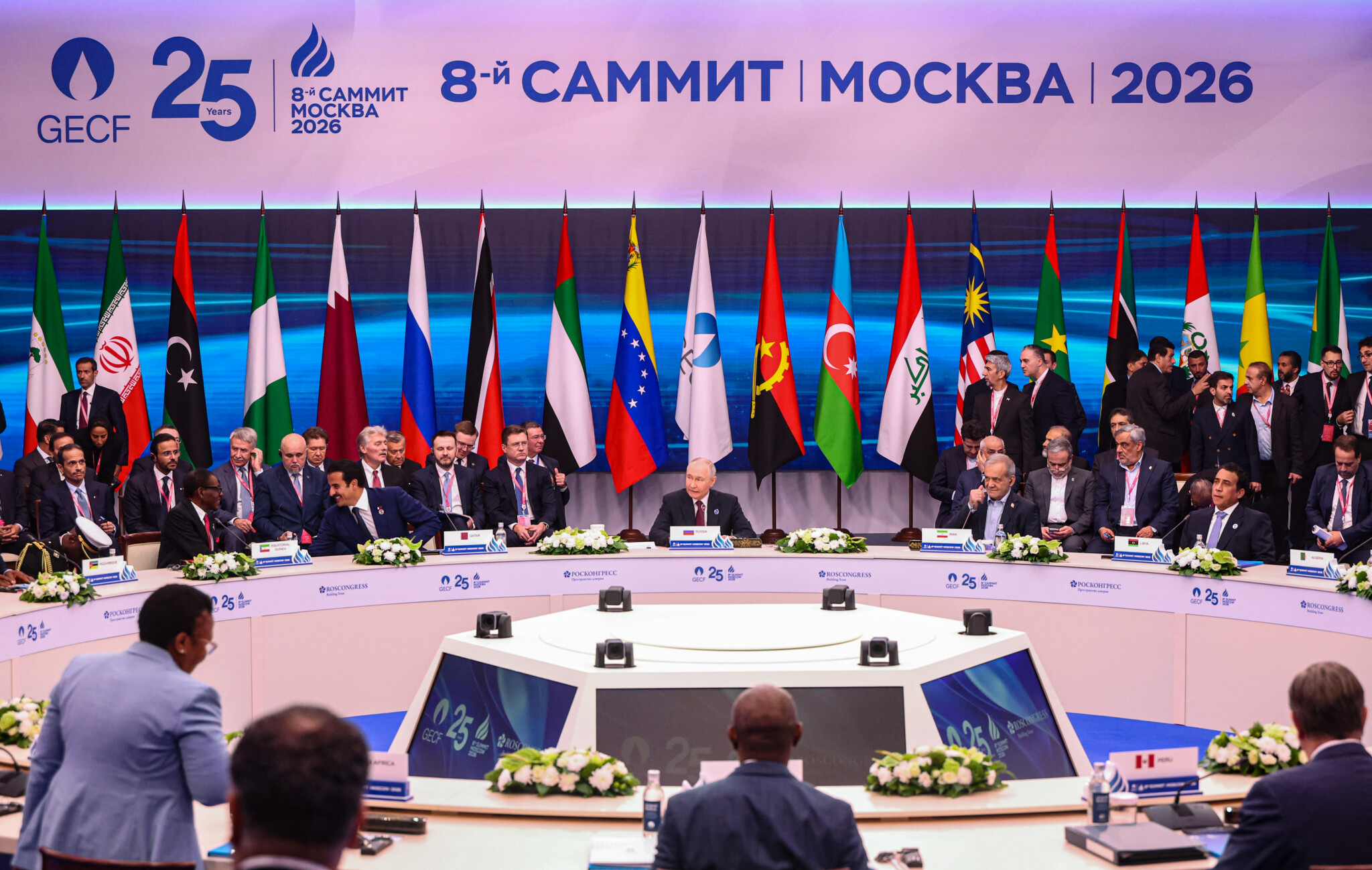
Russian President Vladimir Putin wants to recover the revenue Russia lost from its decline in gas exports to Europe. In a reversal of longstanding U.S. policy, Washington is trying to help him. At the October 27 Gas Exporting Countries Forum (GECF) summit in Moscow, Putin criticized Western sanctions and pitched Russia as a solution to rising energy prices. This comes as U.S. officials are reportedly pushing Europe to revive imports of Russian gas following a potential agreement to end the Ukraine war. Doing so would help fuel Russian rearmament and reverse the progress Europe has made in reducing its dependence on Russian gas Moscow Seeks To Revive Energy Partnerships In addition to Russia, the GECF comprises 11 members from the Middle East, Africa, and Latin America, plus a handful of observers. During his remarks at the summit’s plenary session, Putin noted the market disruption caused by the Iran war. He then lambasted Ukraine’s 2022 attack on the Nord Stream pipelines, which carried Russian gas to Germany, and criticized Western restrictions on Russian supplies and access to energy-related technologies. He argued that the European Union’s abandonment of Russian gas is driving up prices and undermining European industry. Discussing projects in the Arctic, Putin praised Russian-Chinese cooperation, adding that Moscow is “currently exploring the possibility of collaboration with American partners as well.” His remarks followed revelations about a proposed $25 billion Alaska project that Putin reportedly has discussed with U.S. envoys. Its former CEO alleges that Russia’s Novatek had secretly helped finance the venture, which would involve acquiring equipment from the Russian company. Europe Reduced Russia’s Energy Leverage Russia spent decades cultivating European dependence on its gas, then tried to exploit it for political leverage. State-owned Gazprom began restricting supplies even before the 2022 invasion of Ukraine. Russia slashed flows in the months afterward, triggering an energy crisis in Europe. Moscow’s strategy backfired. Europe accelerated diversification, turning to alternative suppliers. EU imports of Russian gas plunged from 152 billion cubic meters in 2021 to just 36 billion in 2025. The European Union is currently moving to phase out Russian gas entirely, with bans on Russian liquefied natural gas and pipeline gas set to take effect in 2027. Losing its main export market has dealt Gazprom a major financial blow. The Russian federal budget has suffered, too, with revenue from gas export duties in 2025 roughly a quarter of its 2022 peak. Although Russia hopes to increase eastward exports, Chinese demand cannot replace European business. The White House, however, envisions a resumption of European imports as an incentive for Russia to end the Ukraine war. Washington and Moscow have even discussed bringing in a U.S. investor to revive the Nord Stream pipelines. While European officials are broadly skeptical, some politicians and business communities in Germany and elsewhere still favor resuming Russian gas imports, and pressure will likely grow once the war fades from view. Just this week, Slovakia, which is challenging the EU ban, reactivated an intergovernmental commission with Russia focused largely on energy cooperation. Fool Me Twice … Europe has already learned the dangers of energy dependence on Moscow. Although the White House is betting on “peace through trade,” decades of economic cooperation failed to deter Putin’s invasion of Ukraine. Instead, Russia exploited that dependence to pressure European governments. Restoring Russian gas imports would undo hard-earned progress on diversification while supplying Moscow with additional revenue to pour into its military, which will be racing to rearm once the war ends. Experience suggests that a peace agreement with Moscow will likely not be worth the paper it is printed on. Russia’s European neighbors understand this, which is why many of them are rightly wary of the White House’s plans. Rather than rushing to put European allies back on the Russian gas needle, Washington should encourage them to continue with energy diversification. Keti Korkiya is a research analyst with the Russia Program at the Foundation for Defense of Democracies (FDD), where John Hardie is deputy director. For more analysis from the authors and FDD, please subscribe HERE. Follow John on X @JohnH105. Follow FDD on X @FDD. FDD is a Washington, DC-based, nonpartisan research institute focused on national security and foreign policy.
Washington Should Not Push Europe Back Toward Russian Gas
Full Article
Original Source
Read the full article at Fdd →KhanList aggregates and links to publicly available news content. We do not host full articles from third-party sources. Always verify important information with original sources.