
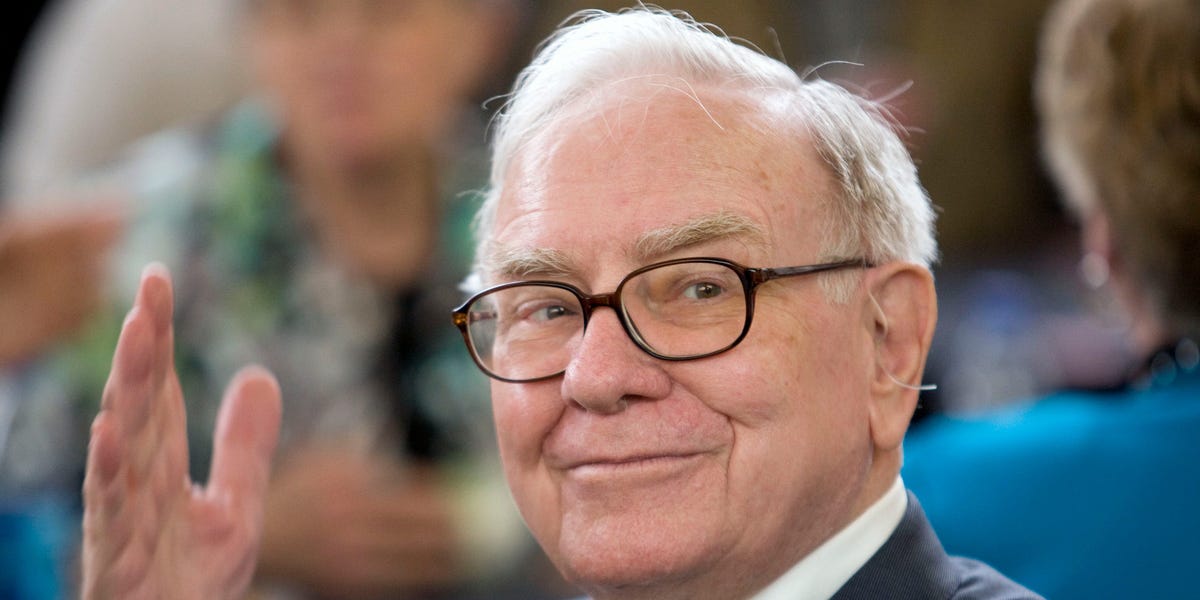
Warren Buffett has recommended the same investing approach for decades. Andrew Harrer/Bloomberg via Getty Images Warren Buffett says almost nobody can do what he does, so they shouldn't even try. His advice continues to pay off.The legendary investor has proclaimed for decades that 99% of people shouldn't try to pick winning stocks, dabble in options, time the market, or hire a money manager."My regular recommendation has been a low-cost S&P 500 index fund," the retired Berkshire Hathaway chairman and CEO wrote in his 2017 letter to shareholders.The benchmark index, which tracks the performance of 500 of the largest publicly traded companies in the US, climbed to a record 7,819 points on Tuesday.It has gained 14% this year, almost 80% over the past five years, and nearly 1,100% since it slumped below 700 points during the financial crisis.Buffett, 96, has said that his go-to strategy avoids high fees that eat into investment returns, and owning a broad index avoids having to identify the best stocks, figure out when to buy or sell them, balance a portfolio, or place leveraged bets that could blow up disastrously.Answering a question from author and lifestyle guru Tim Ferriss during Berkshire's annual shareholder meeting in 2008, Buffett said that his approach lets people invest their money then "forget it and go back to work.""You will not get that advice from anybody because nobody gets paid to give you that advice," Buffett said. "You will have all kinds of people telling you how much better they can do for you than that, and how if you just give them a wrap fee, or give them commissions, or whatever it may be, that they will do better — but they won't do better."Buffett has said he's given similar advice to the trustee who will manage the wealth he leaves to his wife upon his death: "Put 10% of the cash in short-term government bonds and 90% in a very low-cost S&P 500 index fund." "I believe the trust's long-term results from this policy will be superior to those attained by most investors — whether pension funds, institutions, or individuals — who employ high-fee managers," he said.Buffett's advice is rooted in his belief that the US will have a bright future."Over the long term, the stock market news will be good," Buffett wrote in his famous op-ed at the height of the financial crisis, titled "Buy American. I am.""In the 20th century, the United States endured two world wars and other traumatic and expensive military conflicts; the Depression; a dozen or so recessions and financial panics; oil shocks; a flu epidemic; and the resignation of a disgraced president," he continued. "Yet the Dow rose from 66 to 11,497."Buffett's conviction in his go-to recommendation led him to once bet $1 million that over a decade, an S&P 500 index fund would outperform a basket of hedge funds after costs, fees, and expenses. He comfortably won the wager at the end of 2017.This reporter has followed Buffett's advice for his two young children since they were newborns, dollar-cost averaging by making monthly investments in a low-fee S&P 500 index fund on their behalf. Their annualized returns to date are close to 20%.Still, some investors have warned that owning the S&P 500 is less safe today than in the past. The 10 most-valuable companies account for about 40% of the market-capitalization weighted index's total value, and most of them are betting vast sums on AI, a nascent technology.For example, Nvidia is approaching a $6 trillion market cap, Apple and Alphabet are each valued at over $4 trillion, and Microsoft is just behind at $3.9 trillion.Other investors, including Michael Burry of "The Big Short" fame, have cautioned that so much money pouring indiscriminately into stocks has contributed to a more bloated and fragile market.The S&P 500's concentration risk is real; there's no guarantee its historic gains will continue, and the passive-investing boom could mean the next crash is a doozy. But for now at least, the Buffett approach is living up to its billing. Read next Theron Mohamed is a London-based correspondent on the International team at Business Insider. His coverage spans finance, investing, wealth, markets, and the economy.Theron joined BI in 2019 as a reporter at Markets Insider and rose to the rank of correspondent before moving to the Trending team then the broader International team. He previously covered tech, media, and telecom stocks for Investors Chronicle magazine and had a brief stint on the Financial Times' Data team. He interned at the Wall Street Journal in New York where he primarily wrote for Heard on the Street.Theron has freelanced for The Independent, The Telegraph, WIRED, and several smaller publications. He holds an undergraduate degree in geography from the London School of Economics, and a master's degree in journalism from Columbia University.Theron often covers Warren Buffett, Michael Burry, and other elite investors. He also writes about the world's wealthiest people and shares financial advice from all manner of rich and successful people.Email Theron at tmohamed@businessinsider.com and follow him on X @theron_mohamed. Finance Investing Warren Buffett More Berkshire Hathaway Stocks s&p 500 Billionaires Wealth AI
Warren Buffett's classic advice to 99% of investors is still paying off
Full Article
Original Source
Read the full article at Businessinsider →KhanList aggregates and links to publicly available news content. We do not host full articles from third-party sources. Always verify important information with original sources.