
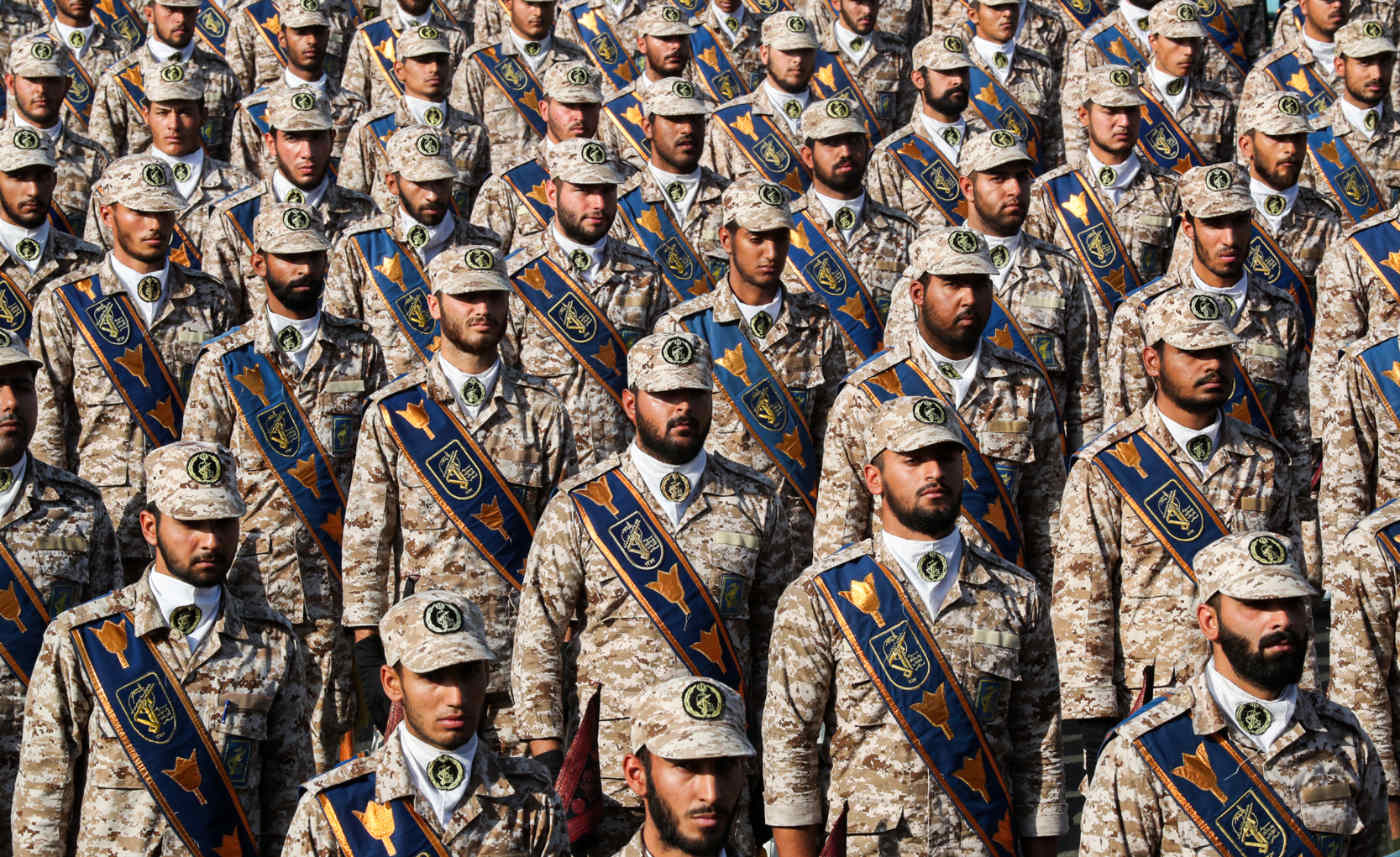
Often called a state within a state, the Islamic Revolutionary Guard Corps (IRGC) is a deeply conservative organisation that has underpinned Iran’s establishment for decades and directed much of its response to attacks by the US and Israel this year. Conceived as a protector of the Iranian revolution, the guard has hundreds of thousands of troops who are distinct from Iran’s official army. It is also unelected, sitting alongside Iran’s elected officials under the ultimate authority of the supreme leader, Mojtaba Khamenei. The IRGC was founded in March 1979 by commanders of the conservative militias that helped overthrow the western-backed Shah Reza Pahlavi the previous month. Known as the Pasdaran (“guardians”) or Sepah (“legion”) in Persian, it was established to protect the new political order and to counterbalance Iran’s army, which retained links to the deposed monarchy and, many feared, might stage a coup d’etat. New MEE newsletter: Jerusalem Dispatch Sign up to get the latest insights and analysis on Israel-Palestine, alongside Turkey Unpacked and other MEE newsletters The IRGC sidelined the leftist factions that helped overthrow the shah, which it opposed ideologically and saw as close to the USSR. Today, the guard has five main arms: a ground army, an air force, a navy, an elite overseas wing called Quds Force (meaning “Jerusalem force”) and a volunteer paramilitary called Basij (meaning “mobilisation”). It is estimated to have 150,000-plus active personnel, plus Basij volunteers who serve as part-time reserves, and whose numbers range from anywhere between 100,000 and 1m. For comparison, Iran’s official army, known domestically as Artesh, has around 600,000 troops. The IRGC also controls Iran’s ballistic missiles, which it has used to attack Israel, and is tasked with safeguarding border security and the country’s nuclear facilities. What is the IRGC’s domestic role? Besides its military role, the guard is embedded in all aspects of life in Iran, from business and politics to education and even sport. Many IRGC veterans hold senior roles in government and parliament, and can determine the success or failure of an individual's job application or business venture. Through Basij, the corps has plainclothes volunteers in neighbourhoods, schools and universities who serve to uphold conservative religious values. Critics have termed the force a “morality police”. Basij volunteers have also clamped down on political opposition figures and crushed public demonstrations, such as the 1999 student protests, the 2009 Green Movement, and the 2024-2025 protests, when thousands of civilians were killed. A protest in Tehran for Mahsa Amini, who died after being arrested, on 19 September 2022 (obtained by AFP) But the IRGC also provides social services (such as after natural disasters) and employment for hundreds of thousands in rural areas, gaining it supporters among parts of the population. As an economic force, the IRGC holds hundreds of government contracts, many of which were awarded under the conservative president Mahmoud Ahmadinejad (2005-13). Through these, it has developed monopolies over industries and now receives an estimated 50 percent of revenues from Iran’s oil sector. Thomas Juneau, professor at the University of Ottawa’s Graduate School of Public and International Affairs, told Middle East Eye that the corps’ business interests “allow the IRGC and its sympathisers to themselves profit, to have access to pots of cash with which they can buy off the loyalty of others, and to marginalise competing business interests. “In that sense, the IRGC has both a vested interest in the survival of the Islamic Republic and its web of cronyism, as well as the means to protect its survival.” What does the IRGC do outside Iran? Through Quds Force, the IRGC has long helped fund and supply a network of regional groups that Tehran has dubbed its “Axis of Resistance”. These include Hamas in occupied Palestine, Hezbollah in Lebanon, parts of the Hashd al-Shaabi (Popular Mobilisation) umbrella group in Iraq, and Ansar Allah in Yemen, better known as the Houthis. Support for Palestine has long been core to the IRGC, and each of these groups has sought to counter Israeli, US and Saudi influence in the region. Hamas has fought several wars with Israel and launched the 7 October attacks in 2023; Hezbollah has battled Israel since the 1980s; and the Houthis have hit Israel with drone attacks and blocked shipping lanes in the Red Sea. Nonetheless, each group retains some independence from Tehran, which for instance denied involvement in Hamas’s 7 October attack - a claim US intelligence has supported. Members of Syria's military in Aleppo on 7 January 2020 mourning the US assassination of Iranian military commander Qasem Soleimani (AFP) The IRGC also supported Bashar al-Assad in Syria prior to and during the civil war, during which hundreds of thousands of people were killed and millions more forced from their homes. Syria under Assad also long served as a supply channel for Iranian weapons for Hezbollah in Lebanon until his fall in December 2024. How did the IRGC become so powerful? One of the guard's first major roles after the 1979 revolution was suppressing armed rebellions by Kurdish and other minority ethnic groups. From 1980 until 1988, tens of thousands were killed during the Iran-Iraq War amid battles, minefields and chemical weapons. Sina Azodi, assistant professor of Middle East politics at George Washington University’s Elliott School of International Affairs, told Middle East Eye that the conflict was pivotal in the guard's development. “The current Iranian political leadership were the volunteers of the Iran-Iraq war who with very basic training went to the front lines with nothing more than assault rifles.” A damaged Iranian tank, decorated with a portrait of Ayatollah Ruhollah Khomeini, on the Iran-Iraq border in September 1980 (AFP) The IRGC's current worldview, he says, was shaped by its memory of the international support for Saddam Hussein's Iraq that it confronted during the conflict. "Their mindset is shaped by those traumas and the need for Iran to be able to stand on its own feet to defend the country." The IRGC was tasked with reconstruction after the war, seeing its role grow under new supreme leader Ali Khamenei and expanding an intelligence arm that now rivals the Ministry of Intelligence. Much of the IRGC’s international network was laid by Qassem Soleimani, Quds Force leader from 1998 until his assassination by the US in 2020 and regarded as the second most powerful person in Iran after Khamenei. His killing shocked the IRGC. Five days later, it shot down a Ukrainian commercial passenger plane as it left Tehran’s main airport, killing 176 people onboard. It later apologised, saying that it mistook the aircraft for a military plane. What action has been taken against the group? The IRGC is regarded as an adversary by many regional Arab-majority governments and much of the West, where it has long been sanctioned. Many governments have gone further, designating the IRGC as a terrorist group, which typically makes it a criminal offence to communicate with, trade with or express support for it or its affiliates. The US was the first to proscribe the Quds Force in 2007, and banned the IRGC altogether in 2019 during the first administration of President Donald Trump. Some officials in the Pentagon and the CIA privately opposed the Trump move: it is diplomatically unusual to ban official parts of other governments. The US considered delisting the IRGC during the Biden administration. But other countries soon followed suit. Canada proscribed the IRGC in 2024, as did the EU in January 2026 after the mass killing of Iranian protesters. The EU move, led by Italy and supported by France and Spain, has been followed by European countries outside the bloc. The UK proscribed the guard in July amid pressure from the US, years of lobbying from pro-Israel and Iranian diaspora groups, and attacks on Jewish groups in London that the UK government has linked to the IRGC. In total, 23 countries, aside from the 27 EU members, have designated the IRGC as a terrorist organisation, including Argentina, Australia, Bahrain, Canada, Israel, Saudi Arabia and Ukraine. While more than a hundred others have not sanctioned the IRGC, ties with the rest of the world are restricted by secondary sanctions imposed by the US, which sanction any firm that trades with any IRGC affiliates. The measures have led Iran and the IRGC to strengthen relations with US rivals that have similarly been cut off from the US-dominated financial system, or have enough economic heft to weather potential US retaliation. The IRGC has sold weapons to Russia throughout its invasion of Ukraine and jet fuel to Myanmar’s junta during the country’s civil war. Iran sells much of its crude oil to China via a so-called “shadow fleet” that aims to skirt US sanctions. Who are the IRGC's key figures? Many of the IRGC’s top personnel have been assassinated by the US and Israel in recent years. Key to its survival has been its succession strategy, with Juneau saying it "has long had extensive contingency plans to replace killed commanders". Its highest rank is commander-in-chief, one of several IRGC roles directly appointed by the supreme leader. Ahmad Vahidi, previously Iran’s minister of defence, has held that position since his predecessor, Mohammed Pakpour, was killed by Israel in March. He in turn succeeded Hossein Salami whom Israel killed in the June 2025 war. From left to right: IRGC leaders Ahmad Vahidi (2026), Esmail Qaani (2024) and Hossein Taeb (2018) (all AFP) Esmail Qaani has led Quds Force since Soleimani’s 2020 assassination. Hossein Taeb, a cleric and former intelligence chief, is current head of Basij after Israel killed Gholamreza Soleimani (no relation to Qassem) in March. Others killed by Israel include Alireza Tangsiri, commander of the IRGC Navy, on 26 March, and Majid Khademi, head of the IRGC’s intelligence wing, on 6 April. Israeli airstrikes have also targeted more moderate figures, including Ali Larijani, a pragmatic politician who headed Iran’s security council until he was assassinated by Israel on 17 March. It is now led by Mohammad Bagher Zolghadr, a longtime IRGC hardliner. How has the IRGC been hurt by the war? Juneau says that “on the one hand, the IRGC has been badly hit by the US and Israel during the war, as have other pillars of the Islamic Republic”. “If we simply count strikes, military installations damaged or destroyed, ships or aircraft damaged or destroyed, then we can conclude that the IRGC has been significantly weakened,” he says. But the guard “has prepared for this war for decades”, he adds. “The US and Israel have destroyed an important proportion of the IRGC's missiles and drones, but the force still has more than enough to continue threatening shipping in the Strait of Hormuz.” For this reason, Juneau says the IRGC is far from admitting defeat, with many hardliners believing they have the upper hand and seeing no need to make compromises. “The way out of the war to the IRGC is to consolidate and institutionalise its geopolitical gains. “It wants, in particular, to see a new arrangement in the Persian Gulf whereby it can de facto veto maritime traffic.”
War on Iran: How the Islamic Revolutionary Guard Corps underpins the republic
Full Article
Original Source
Read the full article at Middleeasteye →KhanList aggregates and links to publicly available news content. We do not host full articles from third-party sources. Always verify important information with original sources.