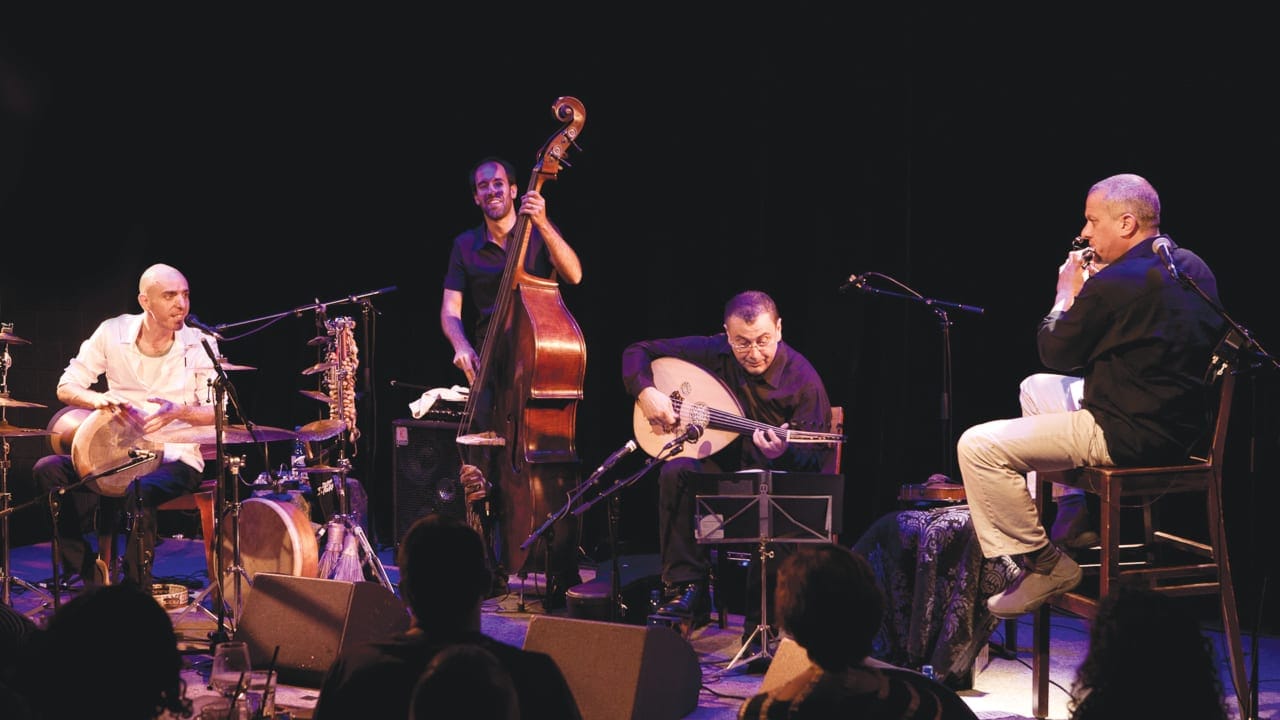
ByBARRY DAVISJULY 18, 2026 15:24As the post-Oct. 7 and post-Iran war – possibly inter-Iran war – trauma continues to leave its mark on us all, we, naturally, get on with our lives as best we can. There are kids to dress, feed and fret over, aging parents to tend to, jobs and careers to nurture, and bills to pay. So much for the body. But what about the soul? As the so-called “People of the Book,” the Jews have traditionally maintained a strong, vibrant bond with the written word and literature of all kinds. Possibly more to the point, we are a nation that has undoubtedly known its fair share of persecution, which has led to a nomadic existence and the hard-earned ability to pull up stakes and pick up more or less where we left off in our new surroundings.That has spawned a predilection for occupation choices, and breadwinning means we can take with us, although the options were often limited by what the authorities of the day considered “kosher” for Jews to engage in. And so Jews became doctors, lawyers and moneylenders, and also artists.The latter has its roots in biblical climes. There was much singing in the temples in Jerusalem, and Psalms were scored, some by King David who strummed his lyre and sang to soothe King Saul’s tortured breast.That salutary sonic offering is a veritable boon for our own circumstantially-generated distress, as we stumbled out of the pandemic straits into the barbarous attack by Hamas, the excruciatingly protracted hostage chapter, and thence to Iranian missile attacks. Ne’er a dull moment.THE JERUSALEM STREET ORCHESTRA received payment for its performance at the Clal Building with the help of the Bar-Kayma association. (credit: Noam Kuzar)Through much of those crises, our artists, across all disciplines, stuck to their creative pathways, despite struggling mightily to make ends meet. “We are crazy,” was one observation I recently encountered, courtesy of Jerusalem-based Art Cube Artists’ Studios CEO Lee He Shulov, following my expression of astonishment and admiration for local artists’ unceasing, abundant and high-quality output. “We just have to keep going with our artistic work,” she added unceremoniously.Looking for mood liftersThat is highly commendable and greatly appreciated, as we seek solace, spiritual uplifting and plain old quality entertainment between going about our business in this troubled spot on the global map. But where do the folks with their authoritative hands on the national and local purse strings figure in all this?How much does, for example, Culture and Sport Minister Miki Zohar really care about the institutions and individuals across the country that keep the creative and soulful stuff coming and, in so doing, provide us with some healing respite from the exigencies of everyday life here?Zohar is, after all, a politician and, no doubt, toes the party political line within the context of his daytime job. That potentially unhealthy state of affairs is further exacerbated by the way the political system works, particularly in this country.Government ministers are rarely experts in their appointed field and, in any case, are hardly likely to hang around too long in their role before they move on – hopefully, from their point of view, to a position that offers them even more power and room for career ladder-climbing maneuvers.In addition to the above disadvantageous facts on the scorched ground, it should be noted that the sum set aside for supporting cultural endeavors in Israel amounts to a hardly credible minuscule 0.18% of the total state budget. “That is probably the lowest of any of the OECD countries,” head of the Israeli Artists’ Association – also known as the Israeli Union of Performing Artists (IUPA or EMI) – Yossi Singer said.Public spending on culture across OECD countries averages 1.2% of total government expenditure, which is indubitably streets ahead of ours. And while even Germany – traditionally a generous supporter of the arts – is reducing its assistance for cultural ventures, with around 0.5% of the annual budget currently earmarked for culture, the situation there is still far rosier than over here.That’s even without casting a glazed green eye toward Norway, where artists have over 4.5% of the national budget at their disposal. What makes it even more frustrating is the quality of talent we have at our disposal in this little war-torn Middle Eastern country.Money for musesFor some not entirely explicable reason, Israelis tend to excel at almost every artistic pursuit they try. That even includes film, which, until around 30 years ago, was a pretty raw field of activity here.All that has changed immeasurably in the interim, primarily since the establishment of the New Fund for Cinema and TV (NFCT), in 1993, which, as it web site poignantly notes, has: “helped bring more than 1,000 films to life, including documentaries, narrative features, and TV dramas that reflect the rich mosaic of Israeli society and are shown both in Israel and overseas.” That is partly down to the money the NFCT was able to channel to creators in the field.Yes, the mythological muses have their place in artistic endeavor, but if your nervous system is working overtime because you’re trying to balance basic survival with coming up with the creative goods, it is highly likely that both areas will suffer.While the cliché about artists having to go through the mill for their work may, in at least some small part, hold a little water, any artist will tell you that not having to worry about extraneous matters leaves them with commensurate time and energy to devote to their craft and make headway with their envelope pushing.There is, says Singer, so much on offer that could do with a helping hand or two. “Israel has such a wealth of culture. There are hundreds of bodies, artists, directors, creators.” There is, he notes, so much just waiting to get out there. “The lack of funding for culture is a true anomaly. There is so much creative stuff and so few resources available.”Culture as a major employment sectorThat is not just a matter of facilitating the evolutionary process. In his capacity as director of the IUPA, Singer is viscerally aware of the bread-and-butter facts on the ground. “There are over 250,000 households in Israel that live off the field of the arts,” he explained.That includes the behind-the-scenes professionals as well as the artists themselves. “There are production people, lighting, sound, you name it.” So we are talking actual existential affairs, and a major slice of the national economy and workforce.All of which shines an even harsher, cold reality light on the miserly handouts provided by the state and municipalities up and down the country. Singer also pointed to the artistic added-value equation, citing the benefits of helping Israeli acts abroad.“It is more than just the financial aspect. We can also export our culture to the world. Our artists can be wonderful ambassadors for Israel, particularly since Oct. 7. We have, for example, great dance companies here that are considered the best around, anywhere. It used to be that every dance festival around the world clamored for Israeli groups to appear in their program.”We all know about the political fallout of the war in Gaza following that fateful day in 2023, and the cold shoulder shoved in the faces of Israelis of all ilks by governments and people across the globe. Which, in Singer’s opinion, makes the provision of the requisite wherewithal to help redress that sorry state of affairs all the more important.He does not, however, express much optimism about the political hierarchy taking on board our artists’ positive advocacy potential and supporting their efforts.“No one in the government is listening,” he exclaimed. “They provide ad hoc solutions for situations, like compensation for loss of earnings during the war with Iran. But these are band-aids; they just paper over the cracks. There is no thought-out order of priorities.”Short-term thinking appears to have been the name of the political game in this country for some time.In the run-up to this article, I contacted various cultural sector players, large and small, to get their take on the state of play in governmental and municipal funding. Quite a few diplomatically refused to comment, including some of our leading organizations, without explanation. I assumed that was because they were wary of jeopardizing whatever support they get, however inadequate it may be.If that is indeed the case, it does not reflect well on the health of democracy and free speech in these parts. That sinking feeling is further exacerbated by the fact that I was unable to procure any response from the municipalities of Jerusalem and Tel Aviv, or the Ministry of Culture.No more offshore PRAdi Sha’al, cofounder of the Vertigo Dance Company, based at Kibbutz Netiv Halammed Heh near Jerusalem, spells out the predicament his troupe, and others like it, find themselves in. “We constantly have to find creative solutions,” he puts it tactfully. As the official dance troupe of Jerusalem, Vertigo receives funding from both the municipality and the state. Together, that covers 45% of the company’s outgoings, leaving more than half to be met through self-generated income and donations.“Funding for culture has been diminishing since corona. You’ll hear that from everyone in the field,” says Sha’al – those willing to talk about it, that is. “For years it was 0.25% of the national budget, now it is down to 0.18%,” he noted, echoing Singer’s bleak observation.Vertigo’s case is not helped by the international boycott of anything Israeli. “Until recently, half of our self-generated income came from shows we performed abroad,” Sha’al states. “That is gone. They tell us they don’t like us, or they don’t like us and don’t say anything.”Even the odd glimmer of light from that direction is summarily doused by shortcomings in local support. “It is very sad that, when there are a few places that tell us we are good at what we do, and they want to invite us to perform there, and are willing to show their public what Israel has to offer, they say we have to bring some funding from our own sources.Then the Foreign Ministry drags its feet, and doesn’t cooperate with us. That hurts a lot, and it needs to be said out loud.”Sha’al is patently made of sterner stuff than some of the aforementioned unnamed pillars of Israeli arts and culture who took the proverbial Fifth.“It is inconceivable that you hold international showcases, of all the disciplines, and then, at long last, someone wants to invite some music group, dance company or theater. You have the [German] Goethe Institute or the British Council or the [Spanish] Cervantes Institute [that provide funding for their country’s artists to perform abroad], But, here, when a foreign institution or festival organizer asks us what assistance Israel provides for the outlay – the contribution from here ranges between zero and some symbolic figure. That prevents us from going abroad to show people there what we do.”In addition to the personal and professional sense of frustration, Sha’al reprises Singer’s take on the national PR advantages of Israeli acts doing their thing elsewhere and, possibly, showing the world a different side to this country.“That is an advocacy flop. It is incredible. It has to change. Regardless of who is in power here, it has to be clear that the arts are the best face of Israel. We heard that from every Israeli ambassador in the countries we have visited. They tell us what we did there in a few days, they [diplomats] don’t manage to achieve in a whole year of work.”Culture Ministry falls shortTel Aviv Museum of Art director Tania Coen-Uzzielli goes along with the national store-window display rewards that can be gleaned from providing our gifted cultural protagonists with the monetary underpinning they need to get the positive, beautiful Israeli message out there and, hopefully, offset some of the negative detritus of the political domain.While she praises the Municipality of Tel Aviv and its long-serving head Ron Huldai for the financial backing it channels the museum’s way, she feels the state could do more, a lot more, to help. “We get 45% funding from the municipality and 5%, or less, from the Ministry of Culture,” she says.That, she feels, is way below what is required, particularly during this trying chapter of our national timeline. “We can’t bring exhibitions from abroad because everyone boycotts us. That makes it difficult for us to be attractive.”That naturally impinges on box office returns and the ability to draw local arts consumers, especially when incoming tourism is non-existent. “Then you have to close the museum and store all the artworks away because there’s a war going on. The situation doesn’t exactly help us generate our own income, from ticket sales and events we normally hold.”Coen-Uzzielli would dearly love the government to step into the breach. “The state promises some sort of compensation. We got that during the [post-Oct. 7] war and other campaigns. They understood the situation. But I can’t say they understood that cultural institutions are important. But we did get some compensation, and we have acknowledged that.”And while the Tel Aviv Museum appears, for now, to be treading water, other purveyors of quality artistic wares may not fare so well.The Jerusalem Symphony Orchestra (JSO), for example, has been operating in a state of uncertainty for some time. Its financial solvency appears to be far from secure, and orchestra staff members are often kept guessing, until the last moment, about whether they will receive their salary on time and in full.That can’t be good for the orchestra’s creative or individual member health.Helping cut red tape in JerusalemNoam Kuzar and Lidia Maletin have been doing their level best to help Jerusalemite artists and acts access some of the funds that are offered by the local municipal authority. They founded Bar-Kayma – Bar-Kayma – for Culture, Art, Music, and Peace in full, with the express purpose of supporting arts and culture initiatives in Jerusalem.The organization’s stated credo says it creates “a protected and supportive environment for the establishment and operation of group and multidisciplinary projects.”That, inter alia, involves helping artists pick their way through the bureaucratic minefield they must navigate to obtain municipal assistance for their work. The cultural funding situation, they say, is pretty dire. “Things have been deteriorating for years,” says Maletin, who serves as project institute manager. She and Kuzar currently support some 60 Jerusalemite bands and artists.“The municipality hasn’t yet finalized its budget for 2026,” Bar Kayma general director Kuzar noted. “How is an artist supposed to plan ahead if they don’t know if they will have any funding for their projects?” How indeed? “That’s why you get so many festivals and events in October, November and December,” Maletin added. “That’s because the budget is finally decided on and there are funds to spend.”That can’t be good for any act or cultural institution, although Effie Benaya, surprisingly and encouragingly, says he has no complaints. “We are supported by the Jerusalem Municipality, Culture and Sports Ministry, and also by the Jerusalem Foundation,” explained the veteran Confederation House ethnic arts venue CEO. Not a bad triumvirate to have behind you. “I am happy with the funding we get.The Culture Ministry didn’t reduce our budget during the war. They maintained the budget from the previous year. There were no additions, but in a year of war, you have to be grateful for what you get.In these dire times, there’s no arguing with that and, as the Ethics of the Fathers has it, we are rich if we are satisfied with our lot. That may be so, but it is questionable whether that positive line of thought helps pay the bills.Follow us on Google
War, boycotts, and shrinking budgets push Israeli culture to the brink
Full Article
📰 Original Source
Read full article at Jpost →KhanList aggregates and links to publicly available news content. We do not host full articles from third-party sources. Always verify important information with original sources.