
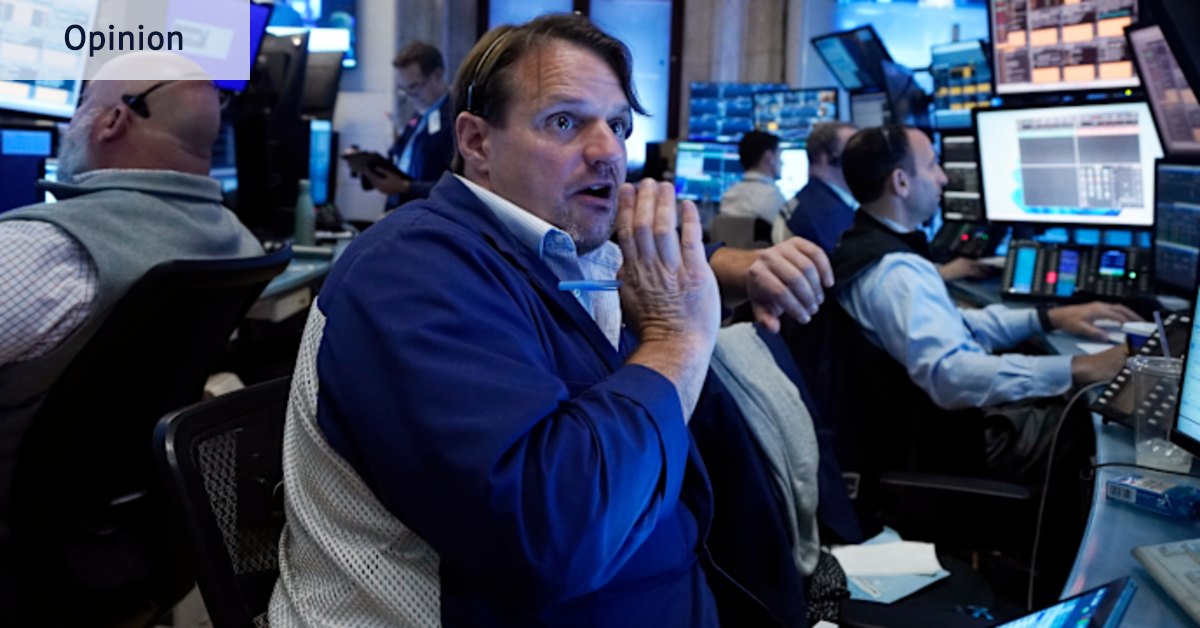
OpinionSenior business columnistNovember 9, 2026 — 12:00pmNovember 9, 2026 — 12:00pmThe “blue tsunami” that destroyed Republican control of Congress last week may have a silver lining for some of the key companies caught up in the scramble for artificial intelligence supremacy and for investors exposed to what appeared to be a swelling bubble.The $US3.2 trillion ($4.7 trillion) meltdown on Wall Street last Thursday as the implications of the Democrats’ control of both chambers of Congress sank in was dominated by AI-related stocks.Wall Street plummeted on Thursday as investors digested the impact of the midterms. APThat’s because AI, and data centres in particular, were high on the list of the issues targeted by the successful Democrat candidates who capitalised on a rising tide of discontent by voters unhappy with the impact of the centres on their neighbourhoods, their power charges and their water supplies.Even more inimical to the interests of the AI sector than the shift in the composition of Congress, which might write new and more intrusive rules for the governance of AI and the build out of data centres, was the success the Democrats had at the gubernatorial level.Before the elections, there were 26 Republican governors and 24 Democrats leading their states. Post-elections, there will be 30 Democrat and 20 Republicans governors.In Texas, the epicentre of data centre developments – between 25 per cent and 30 per cent of all the centres being built or on the drawing boards are in the state – there is now a newly-elected Democrat senator and a new Democrat governor, both of whom campaign against unfettered data centre development.If the build out of data centres slows, so will the pace of AI development more broadly.Data centre construction was already a bottleneck for AI, one that was starting to squeeze as local opposition to their construction intensified.The growth rate of data centre capacity was already lagging the prospective demand from the frontier labs and hyperscalers for computing power that was being reflected in the explosion in capital expenditures they have been foreshadowing. After spending around $US750 billion this year, the hyperscalers alone were expected to spend more than $US1 trillion next year.Any material slowdown in the growth of that capacity will flow back to reduced spending by the AI ecosystem, which may be a material positive for the companies, investors and economies – particularly the US economy, where AI investment has been contributing as much as a third of economic growth while boosting inflation.Trump’s horror day has the potential to reshape the AI world. APThe funding of the AI boom was already showing increasing signs of stress.Shares in the hyperscalers, chipmakers and the neocloud building data centres had already come off sharply from their highs earlier this year.The yields on bonds issues by the hyperscalers and companies like SpaceX had spiked, and the cost of credit default swaps – insurance against loss – on their debt had soared.The brittleness of the funding of the sector was underscored by the incestuous nature of the circular financing and “buy now, pay later” deals being done between its participants because the conventional markets weren’t able or willing to keep up with the sector’s demand for finance.According to the Bank for International Settlements, more than half of all AI investments come from other AI firms and nearly half the value of the deals for cloud capacity and chips are supply-chain driven.There has, and still is, a risk that an “event” within one key participant in the supply chain could cause the entire sector to implode.On Thursday, Wall Street investors clearly priced in the domino effects of a slowing rate of data centre construction.The overall market fell 4.3 per cent on Thursday. The tech-laden Nasdaq index was down 5.5 per cent. The Philadelphia Semiconductor Index of the largest chipmakers slumped more than 11 per cent. Interestingly – importantly – the “Magnificent Seven” big tech stocks were down “only” 4.5 per cent.There were some marginal recoveries on Friday – the overall market was up 0.3 per cent – but the theme within the market was clear.Those companies most closely tied to the data centre build out – the neoclouds and chipmakers – were hit hardest, along with Elon Musk’s SpaceX and Tesla. Musk ploughed more than $US474 million into the losing cause, much of it in Texas. He can expect a tough time from Democrats at both the state and federal level.The chipmakers, Tesla and SpaceX lost more than $US1 trillion on Thursday, the three biggest neoclouds (CoreWeave, Nebius and IREN) about $US10 billion and the hyperscalers (Alphabet, Amazon, Meta, Microsoft and Oracle) about $US380 billion.The neocloud losses, relative to their market capitalisations, were in the mid-teen percentages; the hyperscalers in the low single digits.Both the hyperscalers and neoclouds were well of their highs this year even before Thursday’s rout, although the neocloud losses of value of almost 30 per cent before Thursday dwarfed the 5 per cent or so falls in the value of the biggest tech stocks.That differentiation is significant. What the market was signalling was a recognition of the value of the cashflows the hyperscalers generate from their legacy businesses.This year the hyperscalers have become cashflow negative as their spending on AI has outstripped the cash generating capacity of those businesses. That gap was expected to widen and make the companies increasingly reliant on equity raisings and debt issues to fund it – in markets becoming more nervous (and more expensive for AI-related-issuers) about their concentrated exposures to AI.A slowing of the rate of AI development as the hyperscalers adjust to the more complex, time-consuming and costly permitting process for new data centres will narrow or even close the gap between hyperscaler revenues and capital expenditures. It would put the sector on a more solid financial footing.It wouldn’t be good new for frontier labs or chipmakers – Anthropic and OpenAI have no legacy cashflows and are reliant on access to ever-increasing amounts of equity and debt and ever-escalating valuations while the chipmakers face a smaller and slower-growing end-market for their chips.Anthropic had planned to float and raise $US100 billion of new equity before the end of the year, targeting a valuation of $US1.5 trillion to $US1.75 trillion.The size of the raising and the valuation may have to be scaled back, with market speculation it will be reduced to between $US1.1 trillion and $US1.3 trillion.OpenAI has aspirations to float next year. It, too, may have to raise less, at a lower valuation.As if last week’s turmoil wasn’t enough to destabilise parts of the AI supply chain, the company at the centre of most of the sector’s financial interdependencies, Nvidia, finds itself embroiled in a sex and espionage scandal, with the chief executive of what was, until October, the world’s most valuable company admitting to an extra marital affair with a woman suspected by the US government of being a Chinese spy.The funding of the AI boom was already showing increasing signs of stress.Jensen Huang has long, and aggressively, lobbied for Nvidia to be able to sell more of its advanced chips to China, with significant success.It has been alleged that a Chinese citizen, Alice Huang, formerly a senior executive at Megaspeed International, may have been sharing information with the Chinese government while working with Nvidia to build data centres in Asia. The US has also been investigating Megaspeed over concerns that it might be smuggling Nvidia chips into China.Jensen Huang, the co-founder of Nvidia, be investigated by his board, with no obvious successor in place should they find his position untenable.There’s potential for the outcome of that investigation, or just to response of the government and the new congress to his admission of the affair, to represent a new threat to the stability of the sector, so central have Huang and Nvidia’s chip and vendor financings been to the AI boom.By itself, the Huang scandal might have been one of those “events” that could destabilise the sector. After the midterm shockwaves hit the market, it’s another reason why it wouldn’t be such a bad thing if the sector were to develop at a significantly slower and more financeable and sustainable pace.The Market Recap newsletter is a wrap of the day’s trading. Get it each weekday afternoon.More:AIOpinionUS midtermsUS CongressSharemarketBondsElon MuskTeslaSpaceXAmazonMetaGoogleMicrosoftAnthropicOpenAIFor subscribersFrom our partners
Wall Street’s $4.7 trillion meltdown may have a silver lining
Full Article
Original Source
Read the full article at Smh →KhanList aggregates and links to publicly available news content. We do not host full articles from third-party sources. Always verify important information with original sources.