
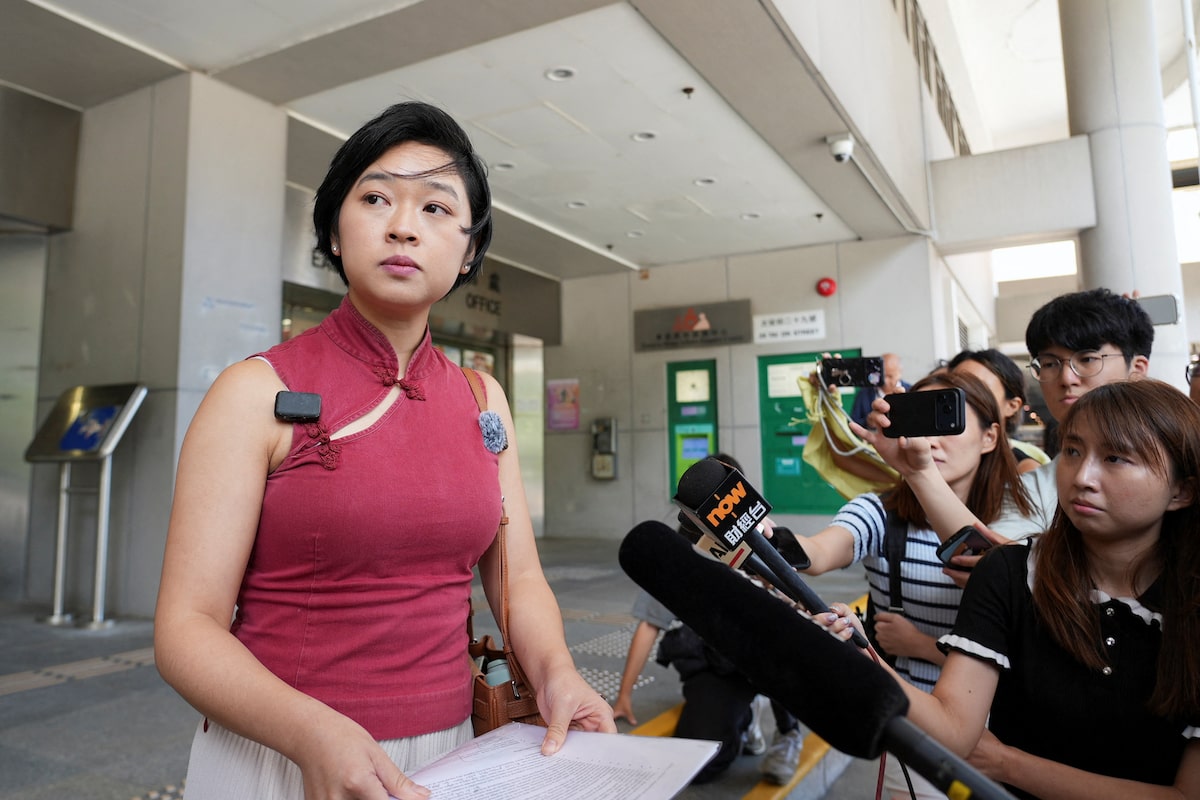
Open this photo in gallery:Former Wall Street Journal journalist Selina Cheng speaks to reporters outside a court in Hong Kong after a hearing on Thursday. The court ruled that her paper's publisher sought to deter her from serving on the union.Joyce Zhou/ReutersThe publisher of the Wall Street Journal was found guilty Thursday of trying to prevent a former employee from becoming head of Hong Kong’s leading journalists union, at a time when press freedom in the Chinese territory is under sustained attack. Selina Cheng, who covered electric vehicles for the Journal, was fired by the paper in July, 2024, weeks after she was elected chair of the Hong Kong Journalists Association. Ms. Cheng said supervisors had ordered her to withdraw from the election and quit the union’s executive committee, on which she had served since 2021. On Thursday, magistrate David Cheung ruled in a Hong Kong court that publisher Dow Jones had prevented Ms. Cheng from exercising her lawful right to become an officer of a registered trade union. However, he cleared the News Corp.-owned company of unlawfully dismissing Ms. Cheng, saying the reason for her firing could not be proved beyond a reasonable doubt. The Journal went through a round of redundancies in May, 2024, moving the bulk of its Asia headquarters to Singapore. Ms. Cheng had survived that culling, and said the company told her how important her position was to its coverage plans, before she was abruptly fired after refusing to stand down from the HKJA role.At the time, Ms. Cheng said it was obvious “the fear and unease the press in Hong Kong have been facing for years now has equally affected the Journal’s management.” “I am disappointed if these editors abroad have come to think press freedom is a controversial issue, as those who wish to intimidate reporters might like us to believe,” she said. “It is not.” The Beijing-based Foreign Correspondents’ Club of China (FCCC) has warned of a “growing trend” in recent years of media outlets blocking or actively discouraging employees from engaging with press groups, such as the FCCC, HKJA and the Foreign Correspondents’ Club, Hong Kong (FCCHK). “We remind media organizations operating in China that freedom of association is a fundamental right and an inseparable element of the press freedoms they publicly advocate,” the FCCC said. The Globe and Mail is aware of at least four British and U.S. media outlets operating in Hong Kong that have previously blocked foreign and local employees from standing for FCCHK or HKJA roles, in cases not made public by the affected journalists. Speaking to reporters outside court, Ms. Cheng said if the employment rights of journalists are not sufficiently protected, “then we can no longer work safely.” “The right for us to work without worry, without stress, without risk, is the foundation of Hong Kong’s press freedom,” she said. That foundation has been shaken in recent years, with Hong Kong plummeting in international press freedom rankings since the passage of a national security law in 2020 and a subsequent crackdown. Independent media, such as Stand News and Apple Daily have closed, and dozens of Hong Kong journalists have moved overseas, while several international outlets have reduced their footprint in the one-time Asia media hub. Foreign journalists have also faced increased scrutiny around visas and growing numbers have been denied entry entirely in cases that are often not made public by the companies involved. Numerous journalists, including HKJA board members, have suffered harassment and death threats in recent years, while the HKJA and several remaining independent media outlets have also faced repeated tax audits among other forms of official intimidation. In February, former Apple Daily publisher Jimmy Lai was sentenced to 20 years in prison after a national-security prosecution widely denounced by press and human-rights groups, the G7 and a United Nations panel. Speaking last month, Hong Kong’s security secretary Chris Tang said Mr. Lai’s case had “nothing to do with press freedom” and denounced the HKJA as unrepresentative of journalists in the territory, with a board made up of “foreign media, so-called free media or online media.” “Regardless of what name or title you use, if you want to engage in acts that endanger national security, collude with external forces, or subvert state power, I will definitely nail you,” he said. Mr. Tang’s criticism came at the time of the HKJA’s most recent leadership election, in which Ms. Cheng was returned as the organization’s chair and took place amid a storm of critical coverage by Chinese state-run media, much of it fed by the security secretary, a potential candidate to be Hong Kong’s next chief executive. James Griffiths is a member of the Hong Kong Journalists Association, and previously served on the union’s executive committee.
Wall Street Journal publisher found guilty of blocking Hong Kong reporter from union role
Full Article
Original Source
Read the full article at Theglobeandmail →KhanList aggregates and links to publicly available news content. We do not host full articles from third-party sources. Always verify important information with original sources.