
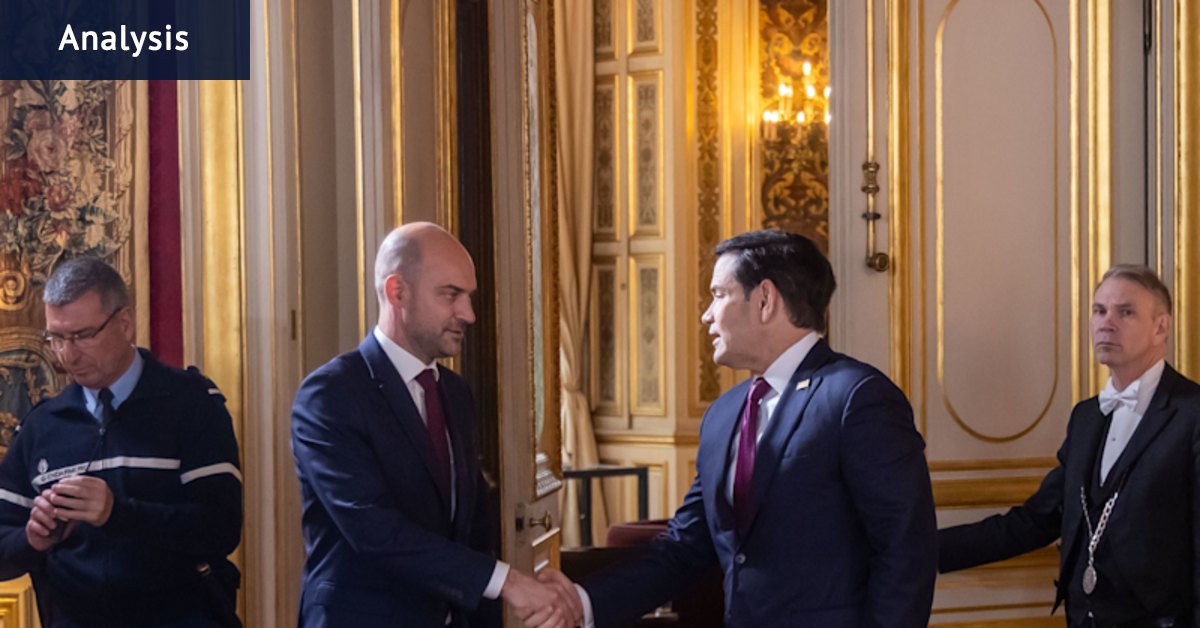
November 10, 2026 — 11:47amParis: European leaders are set for their first stand-off with Donald Trump since American voters turned on the president in last week’s midterm rout for his MAGA movement.Trump thinks he has a deal in the works with Russian President Vladimir Putin that could decide a ceasefire in Ukraine and a new security pact for Europe.But his grand talk is infuriating American allies who believe, with good reason, that any deal on Europe has to be made with Europeans in the room.From left, Germany’s Foreign Minister Johann Wadephul, US Secretary of State Marco Rubio and EU High Representative and Vice-President for Foreign Affairs and Security Policy Kaja Kallas at the G7 foreign ministers summit in Paris on Monday. Brendan Smialowski/POOL AFP via APAnd it is adding even more evidence to the argument that he is a patsy for Putin.The tensions are shaping a G7 meeting in Paris where foreign ministers from the biggest NATO allies are meeting US Secretary of State Marco Rubio. Their message, so far, is that the only way to get a deal that lasts is to maintain pressure on Russia.Behind this message is the entirely rational concern that Trump will happily trade away Ukrainian territory and European security to sign a piece of paper with Putin that promises to end the war.Trump has favoured Putin by halting financial aid to Ukraine, limiting the country’s access to Patriot air defence interceptors, pressuring Ukraine to stop hitting Russian energy targets and easing sanctions on Russian oil exports.Foreign ministers at the G7 (from left): EU’s Kaja Kallas; Germany’s Johann Wadephul; UK’s Ed Miliband; US’s Marco Rubio; France’s Jean-Noël Barrot; Canada’s Anita Anand; Italy’s Antonio Tajani; and Japan’s Toshimitsu Motegi.Brendan Smialowski/POOL AFP via APThe president’s latest comments on Ukraine, made in the aftermath of the midterm election defeat for the Republicans, only deepened the concern that he was a gift to the Kremlin.“It’s going to be very big,” Trump said of the looming deal.“It’s going to involve more than Ukraine, and I could even say it might involve all of Europe. It’s going to be a big, beautiful agreement and everyone’s going to be thrilled.”Rather than dismiss this as standard Trumpian exaggeration, European leaders moved to make sure the Americans did not think they could decide “all of Europe” in talks with Moscow.Polish Foreign Minister Radoslaw Sikorski made a sharp, and entirely logical, case about the limits of American negotiating power. “An arrangement about the future of Ukraine and of Europe above our heads would not just be unwise. It is actually impossible,” he said.Trump only deepened the concerns with his next remark. Speaking on the 60 Minutes program on CBS on Sunday night, he said the deal was “very close” and hinted at what he had in mind for Ukraine.“They’re going to end up with a little bit different shape Ukraine,” he said.Russia offered territoryTrump has repeatedly aired the idea of changing Ukraine’s borders to end the war – basically, by formally granting Putin the territory he has seized by force since 2014.In some versions of the peace plan, Russia not only gains the Crimea (seized in 2014) and the territory it has occupied in the Donbas in eastern Ukraine, but is also granted parts of the Donbas still occupied by the Ukrainian armed forces.French Foreign Minister Jean-Noel Barrot, centre left, welcomes US Secretary of State Marco Rubio during a G7 foreign ministers’ meeting in Paris on Monday.Christophe Petit Tesson/Pool EPAThe meeting of G7 foreign ministers, held on Monday and Tuesday (Paris time), has given European leaders a forum to push back at Trump’s agenda in their talks with Rubio. At the table are foreign ministers from Britain, Canada, France, Germany, Italy and Japan, as well as the US. The European Union is also represented.German Foreign Minister Johann Wadephul sent a clear signal before arriving in Paris.“Europe must be part of the path to a solution,” he said of the war in Ukraine.“It is very clear that Europe doesn’t need a new security architecture, as Russia would have us believe, but simply the restoration of the existing security architecture.”The timing is highly sensitive because Trump has sent his two top envoys, Steve Witkoff and son-in-law Jared Kushner, to the United Arab Emirates this week to meet negotiators from Russia and Ukraine.The talks in Abu Dhabi are the first between the three sides since February and will be held Tuesday and Wednesday (European time).Trump talked up the prospects for success, yet again, in remarks in the White House on Monday (US time), when he said there was a “very strong inclination” to get a deal in Abu Dhabi.Ukraine’s leader Volodymyr Zelensky arrives in Berlin on November 3.Getty ImagesAt the same time, an unnamed US official briefed several media outlets, including Reuters, about the prospects of territory being exchanged as part of a truce. The official said both Russia and Ukraine were showing some flexibility on this key issue.According to Reuters, the official also told reporters that a security guarantee was up for discussion. This is meant to safeguard Ukraine and deter a future Russian attack, although it depends heavily on how binding it might be on Western allies. Trump has never promised a guarantee that would be as strong as NATO, with its Article 5 provision on mutual defence for all members.European leaders have made sure to send negotiators to Abu Dhabi. There will be two senior officials from the European Union as well as national security advisers from Britain, France, Germany and Italy. A senior NATO official is also going.What is not clear, however, is the structure for the talks. It will be in Ukraine’s interest to include the European officials. It will be in Russia’s interest to shut them out. Given that Witkoff described Putin as a “humanitarian” when they spoke in Saint Petersburg last month, who would expect the Trump envoys to stand up to the Russians?Ukrainian President Volodymyr Zelensky has warned against the great powers carving up territory as they did at the Yalta summit during the Second World War. “We don’t want to have Yalta Two. We don’t want to be divided by Russia,” he told CNN.Europe’s position is that Russia, not Ukraine, must make the biggest concessions.“There can be no legal recognition of Russia’s claim to occupy Ukrainian territory,” said EU foreign affairs chief Kaja Kallas at the weekend.“Russia must be held accountable for its war crimes, its violations of international law, and pay for the destruction it has caused. Ukraine’s sovereignty, independence, and the right to choose its own alliances must be respected. There can be no cap on the size of the Ukrainian armed forces. Children deported from Ukraine must be returned home. Russian sabotage across Europe must stop.“In short, concessions should be on the aggressor, not on the victim.”After being stung by voters so badly last week, Trump no doubt wants a deal on Ukraine before he loses control of Congress.Europe, however, is in no mood to give Putin what he wants. And it can point to history to warn that appeasement now will only bring greater conflict later. It can also point to American voters who have decided that, whatever the problem, Trump does not have the solution.Get a note directly from our foreign correspondents on what’s making headlines around the world. Sign up for our weekly What in the World newsletter.From our partners
Voters told Trump what they think. Now Europe wants to stop him being a patsy for Putin
Full Article
Original Source
Read the full article at Smh →KhanList aggregates and links to publicly available news content. We do not host full articles from third-party sources. Always verify important information with original sources.