
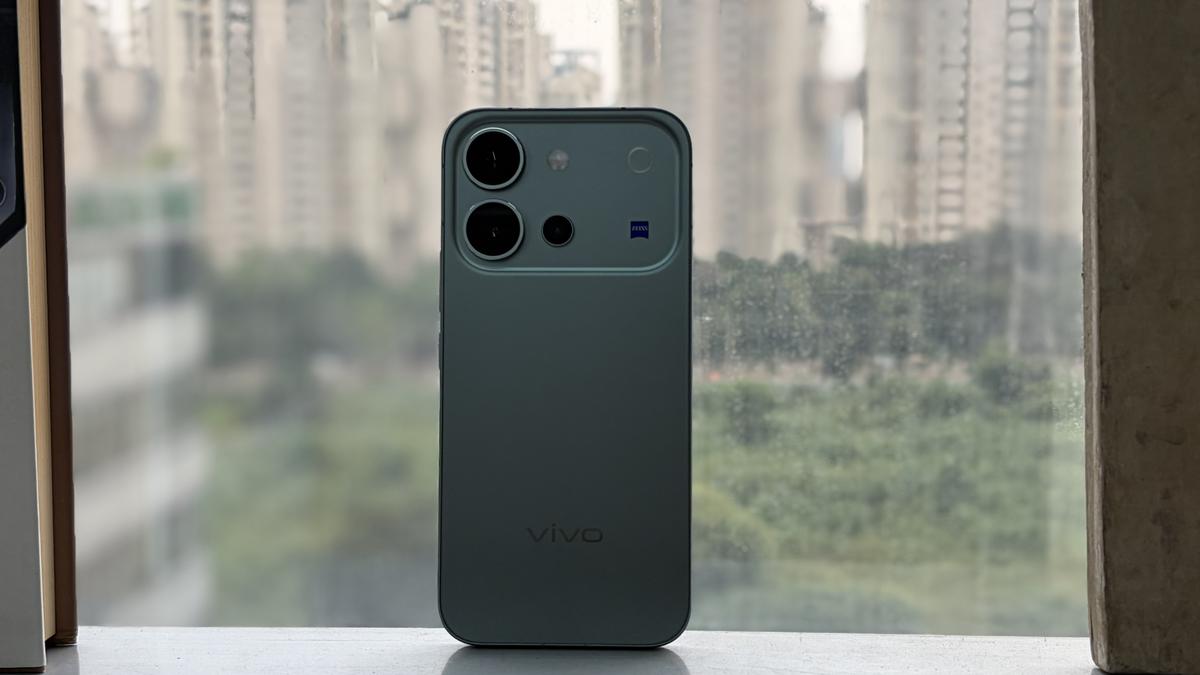
Vivo is back with another addition to its V series, the Vivo V80, starting at ₹62,999.The V series has built a strong identity around sleek designs, capable cameras, and a strong focus on photography, with ZEISS playing a key role in its imaging credentials.Earlier this year, I reviewed the Vivo V70 Elite, which impressed in several areas but found itself in a tricky position because of its pricing. The Vivo V80 enters a similar space, where competition is intense and expectations are high.So, does the Vivo V80 have what it takes to stand out? Let’s find out.DesignThe Vivo V80 looks premium from the first time you pick it up. I reviewed the Horizon Blue version, and its soft finish looks stylish and soothing. The floating camera module adds character and gives the rear an iPhone-like look. The phone measures 7.69mm in thickness and weighs 203g. Despite its 6.59-inch screen, it feels comfortable in the hand. It is wide, though, so smaller hands may need some adjustment. The glass back and aerospace-grade aluminium frame give it a solid feel.The power and volume buttons sit on the right, while the bottom houses the USB Type-C port, speaker and SIM tray. The front looks clean, with 1.25mm bezels around the display. The 3D ultrasonic fingerprint sensor is another useful addition. It feels quick during daily use and avoids the bright scanner spot seen on many optical sensors.Durability is also a point of focus. The V80 gets IP68 and IP69 ratings, along with whole-device drop resistance certification. Stereo speakers, an X-axis linear motor and eSIM support make the package feel more complete. These are not features that immediately grab your attention, but they add to the phone’s everyday usability.Overall, Vivo has done a good job balancing the large screen with a relatively slim body. The V80 is not a compact phone, but it does not feel cumbersome either. The Horizon Blue finish gives it a more refined character than many phones in this segment.DisplayThe 6.59-inch AMOLED display is one of the V80’s strongest features. It offers 1.5K resolution, a 144Hz refresh rate, up to 5000 nits local peak brightness, 1.07 billion colours and P3 wide colour gamut.It looks sharp and vibrant, while the high refresh rate makes scrolling and animations feel fluid. Compared with the V70 Elite, the V80 moves from 120Hz to 144Hz while retaining the same 6.59-inch size, 1.5K resolution and 5000-nit peak brightness claim. The paper-like display and 1-nit ultra-low brightness also help at night.It is a refinement rather than a radical change, but it remains an excellent panel.OS and AIThe Vivo V80 runs OriginOS 7 based on Android 17, and the biggest change you notice is how fluid the interface feels. Vivo has put a lot of effort into animations, and it shows in everyday use. Apps open smoothly, scrolling feels natural, and transitions have a spring-like movement that makes the interface feel more responsive. The 144Hz display complements this well, but the software itself deserves credit for making the phone feel polished.What I liked more was that OriginOS 7 does not make AI feel like a separate menu that you have to hunt for. Some of its useful features sit quietly within the things you already do. For instance, Snap Note can turn a picture of a whiteboard or handwritten notes into editable content. The AI can also separate speakers in recordings and create summaries. These are features that can genuinely save time rather than simply adding another AI badge to the phone.The same approach extends to everyday tasks. AI Search lets you find files or notes by describing what you remember, instead of typing the exact file name. Snap & Go can recognise information from screenshots, such as flight or event details, and suggest adding them to Google Calendar. There is also an AI Call Assistant that can answer calls when you are unavailable and provide a text-based overview later. I found these additions more practical than some of the flashy AI features we have started seeing across smartphones.OriginOS 7 also feels more mature when you look beyond AI. Origin Workbench makes multi-tasking easier by letting you work across multiple windows without constantly restarting tasks. The software supports better connectivity with devices outside the Vivo ecosystem too, including Apple MacBooks, iPads, AirPods and Apple Watches. There is still a learning curve if you are coming from a more conventional Android interface, but after spending time with it, OriginOS 7 feels less like a skin and more like a thoughtfully designed part of the phone.PerformanceThe V80 uses the Snapdragon 7 Gen 4 on a 4nm process. Considering its price, I would have liked a more powerful processor here.My review variant uses 8 GB physical RAM with 16 GB dynamic expansion, along with 256 GB storage. The phone feels smooth during everyday use, with no lag worth highlighting. Vivo also uses a 4300mm² cooling system to manage sustained workloads.The benchmark results, however, surprised me. The V80 scored 1,015 single-core, 3,463 multi-core, 1,603 GPU and 1,110,490 on AnTuTu. The bigger surprise came against the V70 Elite. That phone scored 1,941 single-core, 4,898 multi-core, 9,482 GPU and 1,821,100 on AnTuTu in my testing. So, despite being newer, the V80 is not a performance upgrade over the Elite.Gaming, thankfully, remains good. I played Call of Duty: Mobile, Genshin Impact and PUBG Mobile, and the phone handled them well. Its large cooling system helps sustain performance, while stereo speakers and the haptic motor add to the experience. The V80 is not a performance leader, but gaming is certainly not a weak point.CameraThe camera is still the V80’s biggest reason to consider it. It has a 50 MP ZEISS OIS main camera with Sony LYTIA 700V, a 50 MP ZEISS Night telephoto camera with 3x optical zoom and OIS, an 8 MP ultrawide and a 50 MP ZEISS autofocus selfie camera. Vivo V80 camera sample | Photo Credit: Haider Ali Khan The main camera delivers good clarity, detail and colour. Images look sharp without feeling excessively processed. Night shots are particularly impressive, retaining detail while controlling noise. The large sensor and OIS make a clear difference when the light drops. This is an area where Vivo continues to deliver on the V-series promise. Vivo V80 camera sample | Photo Credit: Haider Ali Khan The telephoto camera adds useful flexibility. Its 3x optical zoom works well for portraits and distant subjects, while 10x zoom-in portraits offer more creative freedom. ZEISS Multifocal Portrait modes add different bokeh styles, and portrait shots showed good subject separation. Vivo V80 camera sample | Photo Credit: Haider Ali Khan The 50 MP front camera captures detailed selfies and supports autofocus. The phone also records 4K at 60fps and offers cinematic modes such as Modern Movie, Vibrant and Pastel. Compared with the V70 Elite, the core camera quality remains strong, while the V80 adds more creative tools and a 50 MP night telephoto camera.BatteryThe 7,200 mAh battery is another major strength. Vivo calls it the largest battery in its V series, and it comfortably gets through a full day with heavy use. The 4th-generation silicon-carbon anode technology helps Vivo pack this capacity into a relatively slim body.The phone supports 90W FlashCharge. Compared with the V70 Elite’s 6,500 mAh battery and 90W charging, the V80 adds 7,000 mAh without increasing the charging power. That makes battery life one of the clearest upgrades here.VerdictThe Vivo V80 preserves the V-series strengths. It has a polished design, excellent display, capable cameras, strong battery life and a more useful AI layer through OriginOS 7. However, the performance results make its positioning complicated, as the V70 Elite remains significantly faster in raw numbers.So, is it a meaningful upgrade from the V70 Elite? Not entirely. The V80 brings a 144Hz display, 7,200 mAh battery, newer software, more AI tools and a stronger creative camera experience. But its lower performance scores prevent it from being a clear generational upgrade.For buyers who value photography, design, display and endurance, the V80 makes sense.
Vivo V80 Review | Preserves the strengths of V series
Full Article
Original Source
Read the full article at Thehindu →KhanList aggregates and links to publicly available news content. We do not host full articles from third-party sources. Always verify important information with original sources.