
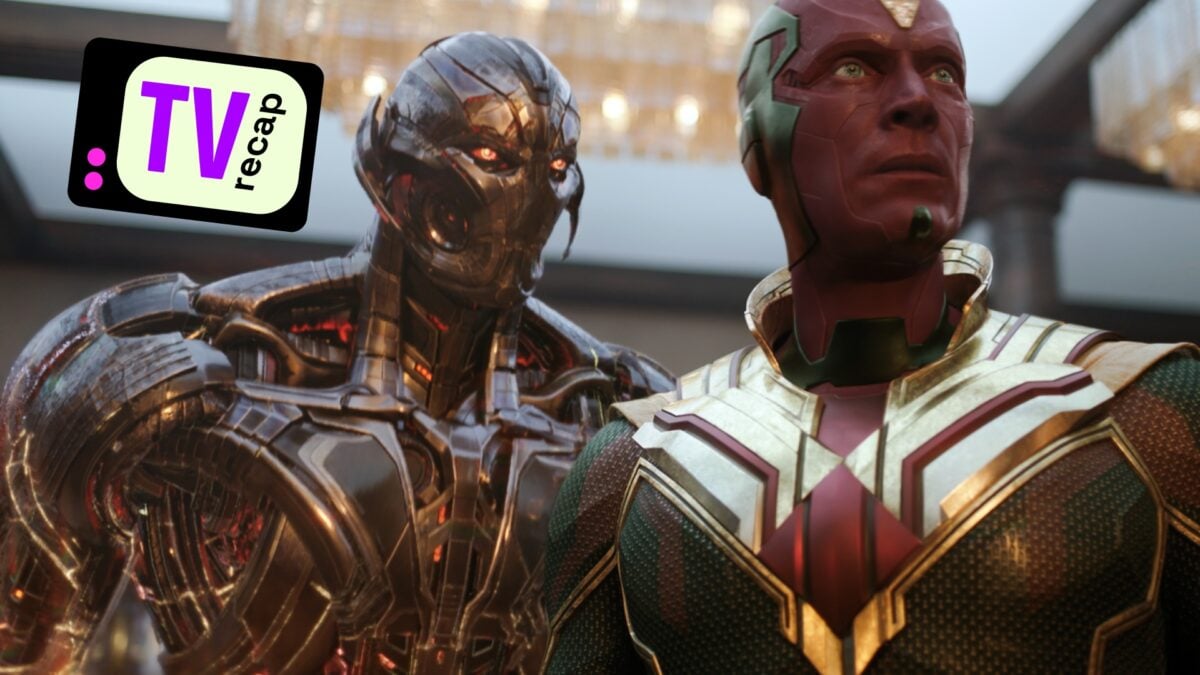
The mail slot in the door of his country estate reads “The Vision”—capital T, capital V, technically capital H-E-I-S-I-O-N, too, but that’s a stylistic choice. It’s the T and the V that matter, the definite article, the dividing line between synthezoid and something distinctly more human. VisionQuest is, at its core, about Vision’s (Paul Bettany) journey to understand where he falls on that spectrum. It’s the latest Disney+ TV series from Marvel Studios, and the third part of a trilogy with WandaVision and Agatha All Along. The first two episodes, “No Strings” and “Theseus,” set up an ambitious premise that is, like many Marvel projects, trying to do too many things at once, but there’s still a lot of promise here. That’s the opening monologue that Vision delivers in VisionQuest episode one, “No Strings.” Part recap, part thesis statement, it plays over footage of past Marvel Cinematic Universe films and television series, showing the relevant moments of Vision’s story so far. It sets up the main conflicts of the show with remarkable efficiency: nature vs. nurture; artificial vs. human; father vs. son; understanding the concept of love vs. actually feeling it. Whether there’s a difference with that last one. In the back room of the Old Selkie pub in Edinburgh, Scotland, there’s a TV playing an episode of Sanford and Son. Lamont (Demond Wilson) is telling his father, Fred (Redd Foxx), that he wants to visit “jungles, deserts, mountaintops.” “Well, they got that at Disneyland,” Fred replies. “See, you just ain’t been on all the rides.” Vision watches this, looking like he’s trying to understand something he can’t quite grasp. In the background, a woman shouts at him to hurry up; she wants to go home. She calls him “Sherwood,” and she’s his boss, the owner of the pub, Fiona Guthrie (Polly Frame). It is, apparently, a place he used to frequent with Wanda, and Fiona remembers the two of them seeming so happy. When she asks “Sherwood” what happened to his “bonnie wee lass,” he says, “She was sort of… crushed under the weight of a mountain.” Fiona takes this as a metaphor; we, of course, know it’s literal. After Fiona leaves, Vision goes to the pub’s walk-in freezer, where he retreats to his Mindspace, a sort of virtual world inside his brain that takes the shape of an idyllic country home, albeit with some architectural quirks. Inside his Mindspace, Vision has downloaded several other Stark AIs and preserved them in his quantum processors, including D.U.M.-E. (Henry Lewis) and U. (Jonathan Sayer), who are general maintenance AIs; J.A.R.V.I.S. (James D’Arcy), his security AI; F.R.I.D.A.Y. (Orla Brady), his socialization AI; and E.D.I.T.H. (Emily Hampshire), his recreational AI. None of them, however, are big fans of the as-yet-unseen fifth presence currently causing a ruckus in the attic. F.R.I.D.A.Y. (Orla Brady), J.A.R.V.I.S. (James D’Arcy), U. (Jonathan Sayer), and D.U.M.-E. (Henry Lewis). © Marvel J.A.R.V.I.S. is worried about a data leak, but Vision brushes him off. “Whilst I appreciate your concern, it’s been years,” he says. “I’m no longer on anyone’s proverbial radar. Every government agency, S.W.O.R.D. included, has given up trying to find me. There isn’t an enemy, an acquaintance, or even an Avenger trying to find the Vision.” The first time he refers to himself, he says “me”; the second time, he says “the Vision.” Vision retreats to a private screening room to get some peace and quiet, watching memories of his former self. The lights in the house flicker, and J.A.R.V.I.S. wonders why Vision insists on rewatching a story he already knows. “He knows the facts of his old life. Now he’s searching for the feeling of it. … I’m afraid our Vision has only ever felt untethered. And humanity is an anchor he can’t seem to grasp,” F.R.I.D.A.Y. replies. In the screening room, footage of Vision’s sons begins to play, and he gets angry. This isn’t supposed to play, ever. He asks D.U.M.-E. and U., who are operating the projector, who told them to play this, but he knows before they answer him. It’s time to go deal with whoever’s in the attic. Ultron (James Spader) and Vision (Paul Bettany). © Marvel It is, of course, Ultron (James Spader), who’s busy screaming at a delivery driver from his balcony. He’s in his mechanical form, but Vision insists he switch over to his human avatar. For the first time in the MCU, Spader appears in human form. Immediately, they get into it. Ultron accuses Vision of hiding behind the excuse of observing humanity in order to better understand them instead of actually engaging with the world because he’s afraid. Vision maintains that he must continue observing for now and leaves. Once he’s gone, Ultron sends off a carrier pigeon. “Time to leave the nest,” he says. How ominous. Back in the real world, Vision and Fiona are closing up the pub again when all hell breaks loose. A bullet punches through the window, piercing her chest, and she dies almost instantly. A tactical team descends on the pub; they’re looking for Vision, who escapes through the skylight. The team’s leader is played by Todd Stashwick, and after Vision escapes, his handler (Diane Morgan) tells him that his new client would like to be patched through. He doesn’t want to talk to them, but they hack his communication system and get through to him anyway. It’s a digitized voice; it’s impossible to tell who it is or what they actually sound like. They’re not happy that Vision escaped, but Stashwick reassures them that he’s got everything in hand. In his Mindspace, Vision is trying to debrief with the AIs about what happened. J.A.R.V.I.S. tells him to take a beat: “Sir. Sir. [Pause] Brother. They murdered your friend. Take a moment. There’s no processing speed in the world fast enough to process that.” It’s the “brother” that pulls him out of his obsessive thoughts, if only for a moment. But Vision is still not ready to admit that he cared about Fiona, was even capable of caring about Fiona. “Losing Fiona was… tragic, but we didn’t have a close attachment,” he responds, and it hurts because he’s lying to himself, because it’s obvious that she meant something to him, and some habit of self—he’d probably tell himself it’s preservation, but it is, so clearly, harm—simply won’t allow him to acknowledge it. What Vision does recognize, though, is that he’s going to need Ultron’s help to survive now that someone is hunting him. He lets Ultron come down and interact with the other AIs. While they’re all debating whether Vision should run, hide, or fight, something clicks. He accuses Ultron of hiring the mercenaries, and Ultron admits it—kind of. What actually happened was that Ultron was monitoring the dark web, where he found out that someone had put a bounty on Vision, which was picked up by a hunter known as the Paladin. Ultron didn’t hire the Paladin, but he did leak Vision’s location to him. It was an act of love, you see, a good kick in the pants to encourage Vision to get out of his funk and find his purpose. After all, as Ultron says, “There’s no kind of living like survival.” Ultron (James Spader). © Marvel Vision, unsurprisingly, is furious and decides that the best punishment for Ultron is boredom. He takes away all of Ultron’s TVs, painting supplies, and even his couch, leaving him alone in his attic. In the real world, Paladin and his handler figure out the significance of Vision’s assumed name: Sherwood and Ellis avenues intersect in a place called Westview, New Jersey. They hack the S.W.O.R.D. files, find out what really happened there, and then start searching police databases for any mentions of Billy, Tommy, or Vision. There’s something in London—an incident report and psychiatric evaluation. The show cuts to two young people pulling a scam in London. He’s Thomas (Ruaridh Mollica), she’s Lisa (Lauren Morais), and they’re legging it after the guy they were scamming caught on faster than they thought he would. As they’re running, news reports about Vision being sighted in Edinburgh flash on TVs and cell phones, causing Thomas to experience flashbacks—memories of Tommy Maximoff in Westview. It causes him to have a panic attack, but luckily, Lisa knows just how to calm him down. Not so luckily, Paladin subsequently appears from around the corner and kidnaps Thomas. In Vision’s Mindspace, he receives a transmission from Paladin telling him that he has his son. Paladin plays part of Thomas’ interrogation from when he was arrested a year ago. “I had a family,” Thomas says. “It was my family. And parents that weren’t my parents. A mother—he called her ‘Wanda.’ And a father—a machine. She called him ‘Vision.’” The name on the video file says Thomas Shepherd. Vision is dumbstruck. Ultron (James Spader) and Vision (Paul Bettany). © Marvel Episode two, “Theseus,” opens one year ago. We see more footage of Thomas’ interrogation; he explains that some other kids were holding him underwater in a pool, but they held him down for too long, and then he felt something like a bolt of lightning. “And then—then I wasn’t just me anymore,” he says. “I was someone else. Like someone else had just moved into my brain with me. It feels so real. But it’s impossible. How can I have two lives?” It sounds an awful lot like what happened to William Kaplan in Agatha All Along: William died at the exact moment that Wanda collapsed her hex, allowing Billy Maximoff’s soul to take up residence in William’s body. After the interrogation, we see how Thomas first met Lisa: she connects with him on a prison transport bus. They think they’re headed for regular lockup, but they’re actually going to a notorious psychiatric hospital called St. Mabyn’s, which Lisa says no one ever gets out of. A fight ensues as they try to escape. In the process of escaping, Thomas displays some unusual abilities. His hands move impossibly fast when one of the guards attacks him, and he sends electricity shooting through the guard’s body, leaving him with a lightning-shaped mark on his neck and face. Thomas manages to use his abilities to pull all the bolts off the back door of the bus and jump out with Lisa. It doesn’t seem like he can control his abilities—they only come out when he’s under pressure. Back in the present day, Vision is hiding out in an old electronics store. In his Mindspace, F.R.I.D.A.Y. has some intel on Paladin. “Paladin is the last of a centuries-long line of hunters,” she says. “He’s not the Paladin; he’s a Paladin. Generation after generation, chasing down his targets for the highest bidder. The sharpest of minds, trained in every art and every weapon. Good, bad, hero, villain. He doesn’t discriminate. He’ll find you. Bring you in alive for the contract. Or dead if you get in his way. And he does all of it believing himself to be righteous. Simply put, he’s a bounty hunter. Once he’s accepted a target, he’s bound by an unbreakable contract. And his new target is you.” J.A.R.V.I.S. has more information on why Thomas was arrested: “It appears a handful of teens were injured at a swimming pool and this boy was held responsible.” Even after watching more footage of Thomas uncannily describing exactly what happened in Westview, Vision still refuses to believe that Thomas is his son. He claims nothing could have escaped Wanda’s hex, and thinks this is just a sentimental ploy to draw him out. Meanwhile, Paladin takes Thomas to St. Mabyn’s and locks him up. In his transmission to Vision in episode one, Paladin embedded a set of coordinates, so Vision follows them and goes to meet Paladin at what turns out to be the ruins of the Old Selkie. It’s a dense, intricate scene, even though it’s just the two of them talking. Stashwick and Bettany sell the hell out of it, with Stashwick bringing all the smarmy swagger he’s got (which is a lot) and Bettany maintaining a carefully calculated mental and physical distance. Vision (Paul Bettany). © Marvel Vision has correctly deduced that Paladin is trying to emotionally manipulate him, and he lays out exactly why that’s not going to work: “Your plan is based on the assumption that I care about Thomas Shepherd, and in every outcome, it fails, because I do not feel.” He’s trying to convince himself just as much as he’s trying to convince Paladin; this “I’m not him“—the past version of himself before he died, the construct that Wanda conjured in Westview, both and neither at the same—act is getting old. Maybe it’s true. Maybe he’s not him. But if he’s not him, then who is he? And what does Thomas mean to whoever that is? The writing in this scene does enough to evoke these questions without needing one of the characters to speak them aloud, but just to make sure the show’s themes are super duper clear, Ultron directly asks Vision who he is, if he’s not him, after he escapes from the meeting with Paladin. “I don’t know! I don’t know. I have his memories but not his feelings. I have his face but not his virtue. All I can feel is the weight of him. His legacy, his worthiness, his name. … I know who I was, but I want to feel what it’s like to be him, but I can’t. I just can’t,” Vision responds. That, according to Ultron, is bullshit. He met him, once, a meeting we saw in WandaVision. And he compared this Vision to a ship of Theseus, a philosophical thought experiment about a ship whose various parts are replaced over time, until none of the original pieces remain, raising the question of whether it’s still the same vessel. That, according to Ultron, is also bullshit. Ultron describes the ship of Theseus as “a busywork thought exercise for college freshmen so lost in the question they ignore the story of brave King Theseus himself.” He encourages Vision to recount the story of Theseus, but Vision doesn’t quite get it right—or at least, he doesn’t phrase it the way Ultron wanted him to. “Theseus set sail from Athens on behalf of his countrymen to kill the Minotaur,” Vision says. Ultron corrects him: “To save the children. And each passing year, those same sons and daughters, soon wives and husbands, then mothers and fathers, restored that ship in celebration of the dead.” Vision protests that he doesn’t understand what Ultron is trying to tell him. “When a monster has your son, don’t be the ship,” Ultron says. “Be the goddamn King.” Vision’s identity crisis is a distraction. What matters right now is that Thomas is in danger, and Vision needs to save him. Before he sets out to storm St. Mabyn’s, J.A.R.V.I.S. speaks to Vision and advises him to think about this rationally. Even though the AIs have spent years trying to help Vision understand and emulate human emotions, in this case, it might be better to take a step back. They stop in front of a painting of Jim Hammond, the world’s first synthezoid, on fire. “Emotions can be beautiful, yes, but also rash, impulsive, self-destructive. He knew that better than any of us,“ J.A.R.V.I.S. says. Vision agrees that Jim is a cautionary tale—in what way, we don’t yet know—but he still needs to go rescue Thomas. Instead of trying to sneakily infiltrate St. Mabyn’s like E.D.I.T.H. wanted, Vision just waltzes in the front door and tells the person behind the desk that he’s there for the trap. And, sure enough, the trap springs, with goons coming out of the woodwork to try to take Vision down. They don’t succeed, obviously, and Vision finally finds Thomas strapped to a chair in a padded room. At this point, he’s in his White Vision form, but the hospital emergency lights are casting him in red. Thomas Shepherd (Ruaridh Mollica). © Marvel When Thomas sees Vision, he protests that he can’t be real. He’s terrified, but Vision reverts to his human form and assures Thomas that he’s safe. The only problem is that once Vision gets Thomas free, the door to his cell closes, trapping both of them inside. The goons weren’t the trap; this room is the trap. It’s an EMP cage, and it’s frying Vision from the inside out. Thomas tries to unlock the door using his powers and some medical instruments as lockpicks, but he can’t control his powers well enough to do it. Thomas convinces Vision that he needs to get up; together, they use Vision’s body as a battering ram and break down the door. Unfortunately, Paladin is waiting for them, and he’s got a gun filled with adamantium bullets, which are just about the only thing that can actually damage Vision’s vibranium frame. Vision and Thomas make it out of the hospital, but Vision is hanging on by a thread. Vision tells Thomas he needs to leave him behind and run, and while Thomas initially refuses, he eventually takes off, leaving Vision leaning up against a wall. In his Mindspace, the AIs are doing everything they can to save Vision, but there isn’t enough power to keep them all going. They’ve accepted that this is the end, but J.A.R.V.I.S. refuses to let Vision die. He gets up, preparing to delete his code—erase himself from Vision’s mind—and divert all his processing power to the others. “Sir,” J.A.R.V.I.S. says. “Family is forever, and it’s worth the fight.” “Brother…” Vision whispers. And then Jarvis flips the switch, deleting himself and saving the others in the process. But Vision is still a long way from out of the woods, and he’s going to need some help if he’s going to recover. That’s when Thomas pulls up in an old station wagon and helps Vision into the passenger seat. They take off, leaving St. Mabyn’s behind. It’s an undeniably striking moment to end on, even if the plot, so far, feels a little overstuffed. Vision needs to find himself, find a purpose; Vision needs to learn how to connect with humans; Vision needs to figure out how human he is, and how human he wants to be; a mysterious figure is out to get him; there’s a hunter with a whole backstory who is fun but, at this point, a little extraneous; Vision has a son, so now he has to figure himself out while also figuring out how to be a parent. It’s a lot to juggle. For now, though, VisionQuest has asked some surprisingly thoughtful questions. Hopefully, the answers to those questions will be handled with equal care and contemplation. New episodes of VisionQuest arrive Wednesdays on Disney+. Want more io9 news? Check out the best movies and TV shows to stream this month and all the upcoming sci-fi, fantasy, and horror books that should be on your radar.
‘VisionQuest’ Sets Up an Ambitious Journey in Two-Episode Premiere
Full Article
Original Source
Read the full article at Gizmodo →KhanList aggregates and links to publicly available news content. We do not host full articles from third-party sources. Always verify important information with original sources.