
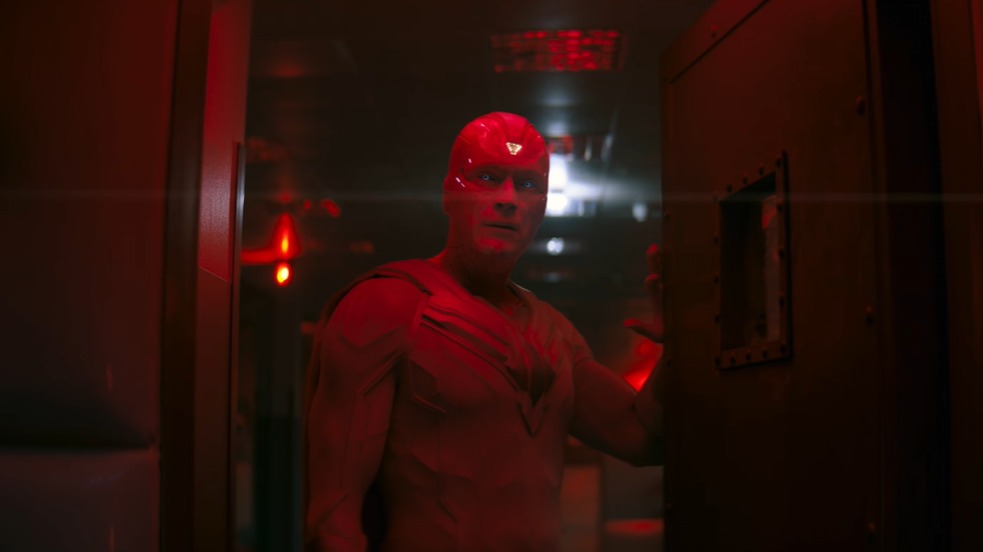
Vision, an android who has spent years trying to understand humanity, now finds himself in the rather ironic position of having to learn what it means to be himself. It is a promising starting point for VisionQuest, Marvel’s attempt to complete the story that began with WandaVision and continued with Agatha All Along. But while the series has plenty to say about identity, memory and artificial intelligence, it occasionally seems more interested in explaining its ideas than making us feel them.Paul Bettany returns as White Vision, the reconstructed version of the character who was killed by Thanos in Avengers: Infinity War and later reassembled without his original memories. Now living under an assumed identity in Edinburgh, Vision is trying to figure out what remains of him when the memories, relationships and emotional attachments that once defined him are no longer entirely his own.His search takes him into his own digital mindscape, where familiar artificial intelligence programmes, including J.A.R.V.I.S., F.R.I.D.A.Y. and E.D.I.T.H., appear alongside a particularly unwelcome presence: Ultron (James Spader). Meanwhile, the series introduces Thomas (Ruaridh Mollica), a teenager whose connection to Vision opens another door into the complicated history of the Maximoff family.There is an intriguing question running through all this: if memories can be transferred, consciousness reconstructed and personality reproduced, what actually makes someone a person? Vision’s predicament offers Marvel an opportunity to explore that question beyond the usual superhero conflict. His struggle is not simply about recovering what he has lost, but deciding what he wants to become. The trouble is that VisionQuest has a habit of burying its most interesting ideas beneath layers of explanation. The series asks one to keep track of multiple versions of characters, their histories, the rules governing their existence and the connections between different corners of the Marvel Cinematic Universe. Some of this mythology is essential to the story, but the constant reminders can make an already complicated narrative feel like homework.The irony is difficult to miss. Vision is trying to explain his own existence to someone who cannot understand it, while the series occasionally leaves its audience in a similar position. Knowing the MCU’s history helps, but familiarity with the franchise does not automatically make every emotional beat land. Bettany remains an engaging presence. There is a peculiar charm to his portrayal of a character who can process vast amounts of information but struggles with the messier business of human connection. His understated performance suits Vision’s uncertainty, particularly when he is forced to confront the difference between remembering an emotion and experiencing it. Yet the character’s introspection sometimes becomes repetitive, with the series circling questions it has already raised without giving them much additional depth.Spader, meanwhile, brings welcome mischief to Ultron. His sardonic delivery and theatrical presence make him one of the show’s more entertaining elements. The dynamic between the two characters gives the philosophical conversations a much-needed spark, even when the dialogue threatens to become overly elaborate.The mindscape is also where the series finds its visual personality. The playful use of AI to shift environments allows the show to experiment with the boundaries between reality and simulation. These sequences have a quirkiness that recalls the inventive spirit of WandaVision, which used its changing television formats to explore grief. Here, however, the formal experimentation is less consistently connected to the emotional story.That is the larger problem with VisionQuest. WandaVision made its central conceit inseparable from Wanda’s grief; the sitcom homages were not merely stylistic flourishes but expressions of her attempt to escape reality. VisionQuest has a similarly thoughtful premise, but its many moving parts often compete for attention. The series wants to be a philosophical science-fiction drama, a family story and a superhero thriller. It can manage each in isolation, but bringing them together is a less assured exercise.The emphasis on family offers some emotional grounding, particularly as Vision begins to consider what his connections mean beyond biology, programming or inherited memories. But the familiar language of sacrifice and chosen family occasionally feels like a shortcut to feelings the series has not fully earned. VisionQuest is not without merit. It gives Bettany more room to explore a character who has too often been defined by his relationship with Wanda or his place among the Avengers. Its questions about artificial intelligence and personhood are timely, and Spader provides some much-needed levity. But ideas alone cannot sustain an emotional journey; the characters must make us care about the answers.By the end, VisionQuest feels like a series that understands the mechanics of humanity better than its emotional texture. There is a heart in there somewhere. Marvel just makes us work a little too hard to find it.The first two episodes of the series are out on Jio Hotstar.- Ends
VisionQuest review: AI adventure has a heart, but struggles to connect
Full Article
Original Source
Read the full article at Indiatoday →KhanList aggregates and links to publicly available news content. We do not host full articles from third-party sources. Always verify important information with original sources.