
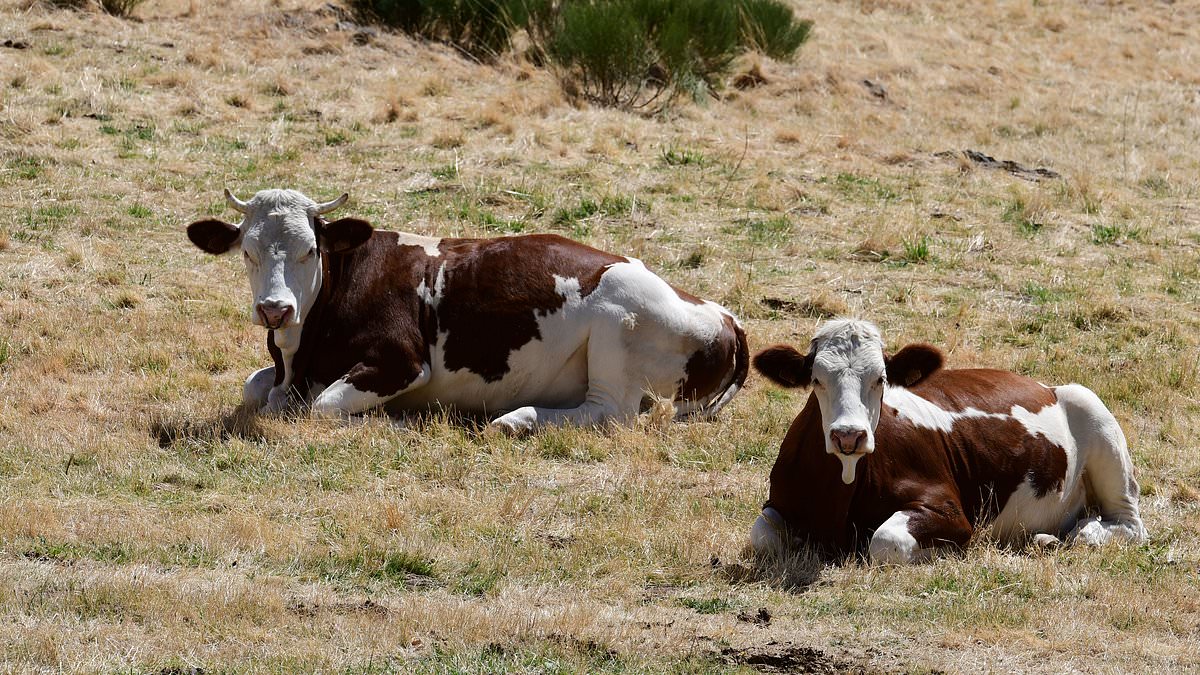
A virus that causes fever, diarrhoea and reproductive problems in cows has been transmitted to a human for the first time.Shamonda virus has been detected in a man in France, who died with the illness in early October.It's believed the victim was bitten by a midge – which can carry the virus – in eastern France, where it had circulated among animals earlier this year, authorities said.Until now the virus, known as Shav, has been considered non-transmissible to humans.Officials said the patient was already 'severely immunocompromised', meaning they were more vulnerable to infections and viruses.And local health officials said it was an 'exceptional case' - stressing that there is currently no risk to the wider public.However, the European Centre for Disease Prevention and Control, and the World Health Organisation, said they were 'carefully monitoring the situation'.Experts also said there is a 'tiny' risk that the virus could 'evolve over time in such a patient to become more transmissible to humans'. A virus that causes fever, diarrhoea and reproductive problems in cows has been transmitted to a human for the first timeShav is primarily found among cattle but cases have also been detected in sheep, horses, goats and alpacas. The virus was first spotted in Europe in July, and has since been found among a host of other locations – including on British isles.Countries that have been affected include Ireland, Austria, Belgium, France, Germany, Italy, Liechtenstein, Luxembourg, the Netherlands, Portugal, Spain and Switzerland.The UK's Animal and Plant Health Agency also confirmed that it was detected among cattle in Jersey just last month.'This confirms the virus is present in the British Isles and in close proximity to Great Britain, highlighting the potential for further spread across north-west Europe,' they said.Local news outlets identified the victim as a man in his 60s living in Lyon, the third-largest city in France with a population of more than 500,000. Authorities said the patient was treated at a nearby hospital with neurological complications – problems that affect regions in the nervous system, like the brain.Horses infected with the virus have reportedly had encephalitis, a life-threatening inflammation of the brain tissue.While the human case is the first of its kind, experts stress that there is no reason to panic.'This is an important scientific finding, as it is the first reported human infection with Shamonda virus,' said Dr Ben Brennan, group leader and senior lecturer at the MRC-University of Glasgow Centre for Virus Research.He added that the virus being found in a person who was 'severely immunocompromised' does not mean 'it poses a significant risk to otherwise healthy individuals'.'At present, there is no evidence that Shamonda virus causes widespread human disease,' Dr Brennan continued.'Based on the information currently available, there is no reason for the general UK public to be unduly concerned.'Paul Hunter, professor in medicine at the University of East Anglia, said the disease 'is primarily a problem in less economically developed countries'.This, he says, means 'we cannot say for certain that no human cases have previously occurred'.'At present we can assume that the risk of onward person-to-person transmission is tiny,' Prof Hunter continued. 'But tiny is not zero.'One of the issues with infections in people who are immunocompromised is that they may not clear the infection.'There is, therefore, the risk that the virus could evolve over time in such a patient to become more transmissible to humans. The fact that this case has died reduces that possibility.'The risk that this virus goes on to cause more widespread problems is very small, but if I was involved in the investigation, I would want to check contacts to make sure no one else has picked it up.'Professor Tom Solomon, director of the pandemic institute at the University of Liverpool, said 'there is still a great deal we don't know'.'We don't know whether healthy people can become infected without developing symptoms, what symptoms the virus might normally cause, or how frequently it might cause serious disease.'Prof Solomon said 'there is no reason for public alarm' but added that the case reinforces the importance of surveillance for emerging infections'.
Virus that causes sickness in cows is linked to death of French man in first ever human case of Shamonda
Full Article
Original Source
Read the full article at Dailymail →KhanList aggregates and links to publicly available news content. We do not host full articles from third-party sources. Always verify important information with original sources.