
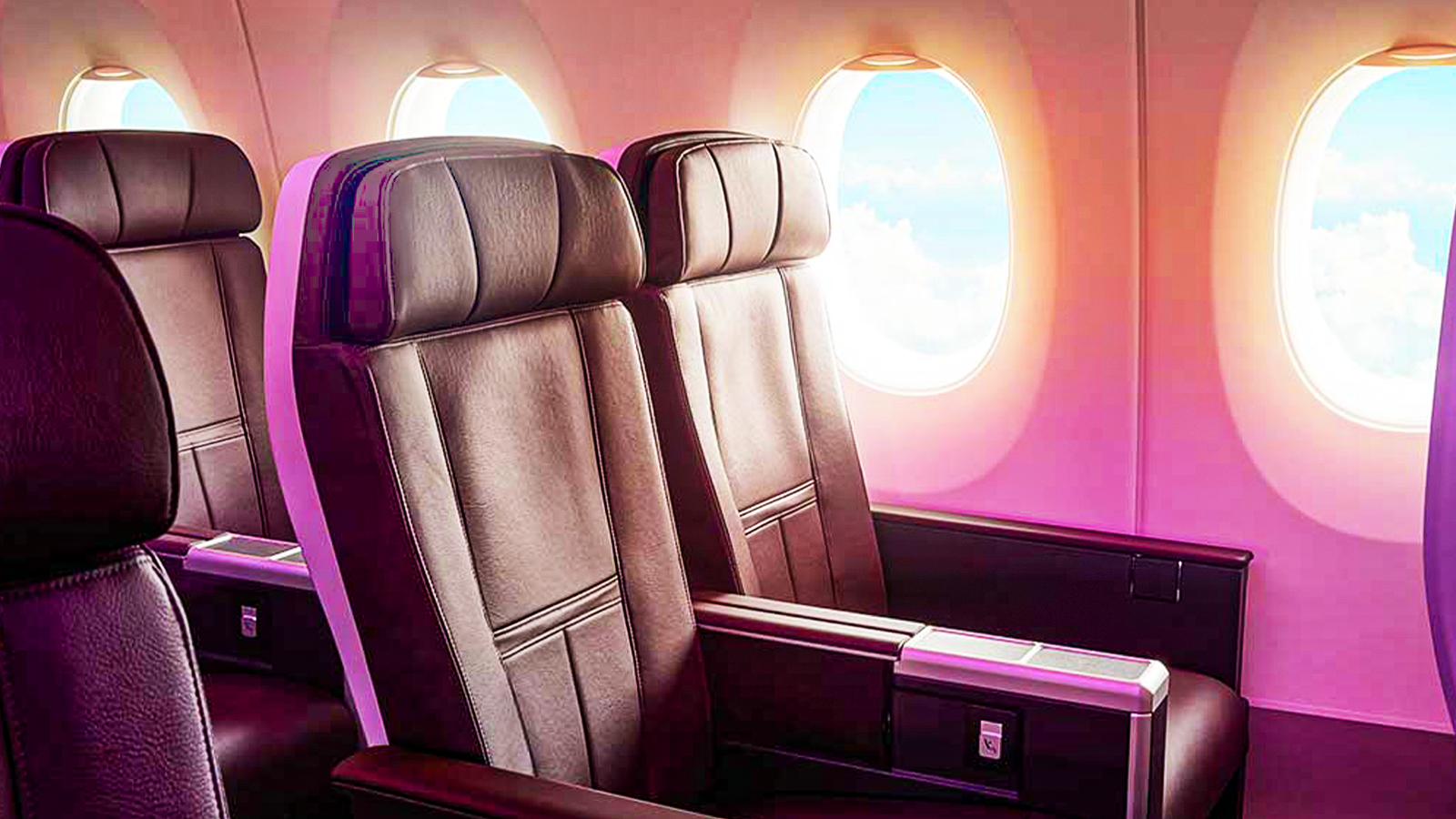
Published Oct 20, 2026, 4:00 AM EDT Paul has had a career of 25+ years focused on the international technology sector, which has taken him to over 100 countries. Along the way, he developed a deep love for aviation, with a travel bucket list measured by aircraft types flown rather than destinations reached. Now he brings that avgeek passion, along with the journalism experience he accumulated early in his career, to write insightful pieces for Simple Flying. Virgin Atlantic's Premium cabin occupies an increasingly important position between traditional Economy and the airline's flagship Upper Class. With up to 38 inches of seat pitch, compared with 34 inches in Economy Delight, passengers receive considerably more than simply additional legroom. Wider seats, upgraded dining, priority boarding and a more generous baggage allowance all contribute to a more comfortable long-haul experience with the premium economy experience on Virgin Atlantic. However, Premium excludes two of Upper Class's most desirable benefits: lounge access and a fully flat bed. For travelers considering whether to upgrade, particularly on daytime transatlantic services, the question is whether those missing benefits justify paying substantially more for business class. Credit: AV8 Photos | Shutterstock Virgin Atlantic offers three distinct Economy experiences, although only Premium occupies a separate cabin. Economy Classic provides a seat pitch of approximately 31 inches, while Economy Delight increases this to as much as 34 inches without fundamentally changing the seat itself. Premium goes further, offering up to 38 inches of pitch alongside a wider leather seat, additional recline, and greater separation from neighboring passengers. The distinction matters because Economy Delight is essentially an extra-legroom version of the standard Economy product, whereas Premium is designed to provide a different long-haul experience. Premium's extra four inches over Economy Delight represent a 12% increase in seat pitch, but the differences extend well beyond legroom. Feature Economy Classic Economy Delight Premium Seat pitch 31 in Up to 34 in Up to 38 in Seat width 17–17.9 in 17–17.9 in 18–21 in Recline 4–6 in 4–6 in 7–8 in Separate cabin No No Yes Checked baggage 1 × 23 kg 1 × 23 kg 2 × 23 kg Premium check-in No Yes Yes Priority boarding No No Yes Priority baggage No No Yes Lounge access No No No Virgin Atlantic advertises between seven and eight inches of recline in Premium, compared with four to six inches in Economy Delight, together with adjustable headrests and footrests or legrests. The increased legroom, wider seat, and increased recline all combine to offer considerably more personal space, making it easier to relax during a lengthy flight, particularly for passengers who would struggle to sleep or work comfortably in Economy. The separate cabin is another significant selling point. Premium has fewer seats than Economy and at least one less seat per row, creating a quieter and more spacious environment. Overall, the product has become an increasingly important part of Virgin Atlantic's long-haul identity, and the airline is continuing to invest in the experience and expand the cabin size as part of its wider fleet modernization program. Not All Virgin Atlantic Premium Seats Are Created Equal Credit: Travers Lewis | Shutterstock Although Virgin Atlantic advertises the same maximum 38-inch seat pitch across its long-haul fleet, the amount of personal space passengers receive depends on the aircraft. The Boeing 787-9 is particularly interesting, with Premium seats measuring up to 21 inches wide, making them substantially wider than the 18.5-inch seats installed on the other widebodies. That difference can be particularly noticeable on longer flights, especially for passengers who value shoulder room. Indeed, Virgin Atlantic's Boeing 787-9 has been repeatedly highlighted as offering one of the widest Premium Economy seats available. The Airbus A330-900 offers a particularly attractive arrangement for couples, with pairs of seats alongside both windows and three seats in the center. Aircraft Seat Pitch Seat Width Configuration Premium Seats Airbus A330-900 Up to 38 in 18.5 in 2-3-2 46 or 56 Airbus A350-1000 Up to 38 in 18.5 in 2-4-2 56 Boeing 787-9 Up to 38 in Up to 21 in 2-3-2 35 Its newer Premium seats include calf-rests, Bluetooth-enabled entertainment screens, and wireless charging, giving the aircraft a technological advantage over older cabins. The Airbus A350-1000, meanwhile, uses a denser 2-4-2 configuration, accommodating eight passengers per row rather than seven. Reviews of Virgin Atlantic's A350 Premium cabin have found the seats comfortable but less generous than those on the 787, demonstrating that newer does not necessarily mean more spacious. Virgin Atlantic is also increasing Premium capacity as part of its broader commercial strategy. Its original A330-900 configuration includes 46 Premium seats, but selected newer aircraft feature 56, alongside 48 Upper Class seats instead of 32. The airline has also announced plans to increase Premium capacity on its refurbished 787-9s from 35 to 56 seats, with the modernization program beginning in 2028. These changes reflect Virgin Atlantic's growing emphasis on higher-yield premium cabins, even as it reduces the number of Economy seats available on some aircraft. Priority Services & Upgraded Dining Complete The Experience Credit: Virgin Atlantic The differences between Premium and Economy Delight begin before passengers board the aircraft. Virgin Atlantic provides dedicated Premium check-in and bag-drop facilities, priority boarding, and priority baggage delivery on arrival. Economy Delight passengers can also use Premium check-in, but do not receive the same boarding or baggage benefits. Premium's allowance of two 23 kg checked bags is particularly useful for travelers taking longer holidays or carrying additional luggage, compared with the single 23 kg bag generally included with Economy Classic and Delight. These benefits can reduce the need to purchase extras separately, strengthening Premium's overall value proposition. Onboard, Virgin Atlantic seeks to deliver something approaching a business-class dining experience without the accompanying fare. Passengers receive a welcome glass of sparkling wine, followed by restaurant-inspired meals with a choice of three main courses. Food is presented on china with proper cutlery and glassware, rather than the more basic presentation generally associated with Economy. The airline's Premium service also includes drinks and additional refreshments throughout the journey, so that overall, the experience is distinguished from simply purchasing additional legroom. Entertainment and connectivity provide further differences over regular Economy, although the experience varies between aircraft. Premium passengers receive personal entertainment screens measuring up to 13.3 inches, together with power outlets, USB connections and improved headphones. The A330-900 additionally features wireless charging and Bluetooth audio connectivity. Adjustable headrests, leg support and a more generous recline also make it easier to settle into a film or work on a laptop. No Clubhouse Access Or Lie-Flat Bed: What Premium Leaves Out Credit: Virgin Atlantic As much as Premium is differentiated from Economy, it is still some way off from Upper Class. Perhaps the most conspicuous difference is lounge access. Despite offering dedicated check-in and priority boarding, Premium tickets do not automatically provide entry to the airline's Clubhouses or partner lounges. This is particularly significant at London Heathrow Airport (LHR), where the flagship Clubhouse in Terminal 3 features restaurant-style dining, a bar, shower facilities and relaxation areas. The Heathrow Clubhouse is a central part of Virgin Atlantic's premium ground experience, but access is principally reserved for eligible Upper Class customers and qualifying frequent flyers, including Virgin Atlantic Flying Club Gold members. Given that Premium passengers can still qualify for lounge access through this eligible frequent-flyer status, that may not actually diminish the value of the Premium offering. The more consequential difference becomes apparent after takeoff. Upper Class passengers can convert their seats into fully flat beds, allowing them to sleep horizontally rather than in a conventional recliner. Feature Premium Upper Class Seat Wider reclining seat Fully flat bed Seat pitch Up to 38 in Bed length up to 79 in Seat width 18–21 in 20–22 in Lounge access No* Yes Checked baggage 2 × 23 kg 2 × 32 kg Dedicated check-in Yes Yes Priority boarding Yes Yes Priority baggage delivery Yes Yes Dining Upgraded meal service Enhanced Upper Class dining Private/fast-track airport services Not generally included Where available The ability to rest properly is particularly valuable on overnight transatlantic flights, when passengers often have only a limited opportunity to sleep before arriving in London the following morning. Virgin Atlantic's Upper Class cabins emphasize sleeping comfort, privacy and personal space, particularly aboard the newer A330-900 aircraft, which feature the airline's most spacious Retreat Suites. Upper Class also delivers additional benefits beyond its bed and lounge access, including a larger baggage allowance, enhanced dining, and access to premium airport facilities where available. On selected aircraft, passengers can also enjoy onboard social spaces, including the A330-900's Loft. These differences explain why the price gap between Premium and Upper Class can be substantial, especially on routes popular with business travelers. Nevertheless, not every passenger needs every benefit. Someone intending to remain awake throughout a daytime flight may attach relatively little value to a fully flat bed, while a traveler arriving shortly before departure might make limited use of the lounge. How Much More Does Premium Cost Than Economy? Credit: Markus Mainka I Shutterstock The financial argument for Premium depends heavily on the price difference between cabins. Some reviews suggest that Premium can be expected to cost approximately twice as much as Economy, while Upper Class may cost several times more than Premium. However, these figures should be treated as broad illustrations rather than fixed pricing rules. Virgin Atlantic uses demand-based pricing, meaning fares can vary considerably depending on route, departure date, booking period and remaining availability. A relatively small Premium supplement might therefore represent excellent value, while a particularly expensive fare could make Economy Delight more attractive. Virgin Atlantic's Flying Club program creates another opportunity to experience Premium without paying the full cash fare. Since introducing dynamic reward pricing in October 2024, the airline has made every available seat bookable using Virgin Points, while offering discounted Saver reward seats on selected flights. Virgin Atlantic Saver Reward Starting Prices Route Economy Premium Upper Class London – New York 6,000 10,500 29,000 London – Miami 7,500 13,500 29,000 London – Orlando 7,500 13,500 29,000 London – Los Angeles 9,000 16,500 41,000 Advertised one-way Saver prices between London and New York begin at just 10,500 points for Premium, compared with 6,000 in Economy and 29,000 in Upper Class. Although availability is limited and taxes and fees must be paid separately, the reward-seat structure creates attractive opportunities for Premium passengers, particularly those prepared to travel on flexible dates. Passengers already booked in Economy may also be able to upgrade to Premium through cash offers. They can also do so via Virgin Points or the airline's bidding system. There are regular examples of successful bids of $200-$300 for an Economy-to-Premium upgrade on a daytime New York–London flight, but minimum bids vary according to the flight and availability, and an accepted bid is never guaranteed. Travelers should also consider the additional taxes and surcharges on reward tickets, which can reduce the apparent advantage of using points. Why Premium May Be The Smarter Choice On Daytime Flights Credit: Ceri Breeze l Shutterstock The strongest case for Virgin Atlantic's Premium cabin arguably comes on daytime transatlantic services. A passenger flying from London to Hartsfield-Jackson Atlanta International Airport (ATL), for example, might spend nine hours onboard without needing to sleep. On such journeys, the benefits of additional personal space, improved meals, priority services and a more comfortable reclining seat are easy to see. Meanwhile, the substantial additional cost of upgrading to a lie-flat bed is much harder to justify. The calculation changes considerably on overnight flights or longer intercontinental journeys. Passengers traveling eastbound from North America often depart in the evening and arrive in London the following morning, making sleep one of the most valuable aspects of the journey. The same applies to lengthy routes such as London to Johannesburg Airport (JNB), covering approximately 5,635 miles (9,069 km), where the ability to lie flat becomes increasingly attractive. Business travelers facing meetings shortly after arrival may therefore find Upper Class worth the additional expense. Virgin Atlantic's investment in more Upper Class suites and larger Premium cabins indicates that the airline sees opportunities to serve both markets, rather than treating the two cabins as direct substitutes. This is because the Premium cabin occupies an increasingly appealing middle ground between Economy Delight and Upper Class. It provides much of the enhanced onboard experience travelers appreciate on long-haul flights, without requiring them to pay for a lounge visit or a fully flat bed they might never use.
Virgin Atlantic's Premium Cabin Gives 4 More Inches Of Pitch Than Economy Delight, But Skips The Lounge
Full Article
Original Source
Read the full article at Simpleflying →KhanList aggregates and links to publicly available news content. We do not host full articles from third-party sources. Always verify important information with original sources.