
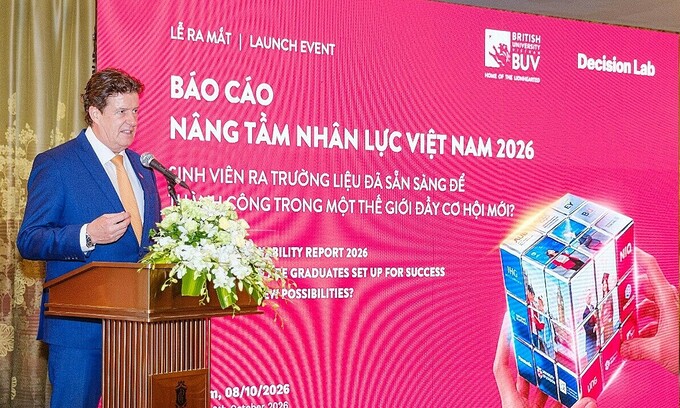
Fresh graduates in Vietnam meet employers' expectations only in digital literacy, while time management and problem-solving show the widest gaps, a survey of 375 companies found. Fresh graduates in Vietnam fall short of employers' expectations in six of seven capability areas, despite growing demand for digital and artificial intelligence (AI) skills, according to the Vietnam Employability Report 2026.Titled "Beware the Gap – Are Graduates Set Up for Success in a World of New Possibilities?", the report was released by British University Vietnam (BUV) and research firm Decision Lab at the International Conference on Educational Cooperation in the Digital Era and Education & EdTech Exhibition (IECEE 2026), hosted by the Ministry of Education and Training.Based on a survey of 375 domestic and international companies, the report examines employers' assessments of fresh graduates and the impact of AI on recruitment. It found that 94% of employers now expect graduates to have stronger digital and AI capabilities than they did two to three years ago. Prof. Rick Bennett, Deputy Vice-Chancellor and Vice President, BUV, speaks at the report launch during IECEE 2026. Photo courtesy of BUV Time management and problem-solving show largest gapsBetween 74% and 86% of employers considered each of the seven assessed capabilities important, but graduates' performance fell short in six areas.Time management recorded the largest gap at 26 percentage points, followed by problem-solving at 23 points. Communication and adaptability gaps stood at 12 and 11 points, respectively. Digital literacy was the only capability in which graduates exceeded expectations, by three percentage points. How AI is changing the criteria for hiring fresh graduates. Graphic courtesy of BUV The report said these weaknesses become apparent when graduates face urgent assignments, incomplete information or tasks requiring coordination across teams. Employers expect them to manage deadlines, flag potential delays and propose solutions independently.More than half of surveyed employers preferred graduates with international degrees, citing perceived advantages beyond English proficiency, including confidence, adaptability in multicultural workplaces and a willingness to question assumptions and present ideas to senior colleagues. Importance versus actual performance of fresh graduates across seven capabilities. Time management and problem-solving show the widest gaps. Graphic courtesy of AI changes recruitment expectationsAI is reshaping hiring criteria, with 83% of employers saying the technology had already changed or was beginning to change their recruitment expectations.However, employers primarily seek practical AI skills rather than advanced technical expertise. While only 3% required AI programming or data analysis skills, 79% expected graduates to use common AI tools effectively or apply them to role-specific tasks.The findings suggest that AI literacy is becoming a basic workplace requirement, while judgment, communication and problem-solving remain important.The report also highlighted limited university-business cooperation. Although 59% of surveyed employers offered internships, only 15% participated in curriculum development, while 23% reported no collaboration with universities.Internships are more effective at developing workplace capabilities when students undertake meaningful assignments, receive supervision and can demonstrate their individual contributions, the report said. It called for stronger partnerships spanning curriculum design, practical training and assessment. How employers evaluate international and domestic degrees, by sector. Graphic courtesy of BUV Degree Plus model aims to address skills gapsIn response to the findings, BUV introduced its Degree Plus model, which combines academic qualifications with structured professional and personal skills development.Under the model, students pursue U.K. university degrees supported by three layers of quality assurance: recognition by Vietnam's Ministry of Education and Training, certification by the U.K.'s Quality Assurance Agency for Higher Education (QAA), and alignment with international standards, including a QS 5-Star rating.Graduates also receive a Global Employment Passport documenting development in three areas:- Professional Skills: Six 12-week modules, including Time Management & Project Management and Applied AI & Digital Literacy. Students can apply these skills through internships and projects with BUV's network of more than 500 corporate partners.- Personal Skills: Five 12-week modules, including Strategy & Problem Solving and Resilience & Adaptability. These modules are included in tuition fees and delivered by accredited training providers in Vietnam and internationally.- International Mobility: Opportunities for international exposure through the university's multicultural campus, overseas exchanges, study programs and internships, supported by more than 80 partner universities across 19 countries. Employers' current expectations of fresh graduates' AI capability. 79% expect application-level use; only 3% require programming skills. Graphic courtesy of BUV BUV said the model aligns with Politburo Resolution No. 71-NQ/TW on education and training development, which emphasizes digital and AI competencies, personal capabilities and global participation."The more powerful technology becomes, the sharper human judgment needs to be. The key question is no longer simply what qualification a student holds at graduation, but what their actual capabilities allow them to do on their first day at work," said Paul Bennett, BUV's chief marketing officer.The university said closing the gap between academic qualifications and workplace capabilities requires cooperation among policymakers, employers, educational institutions and students.Prof. Rick Bennett said BUV would make the full report publicly available and conduct the research regularly to inform discussions on education and workforce development. Paul Julian Bennett (R), Chief Marketing Officer of BUV, presents the report to panelists representing education, industry, and human resources. Photo courtesy of BUV A panel discussion, "Shaping the Talent for the Industry 4.0 Era," explored ways to strengthen university-business cooperation through curriculum development, workplace learning and regular labor-market feedback.BUV said it was the first university in Vietnam to receive a QS 5-Star rating and the first in Vietnam and ASEAN to achieve global accreditation from the U.K.'s QAA. It said its programs combine academic study with practical learning and are regularly reviewed to reflect industry developments.The university also reported that 95% of its graduates secure employment or continue further education within three months of graduation.
Vietnamese graduates fall short of employers' expectations in six key skills: report
Full Article
Original Source
Read the full article at E →KhanList aggregates and links to publicly available news content. We do not host full articles from third-party sources. Always verify important information with original sources.