
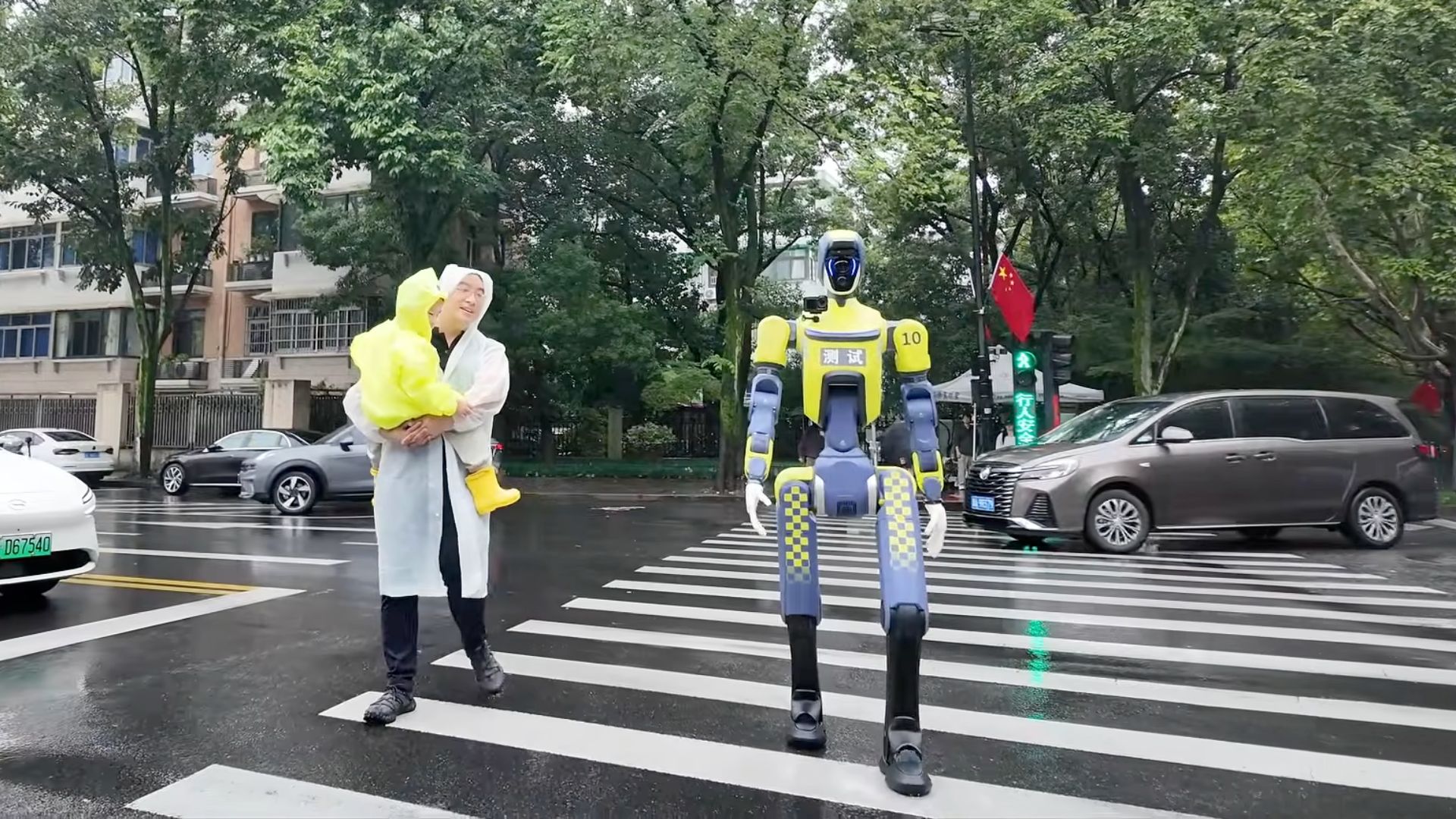
DEEP Robotics has deployed its DR02 humanoid robots to help manage traffic at busy intersections and tourist attractions in Hangzhou, China. The robots were tested in Xihu district in early October, when rain and increased visitor numbers put added pressure on local traffic personnel. They were stationed along major roads and at Xixi National Wetland Park, assisting with traffic direction, maintaining order, and answering basic public inquiries. The deployment demonstrates how humanoid robots could support traffic management in crowded urban environments, particularly during periods of heavy pedestrian and vehicle movement. Humanoids patrol streets DEEP has deployed its DR02 humanoid robots to assist traffic personnel at busy intersections and tourist attractions in Hangzhou, China, testing their ability to navigate crowded streets and interact with the public in rainy conditions. The trials took place in early October, when heavy visitor and vehicle traffic placed additional demands on local traffic crews. The robots operated along Zheda Road and West Wenyi Road in Lingyin Subdistrict, as well as at Xixi National Wetland Park. Their tasks included directing traffic, reminding road users about violations, maintaining order, and answering basic questions from residents and visitors. The deployment provided an opportunity to evaluate the DR02’s ability to combine environmental perception, movement control, and human interaction in a real-world setting. Standing approximately 175 centimeters tall and weighing 143 pounds (65 kilograms), the DR02 is designed to operate in outdoor environments. Its IP66 protection rating resists dust and powerful water jets, supporting operation in wet weather. The robot is also rated to function in temperatures ranging from minus 20 to 55 degrees Celsius, giving it a broad operating range for outdoor duties. Its mobility is another important part of the system. The DR02 can walk at speeds up to 1.5 meters per second and negotiate stairs with rises of about 25 centimeters, as well as slopes up to 20 degrees. These capabilities allow it to move through environments that may include uneven surfaces, changes in elevation, pedestrians, and other obstacles. The robot uses a combination of wide-angle cameras, depth cameras, and light detection and ranging (LiDAR) sensors to perceive its surroundings. These sensing systems provide information about nearby people, vehicles, and objects, helping the machine assess its environment and adjust its movements. Its onboard computing system delivers a reported 275 trillion operations per second, supporting the processing required for perception and movement. Monitor road violations During the trials, the DR02 demonstrated several traffic-related functions. It could remind cyclists to remain behind stop lines, announce when traffic signals turned green, and identify issues such as riders traveling without helmets, overloaded bicycles, and pedestrians crossing stop lines. Rather than issuing fines, the robot used verbal reminders and gestures to encourage road users to follow traffic rules. The system was also tested on public-facing duties beyond traffic direction. At tourist locations, the robots helped manage visitor flow and answered basic inquiries in multiple languages, including questions from residents and visitors. These tasks require the robot to interpret its surroundings while communicating instructions in a way people can understand. The trials are intended to assess how effectively the DR02 can recognize situations, coordinate its movements, and interact with people before any wider deployment. By assigning robots repetitive advisory duties, traffic personnel could devote more time to responsibilities such as accident investigations and enforcement.The Hangzhou tests illustrate a practical application of humanoid robotics that combines mobile navigation, environmental sensing, and public interaction. However, the deployment remains a trial, and its results will help determine how the DR02 could be used in future traffic-management operations.Get the latest in engineering, tech, space & science - delivered daily to your inbox.Jijo is an automotive and business journalist based in India. Armed with a BA in History (Honors) from St. Stephen's College, Delhi University, and a PG diploma in Journalism from the Indian Institute of Mass Communication, Delhi, he has worked for news agencies, national newspapers, and automotive magazines. In his spare time, he likes to go off-roading, engage in political discourse, travel, and teach languages.
Video: Humanoid robots help manage traffic, spot violations and guide tourists
Full Article
Original Source
Read the full article at Interestingengineering →KhanList aggregates and links to publicly available news content. We do not host full articles from third-party sources. Always verify important information with original sources.