
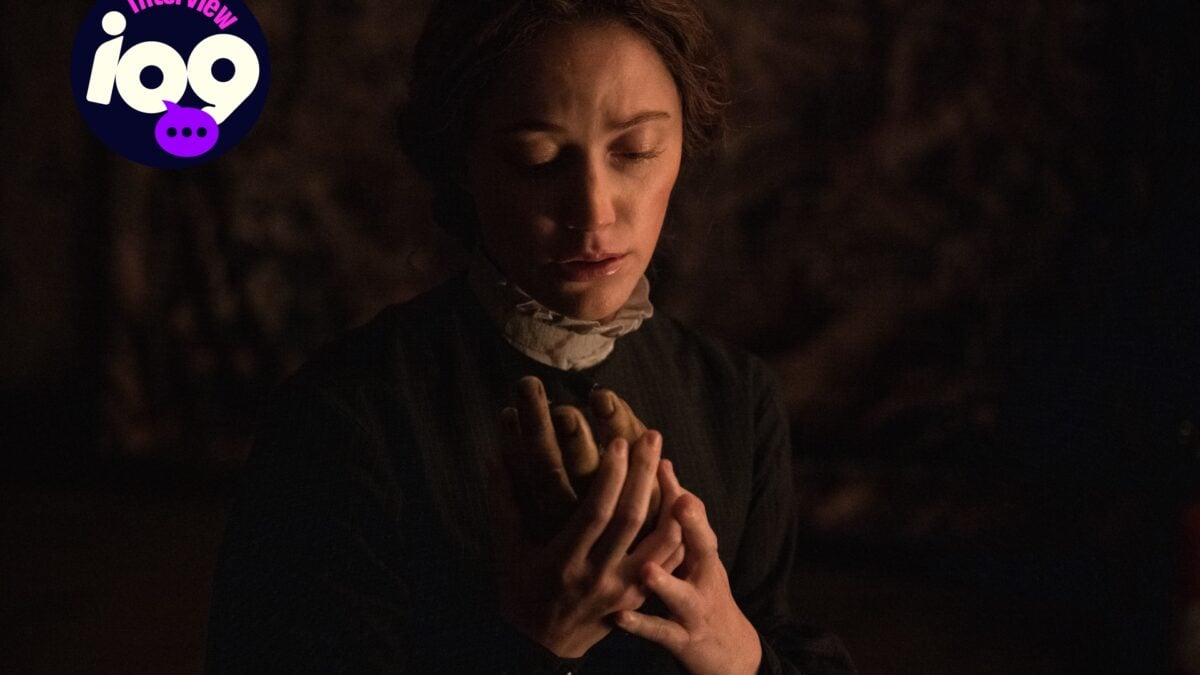
Victorian Psycho arrives in theaters a few weeks past Halloween, but it’s worth extending your spooky season streak to check it out. Maika Monroe stars as a governess named Winifred Notty who arrives at her new gig in a posh country mansion with a sinister past trailing close behind. It doesn’t take long for Winifred’s true nature to begin poking through, and in Zachary Wigon’s film—adapted for the screen by Virginia Feito, who wrote the 2025 novel of the same name—we take an immersive plunge into Winifred’s high-key madness. Ahead of Victorian Psycho’s release, io9 got a chance to talk to Wigon and Monroe about their new horror film. One of its most striking aspects is the sound design, from Winifred’s ever-present voice-over to the way the jittery music cues interact with the visuals. Wigon explained his approach to creating the audio experience of Victorian Psycho. © Courtesy of Bleecker Street “Sound design has the potential to be much more expressionistically conveying the interiors of psychology and of mood than anything that you can do in-picture,” Wigon said. “So with the sound design here, there were really no rules. There were certain motifs that I wanted to have to convey that Winifred is feeling her darkness rising up within her or feeling like her grip with reality is fraying a little bit. There’s a kind of chime-y sound that plays in certain moments when she feels connected to her darkness, and there’s also a kind of staticky sound that we do in moments where you can sort of feel reality slipping away. But basically sound design is one of the great pleasures of filmmaking. It’s pure storytelling; it’s pure expressionism. You can do whatever you want as long as it fits with the vibe of the scene. And I should say, we had an incredible sound editor, a guy named Dan Kenyon, who did both of the Smile films, and it was a real pleasure working with him. He did great work on this.” The camera work in Victorian Psycho is also very distinctive; it offers a glimpse into Winifred’s state of mind, but it also brings a lot of humor. Again, this came from a mix of careful planning and spontaneity. “When the script is finished, that’s when I sit down and write the shot list. And honestly, there’s not much of an intellectual, conceptual basis for that work. It’s primarily intuitive,” Wigon explained. “With this film, I spent about a year developing the script with Virginia [Feito]. So that’s a year that this story is soaking into your bones. You’re really getting a feel for what every scene’s unique character is and what the overall atmosphere of the film is. So by the time that process is done, you’ve been incubating the movie within you, so the shot list is where you kind of turn off your conscious mind, read the script, and you just see what comes to the surface, and then you write it down. And it’s about your feelings about the script, what the scenes need, and then your own visual sensibility, whatever that may be.” Wigon had nothing but praise for the author. “Virginia, to her credit, she was so collaborative. I think the film is fairly faithful to the novel, but she also totally understood that cinema is its own medium with its own rules. She was never precious about anything when we needed to change it, and my hat’s off to her.” Monroe shared those appreciative feelings about Feito. “She’s so lovely. It was nice having her on set because sometimes there’ll be scenes where we want to change the dialogue a little bit, and she was very helpful with that. But otherwise she really just sort of let us do our thing.” Speaking of Monroe, her performance as Winifred is instantly memorable: you’re rooting for her even though she’s terrifying. Monroe also draws on a uniquely alarming array of facial expressions and body language to let us know something is very off with Winifred from the start. Ahead of filming Victorian Psycho, Wigon and his star looked to some nightmarish real-life inspiration to bring their “psycho” to life. A behind-the-scenes moment. © Courtesy of Bleecker Street “One thing that I always find helpful is to talk just generally and broadly about where the character is at over the course of the story. It’s almost an echo of how you work with a writer. You’re talking about where the character is at in the beginning of the movie, where they are at at the end of the movie, and now let’s talk about how they got there,” the director explained. “I would tell Maika my thoughts on what was in Winifred’s head in each scene. We would talk a lot about that. And one thing that was really helpful in getting into the specifics of this was, I sent Maika a video that a forensic psychologist had made, analyzing an interview that Ted Bundy had done,” he said. “The forensic psychologist would pause the interview every so often, and he would point out how Bundy’s facial expressions and tics and whatnot were at odds with what he was saying or belying something about his character contrary to what he was trying to present to the interviewer. I thought that that was really fascinating and really good fodder for an actor to be able to take and run with.” Added Monroe, “We were very lucky because we had a lot of time to do rehearsals. We would do multiple Zooms a week breaking down Winifred, and [her] physicality was a huge part. We studied a lot of videos of actual psychopaths and serial killers that were incredibly helpful and watched certain performances, but we took our time with it to really sort of figure out what worked.” Winifred’s new employers, the Pounds family (the parents are played by Jason Isaacs and Ruth Wilson; the kids are Evie Templeton and Jacobi Jupe), aren’t serial killers, but they’re obnoxious and awful in their own way. These characters help Victorian Psycho further explore and subvert the idea of how proper, high-society people might behave in Winifred’s time. Wigon saw it as “putting one character’s madness into conversation with the accepted madness of a society.” He explained, “There’s a paradox at the heart of the story, which is Winifred is clearly a psychopath, but at the same time, she exists inside a society that has its own accepted, built-in insane and incorrect beliefs. The idea of a character being mad on the outside of a society that has an accepted form of madness—that tension was fascinating to me. I wanted to explore that.” Monroe was also intrigued by these themes. “Obviously it was such a different time for women. Every day I’m wearing a corset for the entire day, and it’s just insanity. I don’t know how they did it,” she said. “But what was so great about this film is that it just kind of turns everything upside down, and you are able to unleash this anger and frustration, and I found it very therapeutic.” Horror fans will recognize Monroe from her many standout roles in the genre, including her wildly divergent star turns in The Guest, It Follows, and Longlegs. Victorian Psycho is a worthy addition to this list, and it sounds like she’s enthusiastic about doing even more. “Horror is a genre that I’ve always loved, but I think especially now it’s come such a long way, with incredible filmmakers stepping into the space, incredible scripts, and some of the most layered roles,” she said. “I think there’s such a freedom within this genre of pushing boundaries, which I really find fascinating. And I think it’s arguably one of the most challenging genres, and it’s very underrated. I think performances are really underrated in this space, and it feels like maybe finally people are starting to pay attention, which is really nice. But I love where the genre is right now. I think it’s pretty incredible.” Victorian Psycho opens in theaters November 13. Want more io9 news? Check out the best movies and TV shows to stream this month and all the upcoming sci-fi, fantasy, and horror books that should be on your radar.
‘Victorian Psycho’ Director and Star on Their Delightfully Macabre New Movie
Full Article
Original Source
Read the full article at Gizmodo →KhanList aggregates and links to publicly available news content. We do not host full articles from third-party sources. Always verify important information with original sources.