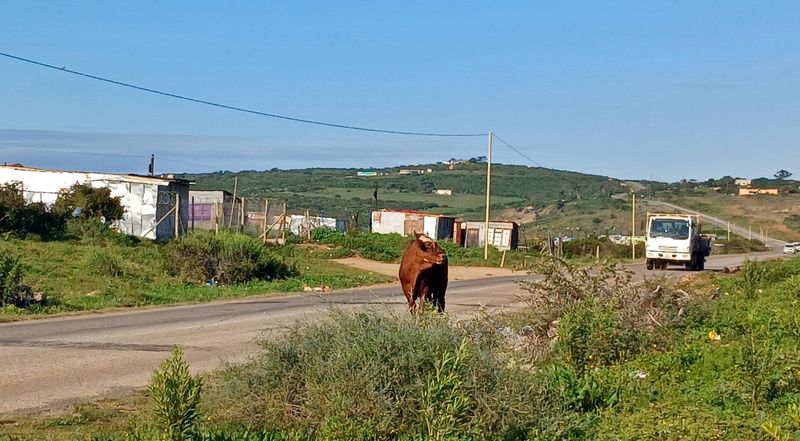
Visiting Nelson Mandela Bay’s municipal animal pound last week (Friday, 7 August) proved to be a lesson in irony.The facility, meant to house the city’s stray animals, sits in an industrial neighbourhood on the outskirts of Kariega. Neighbouring its eastern perimeter wall is a large open field.Last week, a small herd of unsupervised cattle were grazing in the field. No herdsman, no owners, just five stray cows chomping away at the greenery.On the other side of the high wall, the facility was empty. Aside from the dog kennels that were still in use, reports indicated that the pens for stray cattle had not been used in months.When Daily Maverick visited the municipal pound in Kariega on 7 August, stray cattle were grazing on an open field neighbouring the pound. The wall in the background is the perimeter of the municipal facility. However, municipal employees were doing nothing about the stray animals on their doorstep. (Photo: Riaan Marais) And while official municipal comment indicated that a service provider is still in place to manage the pound, employees on the ground said that the contract had lapsed more than a month ago and very little had been happening at the facility since.Under normal circumstances, a picture of stray cattle on the pound’s doorstep would amusing. But the situation is far from normal, and concerns are growing after five separate outbreaks of foot-and-mouth disease (FMD) were confirmed by state veterinary services in Nelson Mandela Bay three weeks ago.Since the outbreaks were confirmed, herds of free-roaming cattle have been seen in these areas, raising alarm bells among experts in the field, who believe more should be done to curb the spread of the animal disease.One of the key counter measures, besides wide-spread vaccination against the disease, is limiting animal movement and utilising a facility, such as the pound, to remove animals that could be carrying the disease from the streets.Upon arrival at the municipal pound last Friday, from the outside the facility seemed deserted. On the signboard next to the main gate several contact numbers had been covered up, indicating that they were no longer in use.Inside the main office building – a container with a single desk – sat a woman who buzzed in visitors. She wore a shirt branded with the Nelson Mandela Bay Municipality logo. En route to the pound, Daily Maverick had found a herd of unsupervised cattle on the side of the R334, right next to Kwanobuhle where FMD had been confirmed.Upon reporting the stray animals to the municipal employee at the pound, she sighed and looked through her phone to find the number for the “animal control unit”. But rather than phone her colleagues, the number was written down and handed over.When told about the five stray cows standing on the open lot next to her office, she pointed at the piece of paper.“You can phone them,” she replied.Reports indicate that the Nelson Mandela Bay municipal pound has neither impounded nor held any cattle for months, and there are conflicting reports about who is currently in charge of operations at the municipal facility. (Photo: Riaan Marais) Asked about the management of the facility and who was responsible for bringing in animals and managing the pound, she said the contract had lapsed at the end of June and the service provider was no longer there. She said it was unclear when a new service provider would be appointed.The previous service provider Busy Bees, which was awarded the municipal pound contract from January to June, found itself in hot water earlier this year and was dragged to court over the treatment of animals at the facility.Municipal spokesperson Sithembiso Soyaya confirmed that the contract had lapsed, but said the pound was still operational.“The municipality continues to manage the operation of the municipal pound while implementing the legally prescribed procurement processes to appoint service providers. It is therefore incorrect to suggest that the facility is not operational due to the expiry of the interim appointment.“The current contractual arrangements continue to be managed in accordance with the applicable procurement and contract management processes. Furthermore, the contractual threshold of R750,000 for the interim appointment has not yet been reached. Operational arrangements remain in place to ensure continuity of municipal pound services,” Soyaya said.He said the municipality has advertised a short-term procurement process, while a three-year contract is out on tender to secure a sustainable long-term solution. “The municipality remains committed to ensuring uninterrupted municipal pound operations while safeguarding the integrity of a procurement process that is lawful, transparent and capable of withstanding legal, regulatory and public scrutiny,” Soyaya added.He provided no response to follow-up questions about the removal or impounding of stray cattle on the property neighbouring the pound.While FMD holds no threat to human health, the disease can be deadly to cattle and other cloven-hoofed animals. Controlling animal movement and strict bio-security measures are crucial to prevent the disease from spreading. However, herds of cattle in Kwanobuhle in Nelson Mandela Bay were left unattended, despite positive reports of the animal disease in the area. (Photo: Riaan Marais) The concerns over operations at the pound was brought into the spotlight after five separate outbreaks of FMD were confirmed in Nelson Mandela Bay three weeks ago.The presence of the animal disease in NMB first came to light during a municipal council meeting on 20 July when Ward 40 councillor Jason Grobbelaar said he had communicated community reports of possible outbreaks to the city manager’s office.He subsequently reported that he received confirmation from the state vet’s office, but public health MMC Tshonono Buyeye denied these claims and argued that his directorate had not received any official confirmation.Shortly thereafter Soyaya confirmed that the municipality was aware of the outbreak, but that its management was in the hands of the state vet and the Department of Agriculture.Deputy director of State Veterinary Services in Nelson Mandela Bay, Dr Lungile Jali, confirmed outbreaks in Bushy Park, Kwanobuhle, Lady Slipper, Motherwell and Rocklands, as well as another outbreak in Thornhill just outside the metro’s border.Since then, according to Jali, instances of animals showing symptoms have been reported in other areas of NMB. Test samples have been taken from these animals to confirm whether or not they are infected with FMD, and appropriate steps will be taken if their results come back positive.Milk SA veterinary adviser Dr Mark Chimes, who also serves on a specialist FMD advisory panel, explained that the outbreak of FMD in Nelson Mandela Bay was very concerning to the broader Eastern Cape and required a concerted effort if the disease is to be curbed.“We know that a vaccination drive has started since the first reports of FMD were confirmed, but vaccination alone won’t stop the spread of the disease. Officials will need to implement serious bio-security and very strict movement protocols to prevent further spread of the disease.”FMD is a highly contagious disease that affects cloven-hoofed animals.Symptoms include hypersalivation; loss of appetite; ulcers and lesions on the tongue and around the hooves; lameness; and a drop in milk production.Fatalities are rare if animals are treated quickly. Younger animals are more susceptible, and most fatalities are among newborn livestock or as result of culling to prevent the spread of the disease. People cannot contract FMD.Chimes said controlling FMD in peri-urban settings, such as townships along the edges of major cities, was particularly challenging as animals within a single herd could have multiple owners and herds are constantly changing and mingling with other animals, including strays.“We have seen quick turnarounds in rural settings as it is often easier to locate owners and communicate the necessary information to them. However, in urban areas, where a herd of a few hundred animals could belong to dozens of different people, effective communication becomes a problem.”He noted with concern the challenges regarding the municipal animal pound and suggested that authorities in Nelson Mandela Bay consider forming a joint operations committee, including law enforcement, traffic control, state vet and other officials who are educated on how to handle the situation and can implement the correct protocols to combat the spread of FMD.“Nelson Mandela Bay is a crucial location as it is in close proximity to major milk production hubs in Kouga and Tsitsikamma. If FMD can be stopped there, it decreases the risk of infection and major losses in the dairy industry,” Chimes added. DM
VEXING VECTOR: Dysfunctional pound adds to growing concerns over foot-and-mouth in Nelson Mandela Bay
Full Article
Original Source
Read the full article at Dailymaverick →KhanList aggregates and links to publicly available news content. We do not host full articles from third-party sources. Always verify important information with original sources.