
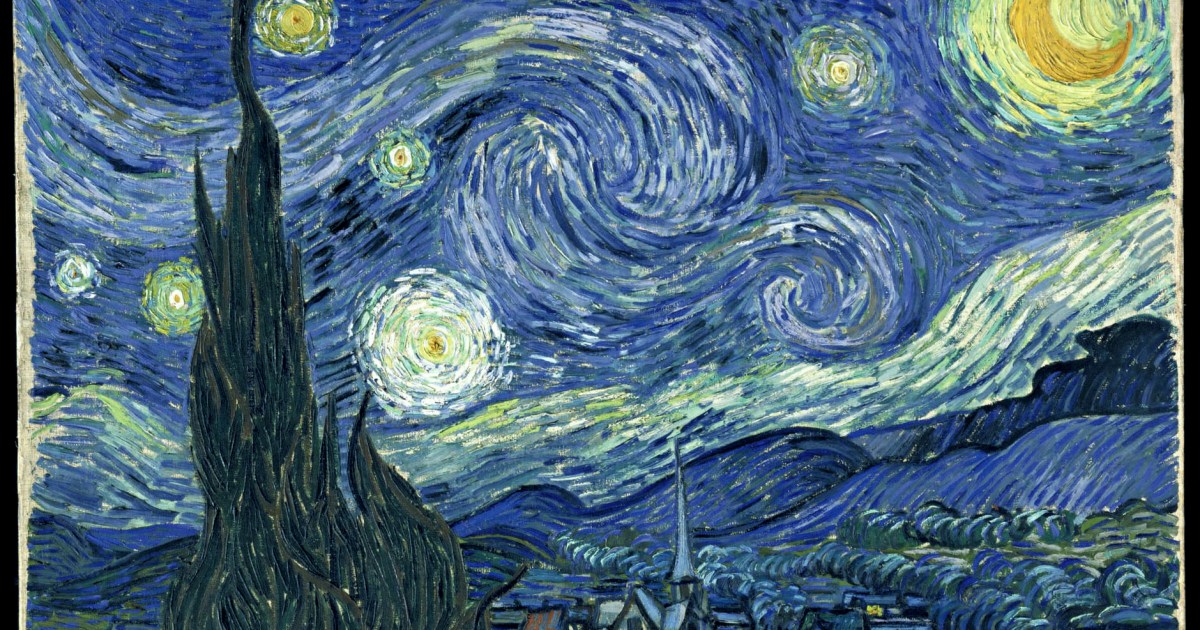
A waning crescent Moon and a cluster of swirling stars fill the predawn sky over Saint-Rémy-de-Provence in Vincent van Gogh’s The Starry Night (1889). A new study argues the scene reflects a real celestial arrangement that Van Gogh could have seen from his window around July 22, 1889. Credit: Museum of Modern Art/Wikimedia Commons For decades, art historians and astronomers have wondered whether the sky of Vincent van Gogh’s The Starry Night shows real stars or imagined ones. A new study argues the stars are real — and that Van Gogh likely saw them a month later than most scholars thought. The study, published Oct. 22 in Scientific Reports, comes from a team led by Elijah Jeong-hyun Kim, CEO of the South Korean telescope maker SLLAB and a Ph.D. candidate at Kyung Hee University’s School of Space Research in Yongin. By combining astronomical data, historical primary sources, and statistical analysis, the team narrowed the celestial alignments shown in the painting’s sky to a handful of late-July mornings. They further suggest Van Gogh likely painted the eastern sky as seen from his asylum room in Saint-Rémy-de-Provence, France, around 3 a.m. on July 22, 1889. That morning, a waning crescent Moon, Venus, and the Hyades — the V-shaped star cluster in Taurus the Bull — were all gathered in the same small patch of sky. RELATED: Exploring the solar system through space art The case for June In May 1889, Van Gogh admitted himself to the asylum of Saint-Paul-de-Mausole, a former monastery outside Saint-Rémy. The previous December, after a falling-out with fellow painter Paul Gauguin, he had cut off his left ear, and more breakdowns followed. At the asylum he kept working, producing some 150 paintings, including famous works like Almond Blossom and The Starry Night. On June 18, he wrote to his brother Theo that he had begun “a new study of a starry sky.” For most scholars, that line anchored the painting to the mid-June sky. In 1984, art historian Albert Boime argued the painting likely shows the dawn of June 19, with the constellation Aries at its center. Two years later, astronomer Charles Whitney used weather records to rule out the 19th and suggested the sky was actually a composite. With the two theories at odds, the idea that Van Gogh painted real stars faded to what the authors call a “marginal minority view.” Most scholars granted only that the bright point near the horizon was likely Venus. Kim’s team thought the stars were most likely real, and that the early studies were incomplete. No one had tested the painter’s field of view, the shape of its pattern of stars, and the historical record together. Plus, on the morning of June 19, the Moon was a waning gibbous, past half and nothing like the slim crescent depicted on the canvas. Proof of concept Rather than assuming a date, the researchers asked whether the sky Van Gogh painted could occur, and when. Their method has two core steps. First, they compare a painted sky with astronomical simulations to see whether its arrangement is even possible. Then, they use a statistical method that measures the similarity between two shapes — called Procrustes analysis — to see how faithfully the painting’s star patterns matched real ones. When more historical data is available, the team also works to reconstruct the artist’s field of view from the landscape and check candidate dates against weather records and letters. As a proof of concept, they applied the method to a handful of other night paintings. A 2011 study had argued that the stars in German painter Adam Elsheimer’s 1609 The Flight into Egypt weren’t copied from a single real sky, and the team’s test agreed. The painting’s Big Dipper sits at an angle to the Milky Way that never occurs in the night sky. French painter Jean-François Millet’s Starry Night, painted between 1850 and 1865, has no letters, weather records, or known painting site to draw on, so the team ran only the core astronomical tests. The painting’s depiction of Orion — including the bright star Rigel — and Sirius revealed the tightest fit of any painting in the study to an actual star pattern. Van Gogh’s own 1888 Starry Night Over the Rhône and Café Terrace at Night were next. Because their painting sites in Arles still stand and his letters and local weather records survive, they got the full treatment. The Big Dipper in Starry Night Over the Rhône matched the real sky with what the authors call “relative precision,” and the Summer Triangle in Café Terrace at Night fit even more closely. RELATED: How Galileo blended science and art before his death 380 years ago It’s a match Then came The Starry Night. Van Gogh is thought to have based the painting’s village on an earlier sketch he had completed of Saint-Rémy. After locating a ridge near the asylum whose view matches the drawing, the team found the sketch captures a zoomed-in slice of the landscape. Measured diagonally, from one corner of the frame to the opposite corner, the field of view spans about 18°. They then made an assumption: that Van Gogh likely framed the painting’s night sky the same way. If he did, there should be a morning on record when the Moon, Venus, and a recognizable star pattern all fit inside that narrow frame and are arranged as painted. Only three dawns in June and July 1889 put the Moon above Venus, as in the painting, inside that field of view: June 23, July 22, and July 23. Only the July mornings also placed the Hyades in view, and on July 22, the Moon and Venus sat in opposite corners with the cluster in between. At the center of the canvas, a cluster of stars forms a lopsided V that closely resembles the shape of the Hyades cluster. But any handful of dots can coincidentally look like a V. The team had to evaluate whether these stars were intentionally painted as the Hyades or just happened to resemble the cluster’s shape. They reasoned that if Van Gogh had painted the real cluster, each painted star should have a real counterpart in the same spot. That is, the star at the point of the painted V should match the star at the point of the real V, and so on down each arm of the cluster. Matching them up that way should give a better fit than any other possible combination. So the team tried every possible way of pairing the five painted stars with the five real ones — 120 combinations in all — and measured how well each fit. The natural, point-to-point pairing was the most accurate. The match was close, but it wasn’t perfect. Of all the paintings the team tested, The Starry Night fit its stars with the lowest statistical accuracy. The authors also acknowledge that a close shape match alone can’t identify a star group. Some other constellations score as well or better and are ruled out only by other evidence, such as where they sat in the sky that morning. Nevertheless, the combined evidence still suggested July 22 as the most likely date. One objection to this scenario remained. Historians have long held that a severe seizure in mid-July left Van Gogh unable to work. But after rereading his letters alongside weather records from that summer, the team argues the seizure may have struck later, in the last week of July, leaving Van Gogh free to watch the dawn sky on July 22. Five stars at the heart of The Starry Night (top left) and in Van Gogh’s hand-drawn copy (bottom left) trace the same V shape as the Hyades star cluster, shown at right in a simulation of the sky over Saint-Rémy before dawn on July 22, 1889. Venus and the crescent Moon flank the cluster, and the painted V even leans at nearly the same angle to the horizon as the real one did that morning. Credit: Kim, E.Jh., Kang, S., Song, J. et al. The actual sky of Van Gogh’s Starry Night: a multidisciplinary reconstruction. Kim et al., Scientific Reports, https://doi.org/10.1038/s41598-026-73025-5 Looking ahead The authors argue that the fact that so many clues converge on one morning makes it “hard to reconcile with the premise that the sky on the canvas is an arbitrary creation.” The simpler explanation is that the painting’s sky is rooted in actual observations of the sky on that morning in July — and the burden of proof now falls on anyone who says Van Gogh invented it. Because the core test needs nothing but the star positions, the team argues it could be turned on other night paintings, including many no one has yet examined. “I hope this work prompts a renewed, multidisciplinary look at the sequence and working methods of the Saint-Rémy paintings, and at Van Gogh’s movements that summer,” Kim said in a statement. “Our conversation with Van Gogh’s other skies is still ongoing. We plan to tell those stories one by one.” See for yourself Stellarium, the free planetarium software the team used to cross-check its simulations, lets you simulate the night sky from any place and date. Enter Saint-Rémy-de-Provence, France, and set the clock to a couple hours before sunrise on July 22, 1889. If the sky looks too bright, turn off the atmosphere in the view settings (or press the keyboard shortcut, A). Then search for the Hyades cluster. Brilliant Venus sits on one side, a slim crescent Moon slightly higher on the other, and between them the V of the Hyades. You can scroll through the hours to watch the scene wheel up from the horizon before dawn. Then step back a day to July 21, or ahead to July 23 and 24, and watch the Moon slide toward Venus. Or compare the view with June 19, the date Boime proposed, and judge for yourself which sky best fits the canvas. Brooks Mendenhall is a staff writer at Astronomy, based in Chattanooga, Tennessee, fueled by an unending curiosity about the universe. A former classroom teacher, he has a knack for breaking down complex concepts for a wide audience.
Van Gogh’s Starry Night shows a real night sky, study suggests
Full Article
Original Source
Read the full article at Astronomy →KhanList aggregates and links to publicly available news content. We do not host full articles from third-party sources. Always verify important information with original sources.