
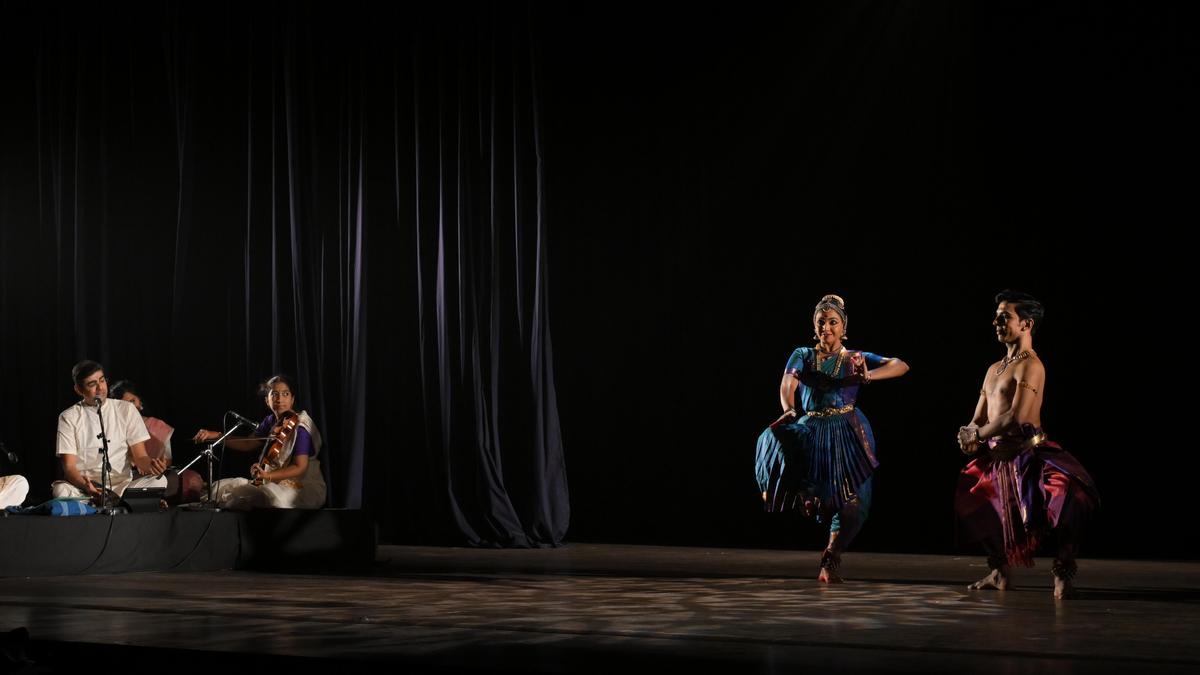
Vaggeyakara Bharatham featuring Sikkil Gurucharan (vocal) with Guru Bharadwaj (mridangam), V.S.P. Gayatri Shivani (violin) and Indu-Nidheesh | Photo Credit: V. Umesh Kumar ‘Vaggeyakara Bharatham’ is a well-known performance series that brings together eminent artistes from the worlds of Carnatic music and Bharatanatyam on the same stage. In its sixth edition, held at Narada Gana Sabha, it featured vocalist Sikkil Gurucharan alongside dancer-couple Indu Nidheesh and Nidheesh Kumar. It was an evening of collaboration that explored and expanded boundaries.The performance commenced with an invocation as Gurucharan rendered Muthuswami Dikshitar’s ‘Sri gananatham bhajare’ in Eesamanohari raga, Rupaka tala. This was followed by select verses from Kalidasa’s Shyamala Dandakam set to music by Gurucharan in Lalitha and Devagandhari ragas, across Adi and Rupaka talas. Verses from Kalidasa’s Shyamala Dandakam were chosen to depict the beauty of goddess Mathangi. | Photo Credit: V. Umesh Kumar Indu and Nidheesh first took the stage to delineate the beauty of goddess Mathangi, hailing her as the mother who blessed Kalidasa. The remaining verses, interspersed with sollu and swaras, were performed by their disciples, whose precise footwork and neat formations stood out. Next came ‘Sri rama padama’, a Tyagaraja kriti in raga Amritavahini, known for its swaraksharas, and a rarely performed song in Bharatanatyam. Choreographed by Nidheesh with finesse, the piece featured a jathi structured by Guru Bharadwaj.‘Pankajakshi pai’, the grand tana varnam in Kamboji, composed by Maha Vaidyanatha Iyer and Ramaswami Sivan, served as the central piece of the presentation. Equating the eyes of the nayika waiting to get a glimpse of Subrahmanya to a lotus that finds its way up through the depths of a pond, blooming only in the presence of the sun, Indu and Nidheesh juxtaposed the two parallel ideas effectively on stage. Indu Nidheesh and Nidheesh Kumar effectively juxtaposed two parallel ideas — the nayika’s longing for a glimpse of Lord Subrahmanya and a lotus blooming only in the presence of the sun. | Photo Credit: V. Umesh Kumar The first two jathis were composed by K.P. Rakesh and the last two by Nidheesh, who, along with Indu, depicted the story of Subrahmanya’s birth during a brief, riveting tanam sung by Gurucharan within the framework of the varnam. Despite a few inaccuracies and coordination gaps, the duo effectively delivered the essence of the varnam.Perhaps the most experimental piece of the evening was the simultaneous exploration of two songs with contrasting perspectives on anger — Dandapani Desikar’s ‘Sinam adaiyaade’ in Bahudari that cautions against the emotion, and Madhan Karky’s ‘Sinam kol maname’ in Vasantha, which envisions anger as a transformative tool. Gurucharan’s transitions between Bahudari and Vasantha were effortless, faithfully followed by the violinist and mirrored by Indu and Nidheesh through their nuanced portrayal. Students of Indu and Nidheesh Kumar performing at ‘Vaggeyakara Bharatham’, organised by Narada Gana Sabha. | Photo Credit: V. Umesh Kumar Next came Thanjavur S. Kalyanaraman’s lilting tillana in raga Gaavati, beautifully rendered by Gurucharan. Choreographed by the dancer-couple and presented by their disciples, the piece was filled with intricate nritta patterns that occasionally felt a little excessive. To conclude, Bharatiyar’s ‘Vaazhiya senthamizh ’, featuring stanzas not usually sung on the concert stage, was presented as the mangalam.Providing competent support throughout the performance was the ensemble, comprising K.P. Rakesh on the nattuvangam, Guru Bharadwaj on the mridangam, V.S.P. Gayatri Shivani on the violin and Rithi Murari on the sruthi. The lighting was noteworthy. Published - October 28, 2026 03:16 pm IST
Vaggeyakara Bharatham: When two traditions spark new possibilities
Full Article
Original Source
Read the full article at Thehindu →KhanList aggregates and links to publicly available news content. We do not host full articles from third-party sources. Always verify important information with original sources.