
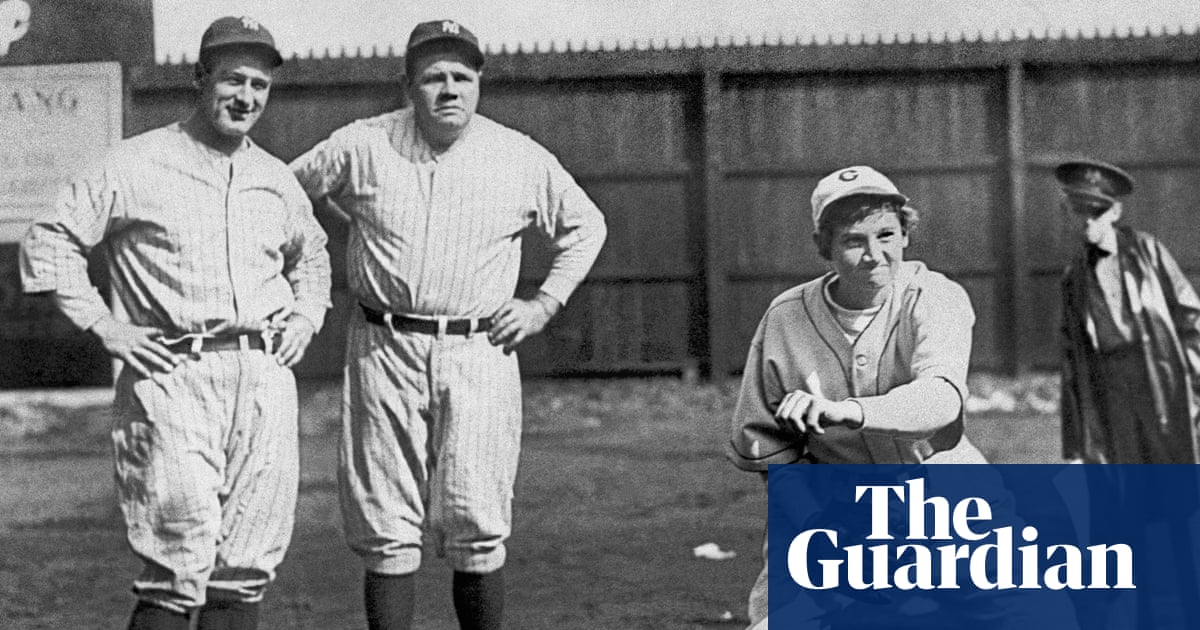
The Sultan of Swat sounded exasperated. “I don’t know what things are coming to,” Babe Ruth sighed during spring training in 1931.“I don’t know what’s going to happen if they begin to let women in baseball,” he elaborated to reporters. “Of course, they will never make good. Why? Because they are too delicate. It would kill them to play ball everyday.”The next day, Ruth and Lou Gehrig were struck out back-to-back by a 17-year-old girl.Making their way home from preseason in Florida, the New York Yankees had stopped off in Tennessee for an exhibition game against the minor-league Chattanooga Lookouts. The Lookouts handed a debut to a promising young pitcher with precise control, a quirky side-arm delivery and a vicious sinker. Her name was Jackie Mitchell.The strikeouts of two all-time greats sparked still-ongoing debates over the legitimacy of Mitchell’s achievement and the general lack of opportunities for female players.Mitchell was summoned from the bullpen in the first inning. In front of a 4,000-strong crowd, Ruth, an Associated Press reporter wrote at the time, came to the plate with “a wry smile playing at the corners of his mouth”. A New York Times writer implied that it was all theater: “The Babe performed his role very ably. He swung hard at two pitches then demanded that Umpire Owens inspect the ball, just as batters do when utterly baffled by a pitcher’s delivery.”Lou Gehrig, Jackie Mitchell, Joe Engel and Babe Ruth pose before the Yankees played the Chattanooga Lookouts in a 1931 exhibition. Photograph: Everett Collection Inc/AlamyRuth struck out looking and was said to have hurled his bat while somehow “registering disgust with his shoulder and chin”. Gehrig then struck out after “three hefty swings”. Mitchell came out of the game after walking the next batter, Tony Lazzeri, and the Yankees went on to win 14-4.Asked in a postgame press conference if the strikeouts were genuine, Mitchell was reported to have “retorted with a gaze of utter scorn and a contemptuous silence”. As Lapham’s Quarterly noted, Ruth and Gehrig enigmatically kept mum on the matter.There is cause to be suspicious. The occasion had been scheduled for April Fool’s Day, though it was postponed by a day because of bad weather. And the Lookouts were run by a tireless promoter and showman known as the Barnum of the Bush Leagues. A former Major League Baseball pitcher and scout, Joe Engel became president of the Lookouts in 1929 and opened a new ballpark - Engel Stadium - the following year.Desperate for publicity as he sought to boost attendance during the Great Depression, Engel made the Lookouts the Savannah Bananas of their era.He famously traded his shortstop, “Binky” Jones, for a turkey “because the turkey was having a better year”. He then served the bird to critical sportswriters, offering them a free lunch and telling them, “You’ve been giving me the bird, so now have one on me.”So Mitchell’s signing was undoubtedly an exploitative publicity stunt, but that does not necessarily mean that the strikeouts were staged. (Though Engel did have an affinity for hoaxes: he would later pretend to carry out a phone call with Adolf Hitler at home plate for the entertainment of a wartime crowd.)One explanation promulgated at the time by male sportswriters was chivalry: it would have been ungentlemanly to have humiliated the kid by launching the ball into the stratosphere. “Babe Gallantly Strikes Out For Benefit Of Girl Hurler,” read one headline. But that explanation does not take into account professional pride. While being struck out by a girl might have appealed to the media-savvy Ruth’s sense of fun, Gehrig was a more earnest character. And Mitchell clearly had talent.Jackie Mitchell learned the basics of baseball from her father. Photograph: Everett Collection Historical/AlamyBorn in Chattanooga on 29 August 1913, the 5ft 8in lefty was a gifted all-round athlete who learned baseball basics from her father and played for Engel’s all-female team (somewhat inevitably named the Engelettes). The story goes that she was taught to throw her signature “drop” pitch by a neighbor in Memphis - “Dazzy” Vance, a Hall of Famer who led the National League in strikeouts for seven seasons in a row.The 36-year-old Ruth would go on to smack 46 home runs in the 1931 regular season with 162 runs batted in; Gehrig, who turned 28 that summer, also hit 46 homers, with an American League-record 185 RBI. Mitchell, though, did not feature for the Lookouts again - at least not until she was invited to throw a ceremonial first pitch in 1982.Kenesaw Mountain Landis, a federal judge and commissioner of baseball, was reported to have voided her contract on the basis that professional baseball was too physical for women and for their own safety they should stick to playing recreationally among themselves. While reports of Landis’s verdict have not been definitively confirmed, Mitchell herself thought it was the case. “I believe I could qualify and might be signed by a major league team and might someday get to play in a World Series if Judge Landis hadn’t ruled against my playing in major league ball,” she told the St Louis Post-Dispatch in 1933.Capitalizing on her fame, she played in exhibitions and, curiously, for the House of David – a barnstorming outfit that was a side hustle for a Michigan religious cult that forbade male members from cutting their hair. She retired in 1937 and went to work for her father, an optician.Organized women’s baseball in the US had started in 1866 when Vassar College in New York state, then an all-female institution, founded a team, the Resolutes. The first known female professional teams, the Blondes and the Brunettes, started play in Illinois in 1875, but they were essentially theatrical troupes performing a novelty act and their rosters were stuffed with actresses, according to the author and historian Debra Shattuck.Jackie Mitchell speaks to her teammates on the House of David barnstorming team. Photograph: Anonymous/APBarnstorming Bloomer Girls - so called because of their baggy trousers - were common in baseball from the 1890s and Lizzie Arlington, the first woman to take part in a professional minor-league men’s game, pitched a scoreless ninth inning (two hits, no runs) in 1898 for the Reading Coal Heavers in an Atlantic League win over the Allentown Peanuts in front of a thousand-strong crowd.This long history did not dissuade sexist newspapers from treating Mitchell as a novelty act. “The curves won’t all be on the ball when pretty Jackie Mitchell … takes the mound,” one preview declared. “It might be supposed that having adopted the exciting and strenuous profession of baseball, Miss Mitchell has abandoned the usual feminine arts, but the contrary is true. She can sew and make a dress, she cooks with skill and success and even plays the piano,” another report observed.Three years after Mitchell’s moment in the spotlight, the celebrated multi-sport athlete Babe Didrikson Zaharias pitched two scoreless innings for the New Orleans Pelicans against the Cleveland Indians in a spring training game, days after pitching one inning for the Philadelphia Athletics against the Brooklyn Dodgers (giving up a walk and no hits) and for the St Louis Cardinals against the Boston Red Sox (conceding three runs on four hits). One of three women to play in the Negro Leagues, and the only pitcher, 5ft3in Mamie “Peanut” Johnson, compiled a 33-8 record for the Indianapolis Clowns between 1953 and 1955.When shortstop Eleanor Engle signed for the struggling minor-league Harrisburg Senators in 1952 it was the kindling for a media firestorm. Acting with the support of MLB commissioner Ford Frick, the boss of the minor leagues, George Trautman, cancelled her contract shortly before her scheduled debut, forcing her to change out of her uniform and watch the game from the press box. Trautman issued a statement asserting that “such travesties” would not be tolerated and clubs attempting to sign women in the future would be “subject to severe penalties”.In 1993 the Chicago White Sox made history by selecting a female player, pitcher Carey Schueler - the daughter of Ron Schueler, a former major league pitcher and a White Sox executive at the time - in the 43rd round of the MLB draft. She did not sign and instead played college basketball. Four years later, Ila Borders pitched for the St Paul Saints and went on to appear in 52 minor league games for four professional clubs over four seasons.Whether Ruth and Gehrig struck out intentionally in 1931 remains an enduring mystery, though the self-assured Mitchell herself had no doubt: “Why, hell, they were trying, damn right,” she told a reporter shortly before her death in 1987. “Hell, better hitters than them couldn’t hit me. Why should they’ve been any different?”
‘Utterly baffled’: the 17-year-old girl who struck out Babe Ruth and Lou Gehrig
Full Article
Original Source
Read the full article at Theguardian →KhanList aggregates and links to publicly available news content. We do not host full articles from third-party sources. Always verify important information with original sources.