
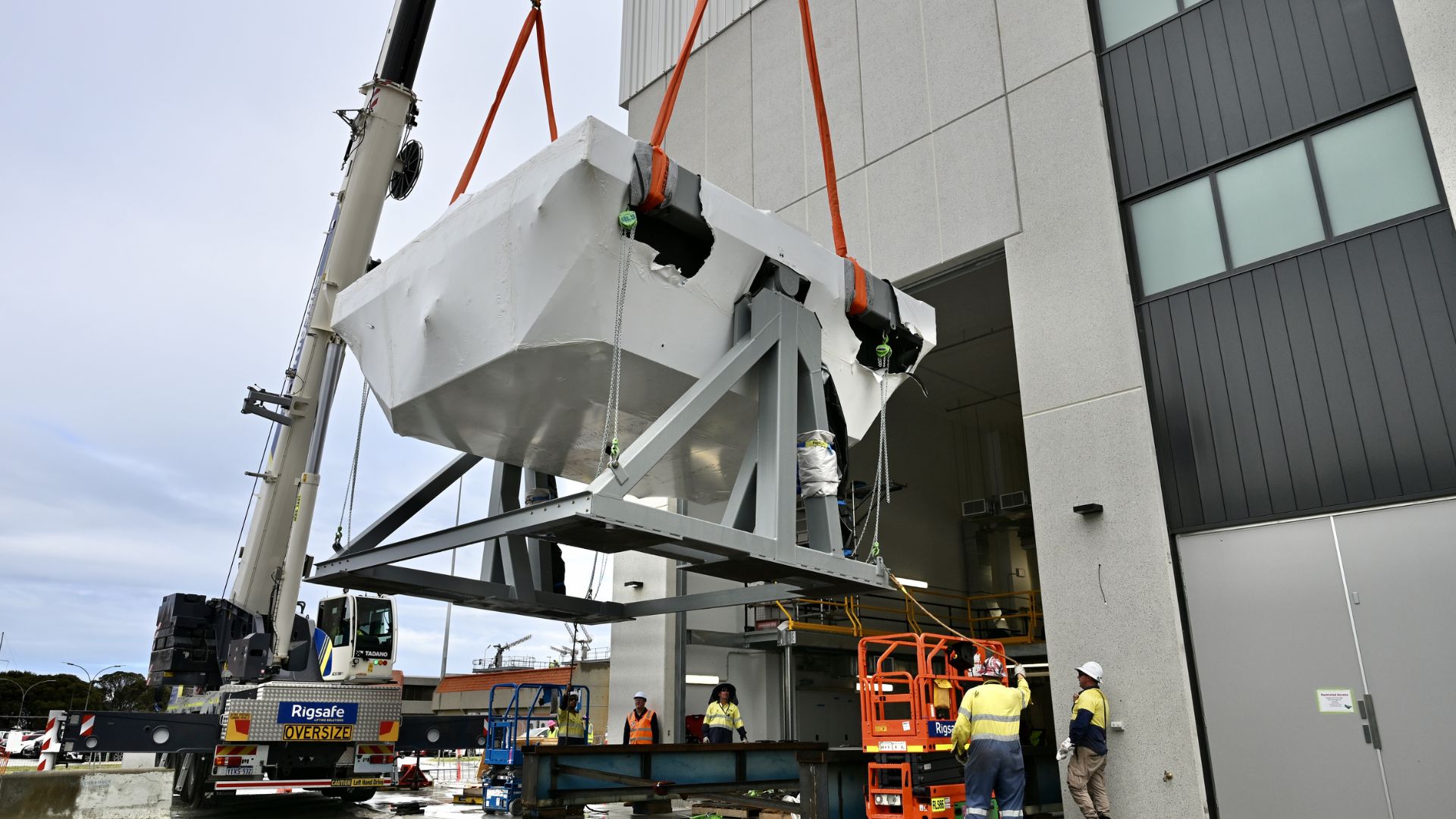
Australia has taken delivery of its first sovereign Virginia-class submarine training systems at HMAS Stirling in Western Australia, marking a major hardware milestone under the trilateral AUKUS security partnership as the country prepares to operate conventionally armed, nuclear-powered submarines. Transported via a coordinated logistics operation involving maritime shipping, heavy-lift cranes, road haulage, and strategic airlift, the more than a dozen training devices will form the core of the upcoming SSN Training Centre-West, with installation scheduled for completion in 2027. Replicating a nuclear attack submarine’s control room According to an announcement by the Australian Submarine Agency (ASA), the centerpiece of the initial delivery is the Virginia Ship Control Operations Trainer (VSCOT). The high-fidelity simulator replicates the ship control station of a U.S. Navy Virginia-class fast-attack submarine, allowing crews to rehearse underwater maneuvering, depth and buoyancy control, standard watchstanding procedures, and emergency casualty response in a controlled shore-based environment. Unlike Australia’s aging diesel-electric Collins-class submarines, Virginia-class boats rely on digital fly-by-wire ship control systems, automated hovering and depth-keeping computers, and pressurized-water nuclear reactors capable of sustained high-speed submerged operations. High-fidelity shore simulators allow instructors to pause scenarios, inject simulated flooding or propulsion casualties, and repeat complex evolutions before sailors step aboard an operational nuclear submarine. “The delivery of Australia’s first sovereign Virginia-class submarine training capability is a tangible demonstration of the AUKUS Optimal Pathway in action,” Alexandra Kelton, deputy director-general of strategy at the ASA, said in the release. “It brings together infrastructure, workforce and high-end capability to ensure Australia is developing the skilled people and enduring foundations needed for the Royal Australian Navy to operate and sustain conventionally armed, nuclear-powered submarines for generations to come.” Rear Admiral Dave Mann, head of the ASA’s Virginia Division, noted that the system supports both individual drills and integrated team exercises across every career stage, from entry-level recruits to senior watch officers. First transfer of Virginia trainers outside the United States The equipment arrival also marks the first time the United States has transferred these sensitive Virginia-class crew training systems outside American territory. Once operational at HMAS Stirling, the facility will enable Royal Australian Navy and U.S. Navy submariners to train side by side under common operating standards. “People often refer to Virginia-class submarines as the ‘crown jewels’ of the United States Navy. Bringing these training systems to Australia is a demonstration of our trust in Australia’s security, stewardship and professionalism,” Captain Jason Pittman, Commodore of U.S. Pacific Fleet’s Submarine Squadron 3 and the senior U.S. Navy officer supporting submarine operations at HMAS Stirling, said in the statement. Under the phased AUKUS Optimal Pathway, HMAS Stirling is undergoing roughly A$8 billion in infrastructure upgrades to host Submarine Rotational Force-West (SRF-West) starting in 2027, when up to four U.S. Virginia-class boats and one British Astute-class submarine will rotate through Western Australia. That rotational presence is designed to build local maintenance and operational readiness ahead of Australia’s planned acquisition of at least three U.S.-built Virginia-class submarines in the 2030s, followed by domestically built SSN-AUKUS boats in the early 2040s.Get the latest in engineering, tech, space & science - delivered daily to your inbox.Kaif Shaikh is a journalist and writer passionate about turning complex information into clear, impactful stories. His writing covers technology, sustainability, geopolitics, and occasionally fiction. A graduate in Journalism and Mass Communication, his work has appeared in the Times of India and beyond. After a near-fatal experience, Kaif began seeing both stories and silences differently. Outside work, he juggles far too many projects and passions, but always makes time to read, reflect, and hold onto the thread of wonder.
US transfers 10,400-ton nuclear-powered submarine trainers to Australia in historic first
Full Article
Original Source
Read the full article at Interestingengineering →KhanList aggregates and links to publicly available news content. We do not host full articles from third-party sources. Always verify important information with original sources.