
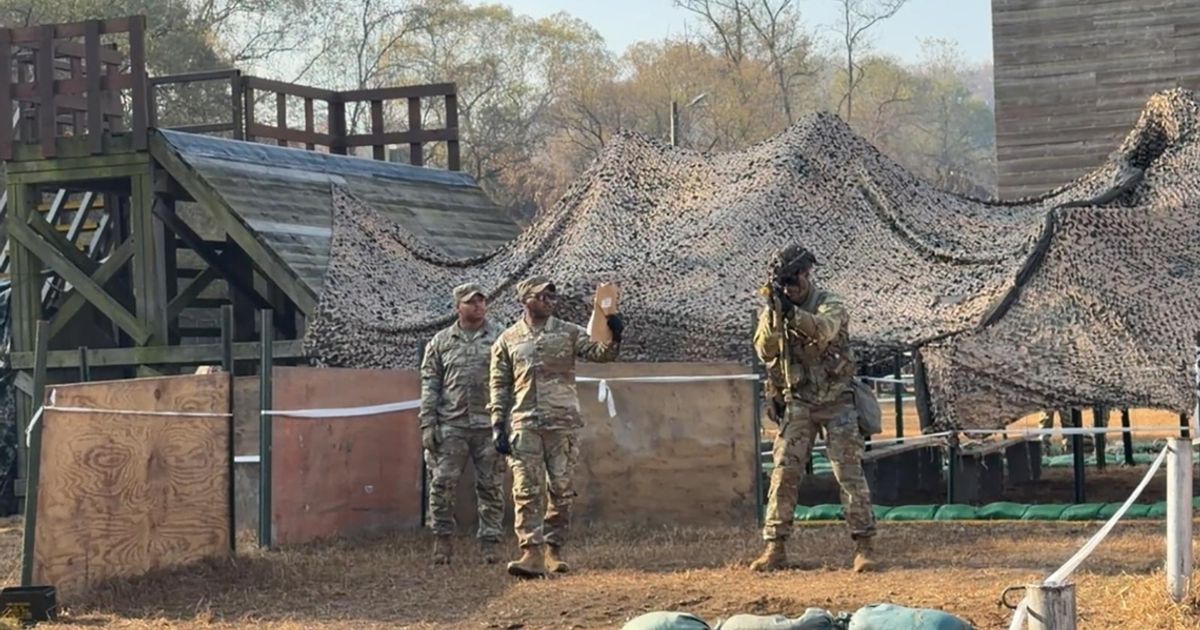
SEOUL - Sounds of intermittent gunfire pierced the crisp autumn air at Camp Hovey’s training grounds in Dongducheon, Gyeonggi Province, a stark reminder of the military tensions that persist on the Korean peninsula.Located about 20km south of the Demilitarized Zone (DMZ), Camp Hovey and its neighbouring Camp Casey are major US Army installations in South Korea and principal garrisons close to the North Korean border.As tensions along the inter-Korean border rise following a landmine blast that seriously injured three South Korean soldiers in September and renewed military activity by North Korea near the border, US and South Korean troops are pressing on with rigorous combat training.Thankfully, the gunfire on that autumn morning was not coming from an exchange of fire with North Korea, but from US and South Korean soldiers firing blanks in preparation for the Expert Two-Badge (E2B) qualification assessment. Against a backdrop of clear blue skies and rust-hued slopes of the Soyo mountain in the distance, little clouds of dust kicked up as the soldiers moved across the sprawling training grounds of Camp Hovey when The Straits Times visited on Nov 12.The cinematic setting could have lifted right off the 2016 hit military romance drama Descendents of The Sun starring Song Joong-ki and Song Hye-kyo, except that the cadence of the gunfire was more realistic than dramatic, startling this correspondent quite a few times in the beginning.The mood was also sombre as the soldiers lined up at 28 individual testing stations, undergoing mock assessments in three skill areas of weapons, medical skills and patrolling. They had earlier undergone two weeks of intensive training.At one station, soldiers belly-crawled through a short dirt tunnel, before demonstrating how to employ and fire an anti-personnel mine within 10 minutes, and recover an unfired mine within five minutes.At another, they had to navigate a 200m course within five minutes, simulating movement under direct enemy fire.Those who passed a task received a nod of approval from the evaluators and responded with a loud “Thank you, Sir!”, while those who failed were sent to the back of the line to practise and try again.The actual E2B qualification test, which takes place from Nov 16 to 20 involving about 1,300 South Korean and US troops, will also include a timed 12-mile (19.3km) march with a weighted backpack. Held roughly every nine months, the assessment combines the Expert Infantryman Badge (EIB) and Expert Soldier Badge (ESB). Considered a prestigious achievement among soldiers, the qualification recognises those who demonstrate proficiency in core combat skills, including land navigation, casualty care, weapons handling, communications, patrolling and manoeuvring.The assessment is so exacting that pass rates can be below 20%.The high standards reflect the importance of soldiers’ preparedness at Camps Casey and Hovey. Both camps host key units of the 2nd Infantry Division, a frontline US combat force tasked with deterring North Korean aggression and helping defend South Korea in the event of a conflict.Officially known as the 2nd Infantry Division/South Korea-US Combined Division (2ID/RUCD), it also integrates South Korean Army personnel into its US-led command structure.Border tensionsWoo Jun-woo, 28, a sergeant first class from the South Korean army, is taking the assessment for the first time. He told ST that while it is not the toughest training he has undergone since joining the Army in 2018 for mandatory military service, it is demanding because of the 10-hour long days of intense training.Sergeants First Class Jim Jung (left) and Woo Jun-woo are among about 1,300 South Korean and US troops taking part in the Expert Two-Badge qualification assessment from Nov 16 to 20. ST PHOTO: WENDY TEOWoo, whose childhood ambition was to be a doctor, had signed on to be a full-time soldier after completing his mandatory military service as he wanted to be “a helpful citizen who protects my country”.While the E2B certification is not mandatory for Woo and his fellow sergeant first class Jim Jung, both felt that the training would provide them with skill sets that can be put to use when necessary. Jung, 30, said: “As part of the signal unit, we don’t get many opportunities to handle weapons. But I thought this was still a valuable skill to learn, particularly knowing how to administer first aid and save lives when the need arises.”Asked about the situation along the border, both said it was not the most tense period they had experienced during their military careers, but declined to elaborate. Appearing reluctant to discuss the matter further, they said only that their rigorous training had prepared them for any contingency.The security situation on the Korean peninsula has grown more volatile following the Sept 21 landmine blast in the DMZ that seriously injured three South Korean soldiers.About 1,300 South Korean and US troops are taking part in the assessment from Nov 16 to 20. ST PHOTO: WENDY TEOA joint investigation by South Korea and the United Nations Command (UNC) had concluded the exploded mines were planted by North Korea, but Pyongyang has steadfastly denied responsibility, accusing Seoul of fabricating the findings.Seoul brought the incident to the attention of the UN Security Council in a letter dated Oct 22, calling on Pyongyang to apologise, remove the mines and take steps to prevent a recurrence.On Nov 5, UN Secretary-General Antonio Guterres called for the two Koreas to resume dialogue and restore communication channels to reduce the risk of miscalculation along the border.His appeal was rejected by Kim Yo Jong, the powerful sister of North Korean leader Kim Jong Un, who accused him of taking Seoul’s side in the dispute.In a statement carried by North Korea’s state-run Korean Central News Agency (KCNA) on Nov 10, Kim described Guterres as “prejudiced and irresponsible” for echoing what she called South Korea’s “unilateral and provocative sophism”.She also accused the UN chief of applying double standards, saying he had criticised Pyongyang’s exercise of its sovereign rights while remaining silent about what she called the “heinous military hysteria” of the United States and its allies.Meanwhile, North Korea has deployed self-propelled artillery along the coast of Kaepung County in Hwanghae Province, with at least one weapon visible from South Korea’s Aegibong Observatory in Gimpo, about 1.5km across the Han River estuary.Photographs taken from the observatory on Oct 26 and 27 showed North Korean soldiers gathered around the suspected artillery piece, which is believed to be a 122mm self-propelled howitzer. One of the weapons bore a painted slogan reading: “Annihilate the US imperialist aggressors, the sworn enemy of the Korean people!”The weapon was subsequently covered with camouflage netting, making it more difficult to spot from the South Korean side. The unusual sight has drawn a surge of visitors to Aegibong Peace Ecological Park. A total of 13,243 people visited between Oct 26 and Nov 4, prompting Gimpo city authorities to limit the number of visitors from Nov 4, in a bid to ensure crowd safety.On Nov 12, a senior South Korean presidential official confirmed that there were no additional North Korean activity detected at the DMZ beyond preparations for possible loudspeaker broadcasts.For now, all is peaceful at the border, but preparation for any aggression from the North continues with no letting up, including the certification of skills crucial in defending the country.As sergeant first class Jung said: “It is important to be prepared.”
US, South Korean troops sharpen skills near tense DMZ
Full Article
Original Source
Read the full article at Straitstimes →KhanList aggregates and links to publicly available news content. We do not host full articles from third-party sources. Always verify important information with original sources.