
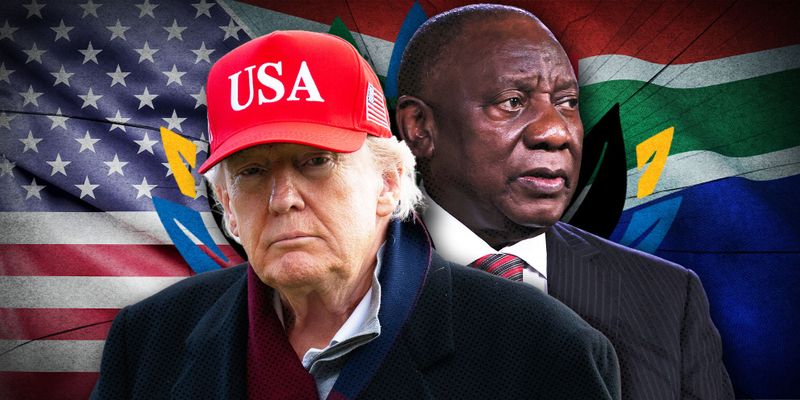
Well, here we are again in the ongoing diplomatic tussle between the US and South Africa. This time the Americans have fired their next salvo. But what does it mean, what is behind it, and what might it mean going forward? And, of course, who wins and who loses in this? When Donald Trump returned as president in 2025, his administration undertook a campaign of pressure towards South Africa, fuelled by the false narrative of systematic oppression and repression of the country’s white Afrikaner population. The underpinnings for this significantly derived from the agenda of South African organisations like AfriForum and Solidarity. Early on, the US totally upended its entire global asylum policies, restricting successful applicants almost entirely to white Afrikaners – several thousand of whom were dutifully admitted into the country. Meanwhile, South Africa’s eligibility for duty-free access into the American market under the provisions of the African Growth and Opportunity Act, or Agoa (assuming that law would actually be renewed by the US Congress), was increasingly seen as problematic. File photo: Newly arrived Afrikaner 'refugees' listen to US Deputy Secretary of State Christopher Landau and Homeland Security Deputy Secretary Troy Edgar (right) deliver welcome statements in a hangar at Atlantic Aviation Dulles near Washington Dulles International Airport on 12 May 2026 in Dulles, Virginia. (Photo: Chip Somodevilla / Getty Images) The Trump administration then explicitly set out its agenda for changing the texture of the bilateral relationship, stating five demands, later called “asks” by the new American Ambassador, Leo Brent Bozell III, perhaps to soften the harshness of them. These five were: Protecting rural communities from violence. Condemning rhetoric that incites hatred or glorifies violence. Ensuring that expropriation policies include clear and fair compensation standards. Expanding digital and critical minerals cooperation. Ending mandatory surrender of ownership or control of corporate decision-making as a cost of doing business. Early in Ambassador Bozell’s tenure, he had already been called into the South African foreign affairs department for a stern talking to, after speaking publicly about his displeasure over the Constitutional Court’s ruling that the infamous “Kill the Boer” chant was not hate speech. Never mind that this chant is largely history, the lack of a strong South African government condemnation of it seems to be permanently stuck in the throat of American officials. President Cyril Ramaphosa holds a meeting with the United States Ambassador to South Africa Leo Brent Bozell III, in Tshwane. (Photo: Elmond Jiyane/GCIS) Hovering in the landscape, too, has been a growing discord between the two nations on foreign policy issues. Most notably, these have included South Africa’s energetic pursuit of a genocide case at the International Court of Justice against Israel, and South Africa’s close ties with Iran and Russia – including military ties.There is also an American sense that while South Africa speaks strongly about its neutrality on regional conflicts such as the Russian invasion of Ukraine involving one of its BRICS partners, from the American perspective this is not the case, judging by both actions and voting in international forums. We have come a very far way from the heady days of the late 1990s with the Mbeki-Gore bilateral commission. Back then, there was the sense the two nations had a common agenda regionally and beyond – and could look forward to close cooperation in the future.US President Donald Trump holds up a printed article from American Thinker while accusing President Cyril Ramaphosa of state-sanctioned violence against white farmers in South Africa, during their Oval Office meeting at the White House on 21 May 2025. (Photo: Chip Somodevilla / Getty Images)SA officialdom bristlingMeanwhile, South African officialdom’s bristling over the two nations’ foreign policy disagreements seems rooted in the notion that its foreign policies are its sovereign right to pursue as an independent nation. However, the muttered rejoinder from Washington has been something along the lines of: Sure, as a sovereign nation that is certainly your right, but there are consequences. And this will be especially the case in this era of a sharply transactional American foreign policy stance, in which there are no automatic gimmes or givens, just winners and losers. The uncertainty of South Africa’s future eligibility under Agoa, now that the act has been signed into law for two more years (let alone other tariff measures) continues to be yet another unresolved area of concern.What seems to have provoked the announcement late in the evening of 15 September of selective visa restrictions on some South Africans attempting to enter the US is that the Americans believe they effectively have received no tangible responses from the South African side to those demands/asks, let alone acquiescence to any of them. Leo Brent Bozell III, US President Donald Trump's nominee for ambassador to South Africa, was sworn in by Senator Ted Cruz on Friday, 9 January 2025. (Photo: Supplied / US Embassy South Africa) From the Americans’ perspective, it was almost as if the South Africans were hoping the whole thunderstorm would just blow over. Then the relationship could return to its more usual, recent style of microaggressions, small abrasions, and an occasional sharp elbow, but still amid strong ties with a major trading partner (one where South Africa holds a net positive balance), as well as rich people-to-people and cultural and academic connections.But the US clearly was operating with a very different sense of how the relationship would work, and how quickly the South Africans might – or should —– respond. With such perspectives in mind, looking at those demands/asks, it would have been strategically wise – rather than effectively retreating into a shell – if the South Africans had come forward with some concrete ideas of their own, primarily about demand/request number one, achieving greater cooperation to build a more vigorous, energetic public security environment, especially for rural communities. (In fact, a generation ago a small cadre of police advisers from the US were called in to assist South Africa’s police force in developing better, more comprehensive plans for combatting crime. Further, given the current controversies with police capabilities, such a proactive approach might have helped all round.)Straightforward declarationSimilarly, a straightforward declaration by the South African government that it does not tolerate hate speech, hate crimes or the promotion of physical violence by anyone, even as individual politicians are within their rights to express even controversial opinions, might have taken the sting out of demand/ask number two. (If the South Africans had been really savvy – and just a touch snarky – they could have noted how such things can be a problem elsewhere, including the US.)The South Africans could also have responded, regarding the third demand/ask, that governmental eminent domain policies exist around the world, and are exercised for a variety of public improvement purposes. In South Africa’s case, the law is situated in the context of a long history of unfair, confiscatory land grabs and restitution is a policy with wide acceptance across the nation.Yes, the South African government has made these points before, but sometimes you have to shout or use posters with illustrations. The point is that they must continue to make precisely these points.Finally, the South Africans could have noted that the fourth and fifth demands/asks were really part of a broader discussion about economic and commercial relationships between the two nations and among businesses and potential investors. As Ambassador Bozell has pointed out, numerous American firms operating in South Africa have constructed innovative ways to bring on board new participants, and the Embassy has highlighted such ideas in praise of new investors.In reality, it is only in the area of foreign relations with other countries where serious disagreements may exist and continue. But even here, nations can agree to disagree, and can eventually find common ground in other ways.Alas, there was little in the way of an energetic response or proposals for further discussions, or much encouragement for that from the US. And so this is where we are now. The Americans, their patience, now presumably exhausted, or so they would say, have announced that individuals “involved in race-based discrimination and incitement of imminent violence, as well as uncompensated land seizures in South Africa” under Section 212 (a) C of the US Immigration and Nationality Act will have a great deal of trouble visiting the US in future. No New York City’s Central Park in autumn, no Disney World, no Grand Canyon, no anything. The list of such individuals has not been released publicly, but presumably those individuals know who they are. Such prohibitions of entry will only make diplomatic discussions more fraught.Larger contextThere is a larger context to this announcement, however. The White Cross Project – an installation art piece – will be hammering 3,000 white crosses, symbolic of rural killings, into the turf of the National Mall in Washington, DC, on 25 and 26 September. In addition, they are organising a seminar at the National Press Club under the auspices of the Lex Libertas body, led by Ernst Roets. The point of this outreach seems to be operating hand in hand with the Trump administration’s tighter squeeze on South Africa, especially in its calls for still more pressure. Behind this effort, it may be noted that these pressures are being exerted less than two months prior to America’s midterm election. While the president is not up for re-election (he is not eligible in two years’ time due to term limits anyway), his Republican Party is increasingly on the back foot on many issues, as per polling data – from the state of the economy and the prices of goods and services such as petrol, to the war of choice with Iran, and to the excesses of overweening, violent immigration controls. Secretary of State Marco Rubio. (Photo: Andrew Harnik/Getty Images) While the circumstances of Afrikaner farmers are certainly not the focus of most of the American electorate, in close elections in certain swing constituencies for Congress (where losses will mean Republicans may end up losing control of either or both houses of the national legislature), energising any possible cohorts of eligible voters sensitive to such concerns might conceivably be the difference between winning or losing for some Republican hopefuls. By the same token, while South Africa’s foreign policy squabbles with America are not part of this country’s upcoming local elections, energising an electorate increasingly drifting from the ANC via a show of standing up to an international bully might play well for some voters in some spaces. And it might conceivably make a difference. As far as the future of the relationship is concerned, things are worse than they were a year ago and, so far at least, there appears to be little appetite for any official reconciliation and the resolution of disputes. And that is too bad; it didn’t have to be this way. But that is where we are now, and everyone is the loser. DM
US-SA RELATIONS: US visa restrictions raise the stakes in its escalating dispute with SA
Full Article
Original Source
Read the full article at Dailymaverick →KhanList aggregates and links to publicly available news content. We do not host full articles from third-party sources. Always verify important information with original sources.