
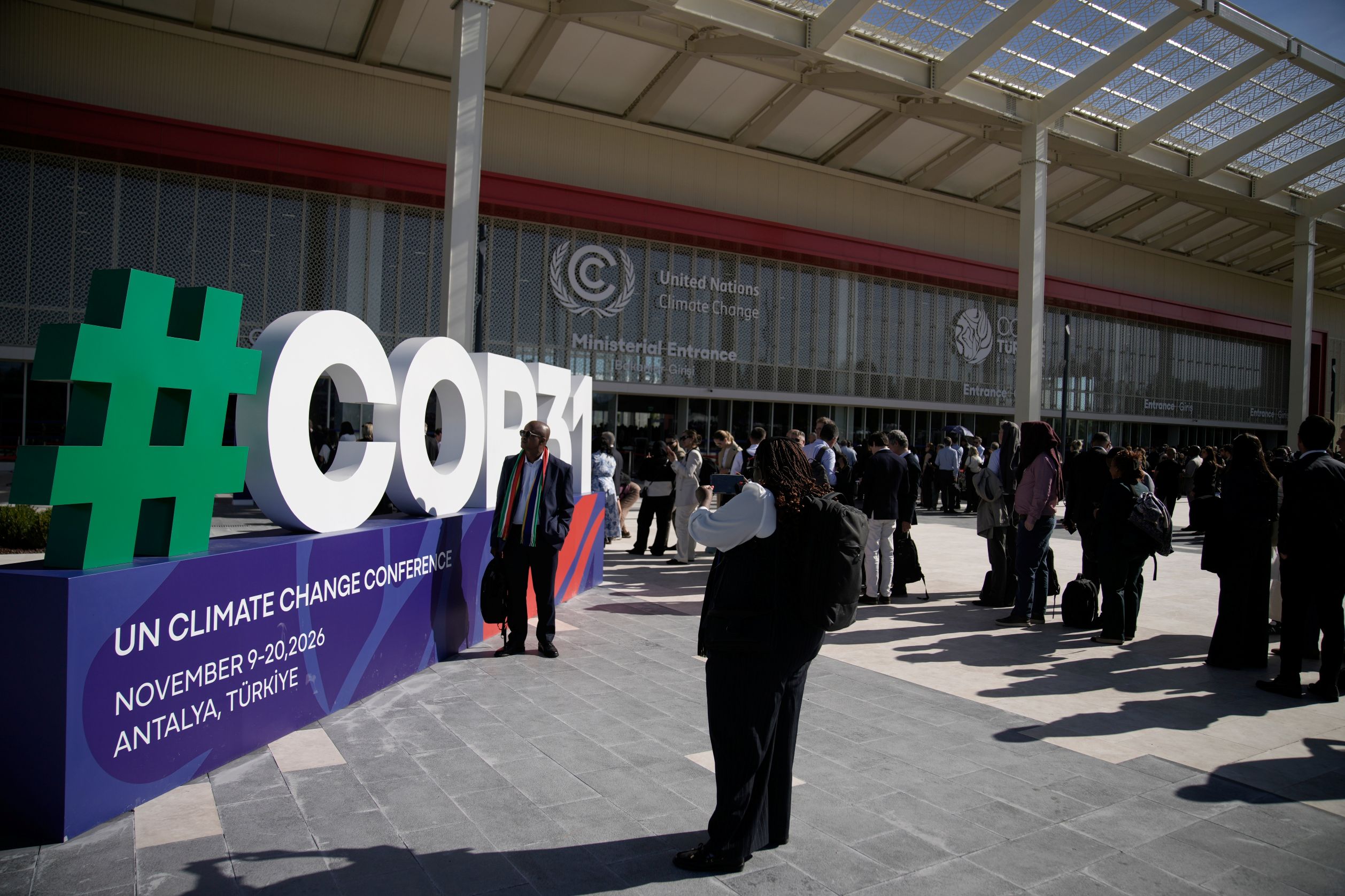
The annual U.N. climate summit has begun. Talks are urgent as heating accelerates and scientists project warming is set to surpass the 1.5 degrees Celsius mark.(CN) — The annual United Nations climate summit kicked off Monday in Turkey, and for a second year in a row, the United States will be absent from talks aimed at saving the planet from devastating warming.Under U.S. President Donald Trump, Washington has dropped out of the international framework for combating climate change. Trump has called global warming a “hoax” while championing fossil fuels and attacking clean energy projects.The summit, better known as COP31, is taking place in Antalya, Turkey, but expectations are low for major breakthroughs amid geopolitical divisions, economic instability and a leadership void caused by the absence of the U.S. and a retreat by European leaders. At the same time, global greenhouse gas emissions are at an all-time high.Urgency in reducing emissions is higher than ever as the dangerous effects of climate change become ever more alarming. Global temperatures continue to rise, causing widespread damage such as melting glaciers, droughts, heat waves, wildfires and biodiversity loss.Ahead of COP31, the U.N. issued a sobering report projecting it is no longer possible to limit the planet’s temperature from becoming 1.5 degrees Celsius (2.7 degrees Fahrenheit) warmer than the pre-industrial age.The 2015 Paris agreement set 1.5 C as a target, but scientists say a continued increase in greenhouse gas emissions makes that scenario no longer possible. The debate now is around how much the 1.5 C goal will be “overshot.”In its report, the U.N. Environment Program said the most optimistic “overshoot scenario” would keep peak warming limited to 1.7-1.8 C (3.06-3.24 F) by around the middle of the century with global temperatures declining to around 1.5 C by 2100.To reach this scenario, UNEP said global greenhouse gas emissions would have to be reduced by 18% by 2030, 45% by 2035 and 69% by 2040. Such reductions are far beyond what countries have pledged to do, but a recent surge in renewable energy around the world has made it much more likely emissions can be drastically reduced.On Monday, the World Meteorological Organization said the past 12 years have been the warmest on record and the past four years are the top four.This year is on track to become the second-warmest on record and the emergence of a very powerful El Niño is expected to bring even warmer and more dangerous weather in the coming months.On Friday, the Potsdam Institute for Climate Impact Research reported the planet is “accumulating heat at an accelerating rate” and that human-caused warming reached 1.37 C (2.47 F) above pre-industrial levels in 2025. It projected the 1.5 C mark would be surpassed in about four years.“We have entered a new age of climate extremes,” U.N. Secretary-General António Guterres said Monday. “A supersized El Niño is colliding with a planet already superheated by manmade climate change.”He urged world leaders to “get serious by cutting emissions faster, accelerating a just transition from fossil fuels and delivering the finance and protection vulnerable countries need.”These themes will be the focus of the summit in Turkey, which is scheduled to end on November 20.At the meeting, countries are being asked to pledge to raise electricity’s share of global energy consumption from just over 20% to 35% by 2035. A key debate will be whether this electricity must come from zero-emission sources, as the European Union insists.Countries also will come under pressure to develop more ambitious plans to reduce carbon emissions. In 2028, nations will need to deliver updated plans on fighting climate change.Also, developing countries are expected to pressure richer nations to do more to fund global efforts to fight climate change.At the 2024 climate summit in Azerbaijan, wealthier nations pledged to funnel $300 billion a year to poorer countries by 2035. But developing nations say this amount is far from sufficient.Courthouse News reporter Cain Burdeau is based in the European Union.Subscribe to our free newslettersOur weekly newsletter Closing Arguments offers the latest about ongoing trials, major litigation and rulings in courthouses around the U.S. and the world, while the monthly Under the Lights dishes the legal dirt from Hollywood, sports, Big Tech and the arts.Additional Reads
US once again a no-show at UN climate summit
Full Article
Original Source
Read the full article at Courthousenews →KhanList aggregates and links to publicly available news content. We do not host full articles from third-party sources. Always verify important information with original sources.