
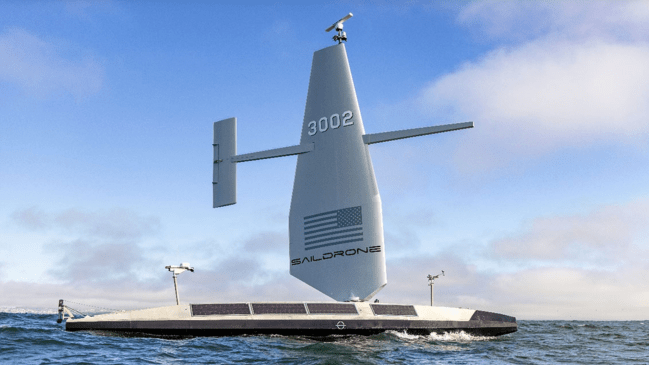
Lockheed Martin and USV manufacturer Saildrone have demonstrated the ability to launch missiles from an unmanned surface vessel during the Rim of the Pacific (RIMPAC) 2026 exercise near Hawaii, showing how commercial autonomous platforms could be adapted for military missions. A Surveyor-class Saildrone was integrated with Lockheed Martin’s Joint-Air-to-Ground Missile (JAGM) Dual Launcher and an Adjunct Remote Engagement System (ARES) fire-control system. During the demonstration, the vessel responded to targeting data and engaged a surrogate high-speed surface craft while operating alongside the USS Theodore Roosevelt Carrier Strike Group. The companies said the system went from concept to live demonstration in six months, highlighting their efforts to rapidly integrate existing defense technology onto commercial unmanned vessels. Unmanned vessel demonstrates missile capability The demonstration was conducted under the US Navy’s Fleet Experimentation Program during RIMPAC, the world’s largest international naval exercise. The Surveyor-class vessel was equipped with the JAGM Dual Launcher and ARES, a remotely operated combat system developed to allow unmanned platforms to receive information and engage targets. According to both Lockheed Martin and Saildrone, the system successfully acted on target data for a surrogate high-speed surface craft. The demonstration was carried out in coordination with the USS Theodore Roosevelt carrier strike group, showing how a USV could potentially operate as part of a larger naval force. The exercise also included a separate electronic warfare demonstration. The Saildrone Surveyor used passive electronic warfare technology to detect, classify and identify a surrogate radar threat, working in coordination with an MH-60S helicopter. The demonstration is part of a broader partnership between the two companies. In October 2025, Lockheed Martin invested $50 million in Saildrone to accelerate the development of unmanned surface vessels for the US Navy. The partnership combines Saildrone’s experience operating autonomous vessels in remote maritime environments with Lockheed Martin’s expertise in weapons, sensors, combat systems and mission integration. Commercial platforms become military assets The companies say the approach could allow established defense technologies to be deployed more quickly by integrating them with commercially developed autonomous platforms rather than designing entirely new military vessels. Saildrone has operated unmanned vessels for maritime missions since 2013, giving the company more than a decade of experience with autonomous operations in challenging environments. The companies also plan to test additional capabilities on Saildrone platforms, including the larger Spectre-class vessel. That platform is being designed to carry significantly larger containerized systems, including Lockheed Martin’s Mk 70 launcher and SURTASS towed-array technology. The RIMPAC demonstration therefore represents an early step in a larger effort to combine autonomous maritime platforms with established military systems. Saildrone CEO Richard Jenkins said the demonstration showed that a proven munition could be paired with an established unmanned vessel platform, while also reducing the technical risk of integrating more advanced weapons onto larger autonomous ships. “This successful live fire demonstration was the result of pairing one of the most tried and trusted munitions with the most operationally deployed class of USV on the planet,” Jenkins noted.Moving forward, future testing will focus on expanding the capabilities that can be deployed from unmanned platforms and accelerating their potential use by naval forces.Get the latest in engineering, tech, space & science - delivered daily to your inbox.Bojan Stojkovski is a freelance journalist based in Skopje, North Macedonia, covering foreign policy and technology for more than a decade. His work has appeared in Foreign Policy, ZDNet, and Nature.
US Navy tests Lockheed Martin missile system aboard unmanned vessel for precision strike
Full Article
Original Source
Read the full article at Interestingengineering →KhanList aggregates and links to publicly available news content. We do not host full articles from third-party sources. Always verify important information with original sources.