
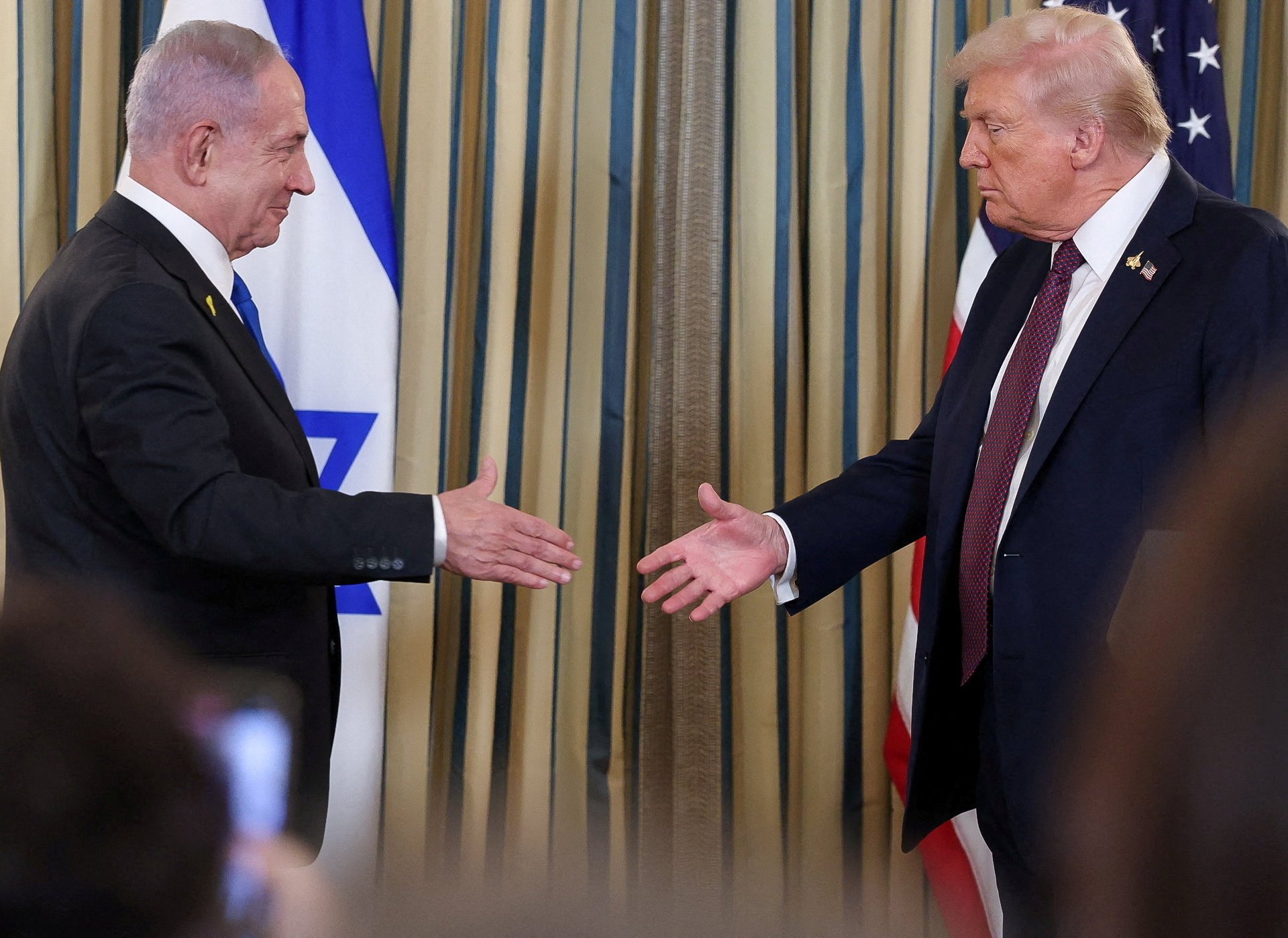
Washington, DC – Three years into Israel’s genocidal war in Gaza, little has changed in terms of official US support.The government in Washington, under former President Joe Biden and current President Donald Trump, has continued near-complete unconditional military aid to Israel since October 7, 2023, even as the region has exploded into wider conflict, including the US-Israeli war with Iran.Recommended Stories list of 3 itemslist 1 of 3Pelosi-backed US candidate calls for ‘full arms embargo’ on Israellist 2 of 3Netanyahu’s fight to own the election narrativelist 3 of 3Three years of genocide in Gaza through one man’s cameraend of listThe US aid has persisted even through periods when the administrations offered tame criticism of the government of Israeli Prime Minister Benjamin Netanyahu’s military offensive in Gaza, repeated violations of a “ceasefire” reached last year, and roadblocks to a more lasting peace in the Palestinian enclave and wider region.To date, at least 74,243 Palestinians have been killed in Gaza since the Hamas-led attacks on southern Israel, which killed at least 1,139 people. At least 1,460 Palestinians have been killed in Gaza since the October 11, 2025 ceasefire went into effect as Israel has continued to expand its area of control.“The bottom line is that under both the Biden administration and the Trump administration, the US has continued to provide unconditional support for Israel, both in terms of finances, arms transfers and other forms, such as diplomatic support,” according to former Department of State official Josh Paul, who now runs A New Policy lobbying firm.“That’s before we start adding in the costs of America’s wars in the region, whose causes are greatly attributable to our support for Israel and to Israel’s actions,” he said.Military aidThe United States has for decades offered Israel outsized military support and preferential access to US weapons, with Washington providing nearly $300bn in aid since its creation in 1948 when adjusted for inflation, more than any other country.Washington has repeatedly codified support for Israel, most notably through a 2008 law that requires the US government to assure Israel maintains a so-called Qualitative Military Edge (QME) over its neighbours.Because of that, Israel’s military remains deeply intertwined with the US government and US-made weapons, upon which it relies for its air force, several of its most devastating munitions, tanks and other military vehicles, as well as its Iron Dome, David’s Sling and Iron Beam air defence systems.Rights groups, including Amnesty International, have repeatedly linked US-made weapons to civilian killings in Gaza and the wider region, although Israel has blocked independent monitors from entering the Palestinian enclave.“Because Gaza is a genocide, and the US has supplied so much weaponry, there’s really no getting out of the fact that the US has a responsibility,” William Hartung, a defence analyst who has analysed US-Israel aid, told Al Jazeera.Since October 7, 2023, the US has provided at least $25.5bn in appropriations to Israel, money that comes directly from government coffers funded by US taxpayers.The most direct form of US military support comes from government appropriations to Israel, which account for $3.8bn a year under a 10-year memorandum of understanding signed by the administration of former President Barack Obama in 2016.The figure includes the $3.8bn a year appropriated in fiscal years 2024, 2025, and 2026. It also includes a towering supplemental security package of $14.1bn, passed by Congress and signed into law in April 2024.The funding is predominantly made up of so-called Foreign Military Financing, which provides funds for US-made arms transfers and other services, and to a lesser degree, so-called offshore procurements, which provide funds for Israel to build its domestic arms industry.Other portions of the funding are specifically allocated to replenish existing weapons stocks and maintain Israel’s air defence systems.Israel also has access to a so-called War Reserves Stockpile, a programme that keeps a store of certain US weapons in the country, allowing for swift access upon approval from Washington.Arms salesDirect US government appropriations overlap with arms sales to Israel. Such sales – which must be approved by the US State Department, which in turn must notify the US Congress – can be paid for with US military aid or from other funding sources.Nevertheless, Hartung says the vast majority of sales are paid for with US aid.Sales can take years to deliver, depending on the availability and sophistication of the equipment being bought, entrenching the US and Israeli military in relationships long after the initial agreement.“It’s a timeline where something approved today will do damage down the road, and the stuff doing damage now was approved some years ago,” he said.To date, the US has approved at least $33.16bn in arms transfers to Israel since October 7, 2023, according to an Al Jazeera analysis of State Department notices to Congress.Since the Israel military offensive began, the US State Department under both Biden and Trump has also repeatedly declared an emergency related to US national security interests when it comes to support for Israel, a rarely used legal manoeuvre that allows the administration to bypass some congressional oversight.State Department-approved sales since October 7, 2023 have included thousands of rounds of 120mm tank munitions greenlit in December 2023 and again in August 2024, F-15 fighter jets and parts valued at $18.82bn approved in August 2024, and a $7.4bn package of bombs, guidance kits and fuses, and Hellfire missiles approved shortly after Trump took office in 2025.At the time, Trump lifted a Biden-era pause on a pre-approved shipment of 2,000-pound (900kg) bombs to Israel.Rights groups say the wide radius of the bombs, which can be up to a quarter mile (0.4km), causes widespread civilian devastation. A 2024 study found Israel dropped nearly 600 of 2,000-pound bombs across densely populated Gaza from October 7 to October 23, 2023.In September, US Representative Gregory Meeks, the top Democrat on the House Foreign Affairs Committee, said he had placed a hold on a $2.8bn transfer of 40,000 2,000-pound bombs to Israel, saying he had not received assurances that the “weapons will be used by the Netanyahu government in accordance with US law and with appropriate protections for civilians”.Diplomatic coverBeyond weapons, three years into Israel’s genocidal war on Gaza, the US has also continued to offer diplomatic cover for Israel.Before the October 11, 2025 ceasefire, that support showed up most clearly in the UN Security Council, where the US, as one of five permanent members, repeatedly vetoed resolutions calling for an end to the war.All told, the US vetoed six separate resolutions related to Gaza, most recently in September 2025.The US approach has since evolved into a pressure campaign against the International Criminal Court (ICC), which has issued an arrest warrant for Israeli Prime Minister Netanyahu and former Defence Minister Yoav Gallant.Trump initially announced plans to sanction the court and those who work with it in a February 2025 executive order. He charged the ICC had engaged in “illegitimate and baseless actions targeting America and our close ally Israel”.The US has sanctioned a series of ICC officials, a UN rapporteur, and several Palestinian rights groups, with Secretary of State Marco Rubio promising in July to accelerate an “all of government” approach to dismantle the tribunal.Joyce Ajlouny, general secretary of the American Friends Service Committee, has called the Trump administration’s approach “an affront to all victims and survivors of war crimes and genocide”.Washington has taken other efforts to shield Israel from accountability.The law appropriating the most recent round of military funding further blocks any US funding from supporting an independent commission launched by the UN Human Rights Council in 2021 investigating the occupied Palestinian territory.It also blocks US funding for the UN agency for Palestinian refugees (UNRWA).Growing US oppositionWhile there has been little divergence from the executive branch in its unconditional support for Israel, the domestic political context in the US has shifted dramatically over the last three years.A May New York Times/Siena poll found that about 68 percent of Democrats opposed providing additional economic and military support to Israel, climbing from 45 percent three years earlier. A Gallup poll from February found that while 70 percent of Republicans sympathise with Israelis over Palestinians, the share had dropped by 10 percentage points compared with just a year earlier.Lawmakers in Congress have increasingly reflected that discontent, even if resolutions seeking to block weapons transfers continue to fall short of the two-thirds majority in the House and Senate needed to take effect.“Years ago, even an amendment to block a sale to Israel would have been unthinkable,” analyst Hartung said. “I think the tide is turning. But I mean, the killing’s happening now, so it’s not a lot of solace unless we really can stop it.”US Senator Bernie Sanders and lawmakers in the House have introduced legislation to block weapons sales.A fact sheet compiled by Sanders office in 2024 pointed to the reported use of US munitions, notably 120mm tank rounds, in several high-profile killings of civilians in Gaza, including five-year-old Hind Rajab in Gaza City, as well as the use of Joint Direct Attack Munitions (JDAMS) in several high-casualty Israeli strikes.A bill to block the sale of military bulldozers passed the Senate by a vote of 40 in April 2024, in what some advocates hailed as a historic shift.In September, 47 Senators voted to advance a bill that would require the State Department to conduct an investigation into US citizens killed by Israel in the occupied West Bank, which could eventually lead to restrictions on military aid.On the opposite side, pro-Israel US lawmakers have sought to formally integrate the US and Israeli military in the National Defense Authorization Act (NDAA) for fiscal year 2027.A version of the bill passed by the Republican-controlled House would boost technological cooperation between the US and Israel, potentially funnelling billions of dollars of US funds into Israel’s defence industry and circumventing congressional oversight.In essence, the provision is an attempt to “transition the defence relationship from the annual appropriations cycle into the deeper machinery of the Defense Department contracting world”, according to A New Policy’s Paul, and in turn, sidestep changing public sentiment.“[A relationship] that is less transparent, less susceptible to political pressure, and more deeply embedded in the US military-industrial complex,” he said.
US military aid to Israel continues three years into Gaza genocide
Full Article
Original Source
Read the full article at Aljazeera →KhanList aggregates and links to publicly available news content. We do not host full articles from third-party sources. Always verify important information with original sources.