
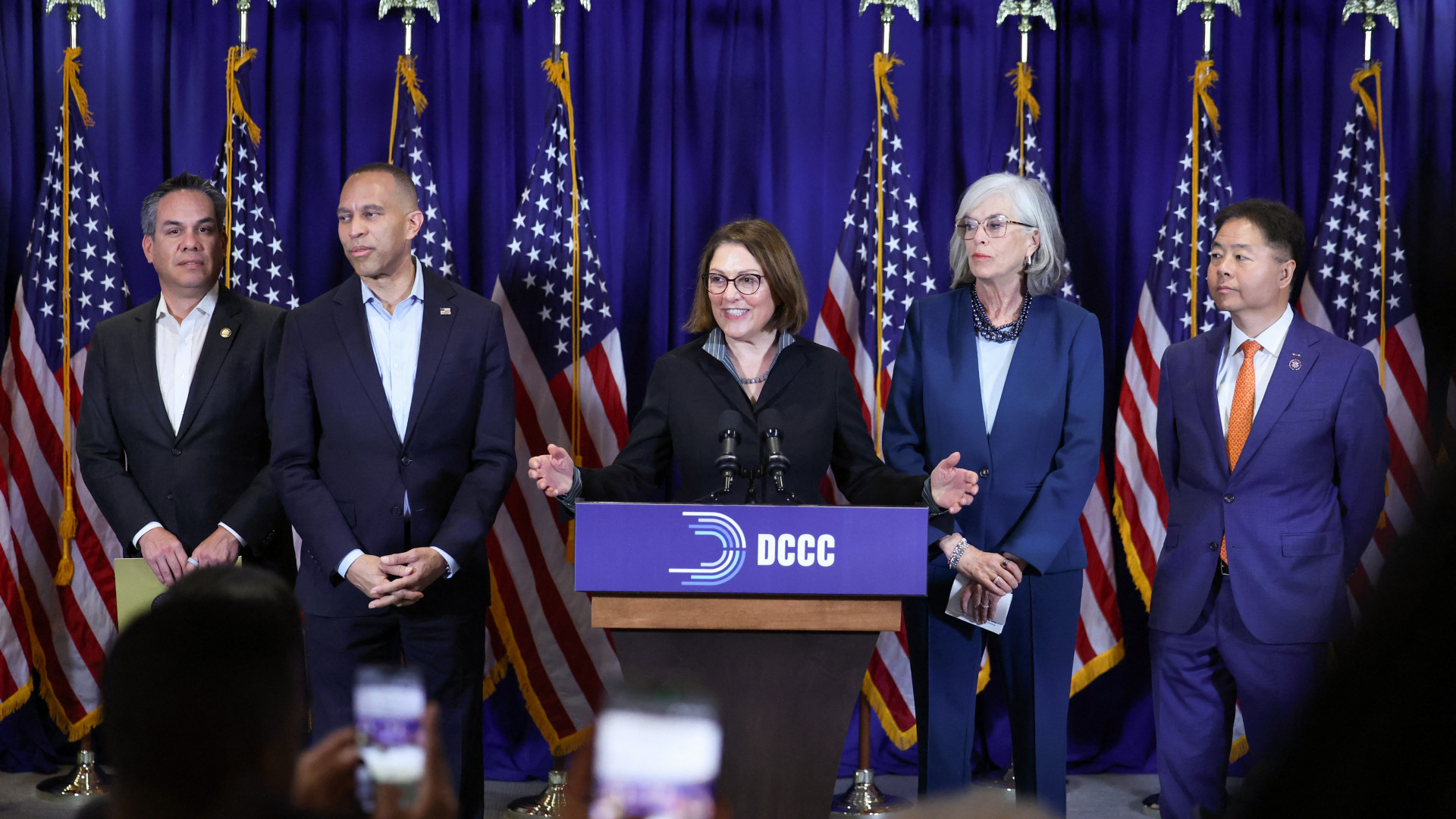
The political tsunami that swept across the US on 3 November was extraordinary in both its scale and implications. The electoral flood that overwhelmed the Republicans was not simply another midterm correction. It was a sweeping rejection of Donald Trump's presidency: his economic policies, his wars, the corruption charges against his administration and his increasingly confrontational use of presidential power. But the more consequential question is what happens next. Will this upheaval produce a fundamental reassessment of American foreign policy, particularly towards Israel, Palestine, Iran, and the wider Middle East? Or will the Democratic establishment try to restore the familiar bipartisan consensus that helped produce the very crises now confronting Washington? The answer will shape American politics throughout 2027 and beyond. The scale of the Republican defeat exceeded expectations. Democrats captured both chambers of Congress. They flipped seven Republican-held Senate seats in Texas, Kansas, South Carolina, Iowa, North Carolina, Ohio and Maine, bringing their total to at least 54. The count in Alaska favours the Democrats, and Mississippi could still elect its first Democratic senator since 1982. Kansas elected its first Democratic senator since 1932, and Texas, which Republicans had dominated in statewide elections for decades, elected Democrat James Talarico. South Carolina and Iowa, long Republican strongholds, delivered extraordinary upsets. New MEE newsletter: Jerusalem Dispatch Sign up to get the latest insights and analysis on Israel-Palestine, alongside Turkey Unpacked and other MEE newsletters Among the losers were several candidates Trump had personally picked, in an election he had sought to nationalise around his name. Democrats also made substantial gains in the House, with a distinct possibility of reaching 258 members, a gain of more than 40 seats, while governorships won in traditionally Republican states, including Texas, Georgia, Ohio, Iowa and Nevada, showed that the backlash extended well beyond Washington into the Republican Party's geographical and demographic foundations. The price of the Iran war The national exit poll found that nine in 10 voters considered government corruption a major or crucial factor in their decision, that 63 percent regarded the decision to attack Iran as wrong, and that 87 percent worried about the price of fuel. The same poll found that nearly three-quarters of voters said the war was a crucial or major factor in their decision, and about a third called it crucial. Nearly eight in 10 said inflation was causing their families hardship, and only 38 percent approved of Trump's performance. Trump had promised peace, prosperity and an end to costly foreign entanglements. Americans got mounting economic pressure and Trump's war of choice The war on Iran may not have been the sole cause of the Republican collapse, but its military, economic and political consequences contributed greatly to the backlash. By late October, average petrol prices had reached about $4.27 a gallon, more than a third higher than when Trump returned to office less than two years earlier. Diesel had climbed even more sharply, to about $6.35. Disruptions to energy shipments through the Strait of Hormuz and damage to regional infrastructure were the main reasons. Vice President JD Vance attributed the Republican defeat directly to the war. "The reason we lost is the war," Vance declared, adding that Trump himself had acknowledged its electoral consequences. Trump subsequently conceded that the conflict and higher fuel prices had damaged Republican prospects. Vance's admission went to the heart of the contradiction between Trump's promises and his record. He had promised peace, prosperity and an end to costly foreign entanglements. Instead, Americans got mounting economic pressure and Trump's war of choice. Trump had squandered much of the political capital that enabled his return to power in 2024. Michigan and Texas The deeper implications of this election were clearest in Michigan. The victory of Abdul El-Sayed over Republican Mike Rogers was significant not simply because it preserved a Democratic Senate seat, but because it challenged assumptions about the viability of candidates openly critical of American support for Israel. Sayed, a progressive Egyptian American physician and former public health official, became the first Muslim elected to the US Senate. His victory followed a contentious Democratic primary in which establishment figures questioned whether his progressive positions, particularly his opposition to Israel's assault on Gaza, would sink him in a competitive state. Michigan's electorate proved more complicated than those calculations suggested. The state contains substantial Arab and Muslim communities, particularly around Detroit, alongside organised labour, African American voters, progressive activists and other constituencies whose priorities cannot be reduced to a single issue. Abdul El-Sayed helps launch the unforgivable rehabilitation of Kamala Harris Read More » In 2024, anger over the Biden administration's support for Israel's war on Gaza had opened a profound rupture between sections of these communities and the Democratic establishment, and the "Uncommitted" movement gained national prominence in Michigan. Sayed's victory demonstrated that a broad electoral coalition can be built without abandoning criticism of Israeli policies or accommodating every demand of Aipac and the pro-Israel political machine. This does not mean that Michigan has become uniformly pro-Palestinian, or that Gaza determined every race. It means that the political boundaries surrounding the Palestinian question are shifting. Talarico's victory in Texas, which had not elected a Democratic senator since 1988, pushed the same boundary further. Talarico made his position on the Israel lobby and Gaza explicit: "I've never taken money from Aipac, and I'm not taking money from Aipac in this campaign. Seeing what's happening in Gaza makes me sick to my stomach as a teacher, as a Christian, as a human being." For years, Democratic leaders operated on the assumption that unconditional support for Israel was both strategically indispensable and politically necessary. The emergence of winning candidates who openly reject Aipac's money and criticise Israel's conduct suggests that this assumption is becoming untenable. The significance of Talarico's victory is not merely that a Democrat won in Texas. It is that a Democrat could win in Texas while openly challenging one of the most entrenched orthodoxies of American foreign policy. The Democrats' contradiction Sayed and Talarico will enter the Senate as critics of their own party's record on Gaza. President Joe Biden's administration armed Israel during its genocide in Gaza and defended it at the UN. In December 2023, the administration bypassed congressional review to sell Israel tank shells and vetoed a resolution in the UN Security Council calling for an immediate humanitarian ceasefire. The Democrats' victory over Trump cannot erase that shameful record. According to Brown University's Costs of War project, Washington provided at least $21.7bn in military assistance to Israel in the two years after 7 October 2023, under Biden and Trump. Yet the Democratic Party is increasingly divided over the very policies its last administration pursued. This election produced at least 11 newly elected members of Congress, two senators and nine House members, who have publicly advocated for Palestinian rights, criticised Israel's conduct in Gaza or opposed aspects of American military assistance to Israel. Some have called for ending military assistance altogether, while others demand conditions, accountability or a reassessment of the relationship. They join established congressional critics such as Rashida Tlaib, Ilhan Omar and Alexandria Ocasio-Cortez, while figures such as New York Mayor Zohran Mamdani represent a broader political challenge to Israel's defenders. Together, they expand a constituency willing to challenge longstanding assumptions about the influence of the Israel lobby and unconditional American support for Israel. None of this means that the Democratic Party has abandoned its traditional commitments to the Zionist state. Its establishment remains closely connected to the foreign policy institutions, influential donors and strategic consensus that regard Israel as a central American ally. A Democratic congressional majority should not be confused with an antiwar majority, much less a consensus in favour of Palestinian liberation. The election results were not simply a repudiation of Trump and his war on Iran, conducted in partnership with Israel. They were also a challenge to the Democratic establishment of Biden, Antony Blinken and Jake Sullivan, whose policies enabled and sustained Israel's assault on Gaza. The question is whether the dissenters remain a minority or become part of a more fundamental transformation of the party. The electoral victory has created an opening, but it has not resolved the struggle over the party's direction on Palestinian self-determination and freedom from occupation. What changes in January When the new Congress convenes on 3 January, the balance of power in Washington will shift dramatically. For the first time in Trump's second presidency, both chambers will be controlled by the opposition, which will substantially weaken his ability to pass legislation, secure senior appointments and avoid scrutiny. Democrats will have considerable power to obstruct, investigate and expose administration policies, but much less power to impose an alternative foreign policy Democratic committees will acquire the power to investigate, subpoena and hold hearings on the Iran war, military spending and arms transfers, and Congress's powers over appropriations could be used to condition support for Israel. Trump nonetheless retains constitutional authority over diplomacy and military command, and overriding his veto requires a two-thirds majority in both chambers, which Democrats do not possess. The outgoing Republican Congress is under pressure to pass the National Defense Authorization Act (NDAA) and associated appropriations during the lame-duck session, while it still controls both chambers. That could fold Israel's massive military funding into broader defence and intelligence legislation. For Israel, this period deserves particular scrutiny. The existing military relationship includes long-term assistance arrangements, weapons contracts and the War Reserve Stockpile Allies-Israel programme, whose authorisation runs to 1 January 2027. Any attempt to renew or expand these arrangements before the transition could constrain the incoming Congress's ability to exercise real leverage over dangerous Israeli policies. Democrats will therefore have considerable power to obstruct, investigate and expose administration policies, but much less power to impose an alternative foreign policy. The immediate consequence is likely to be institutional confrontation rather than a new strategic direction. A turning point, not a revolution For Palestine, the election has created opportunities but offers no guarantees. A larger congressional bloc critical of Israel could increase scrutiny of arms transfers, settlement expansion and the treatment of Palestinians under an entrenched system of apartheid and military occupation. Congressional hearings could give greater visibility to first-hand Palestinian testimony and independent investigations, and Democratic leaders could face pressure to reconsider the longstanding practice of shielding Israel from accountability. The relationship is nonetheless deeply institutionalised. According to the Council on Foreign Relations, Israel has received more than $300bn in American assistance since its founding, adjusted for inflation, underpinned by military cooperation, intelligence arrangements, domestic political networks and decades of bipartisan commitments. These structures will not disappear because of one election. The war on Iran cracked the US-led regional order. The Mecca pact could deal the final blow Read More » On Iran, the implications may be more immediate. Congressional investigations into who authorised the war, what it cost and what it achieved could constrain further escalation and strengthen demands for diplomacy. Vance's admission matters here. When a sitting vice president identifies a foreign war as the principal cause of his party's defeat, he is acknowledging that military intervention has become a serious domestic liability. Opposition to Trump's war does not, however, imply support for a different approach to Iran: many establishment Democrats share Republican positions on Iran's regional influence and nuclear programme, even when they disagree over the use of force. Washington's strategic relationships with regional authoritarian regimes, including Saudi Arabia, the Gulf states, Egypt and Jordan, are equally unlikely to change suddenly. The coming debate will be about the methods, costs and sustainability of American dominance in the region, not its abandonment. The November elections have produced three developments. First, they have delivered a sweeping repudiation of Trump and weakened his ability to govern without institutional resistance. Second, they have shown that criticism of American support for Israel is no longer confined to the margins of Congress. Third, they have exposed a visible contradiction between the Democratic establishment's record and the demands of a growing constituency seeking accountability, restraint and a different relationship with the Middle East. Electoral change is not necessarily structural change. The system that produced bipartisan support for Israel's assault on Gaza remains largely intact, and its military institutions, lobbying networks and strategic assumptions continue to exercise enormous influence. The question for the next two years is whether the new congressional balance will merely constrain Trump or begin to challenge the deeper foundations of American foreign policy. The flood may have swept away Republican control of Congress. It has not yet swept away the structures that sustain America's wars or its blind support for Israel. The views expressed in this article belong to the author and do not necessarily reflect the editorial policy of Middle East Eye.
US midterms: A blue tsunami has rebuked Trump. Will it end Washington's wars?
Full Article
Original Source
Read the full article at Middleeasteye →KhanList aggregates and links to publicly available news content. We do not host full articles from third-party sources. Always verify important information with original sources.