
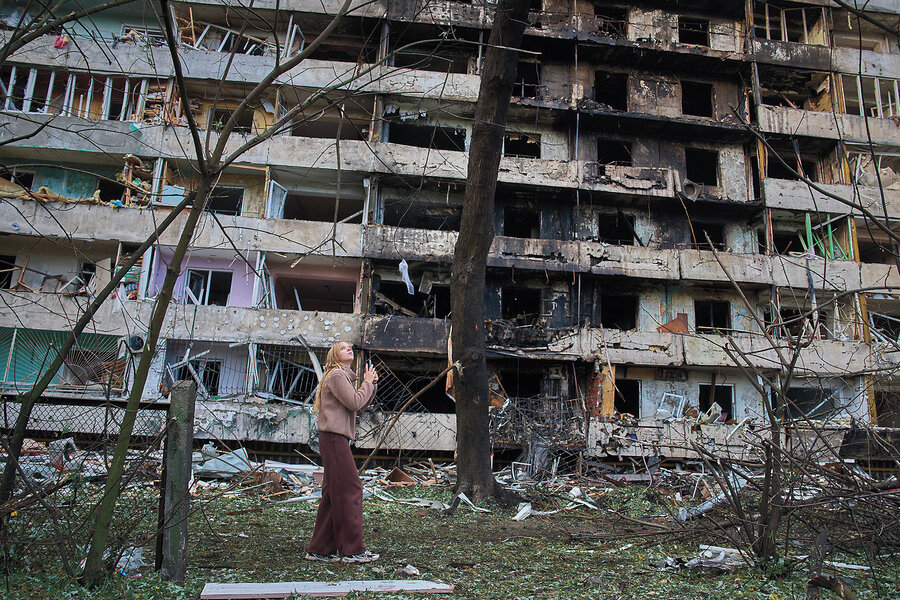
London | Oct. 15, 2026, 5:01 p.m. ET | 5 min read Typically, when Russian missiles and drones are about to strike, Kyiv receives advance warning from the U.S. military. But for two nights this week, it did not – dramatically raising the risk to residents who had no time to seek shelter.“Everything was very fast,” Maksym, a local, told the Kyiv Independent newspaper. “We didn’t even understand anything.” Windows were blown out by an initial blast overnight on Tuesday, he said, after which he and his partner evacuated to their corridor, then to a bomb shelter.The two-day stoppage of early warnings raised alarm bells in Ukraine, where Russia has been increasing bombardments of power plants and, that night, hit a nine-story building in Kyiv and other civilian sites, killing five people. The lack of alerts in Kyiv was just one facet of a spate of broader restrictions on U.S. support implemented over the past week, underscoring Ukraine’s continued dependence on Washington and on Elon Musk’s SpaceX company. SpaceX operates Starlink satellites critical to Ukraine’s defense against Russia’s jet-powered drones, as well as to Ukraine’s own drone attacks against Russia.The United States’ cessation of alerts – which activate Ukrainian air raid sirens to maximize the time people have to race to shelters – came amid an “energy truce” declared by U.S. President Donald Trump, during which Ukraine held off its own deep-strike attacks for three days against Russian refineries. But Russian strikes this week knocked out electricity to 600,000 Ukrainians, and reportedly killed more than 100 people. Scott Peterson/Getty Images/The Christian Science MonitorSoldiers of the Ukraine Army's 95th Brigade walk past a Starlink satellite internet receiver, as their unit fires artillery shells from a howitzer position in the Donbas region of Ukraine, Feb. 18, 2024. Meanwhile, SpaceX imposed speed restrictions on Starlink, which hampered both Ukraine’s defensive and front-line offensive capabilities. Both the rollback of intelligence support and the Starlink restrictions came amid reports of U.S. warnings that intelligence sharing would be cut if Ukraine did not stop strikes on Russia’s refineries.No similar pressure appears to have been put on Russia, which has continued a relentless bombardment of Ukraine’s energy infrastructure that has cut off electricity, heat, and water supplies as winter looms. “It is clear that, when the decision to stop sharing intelligence information between the United States and Ukraine occurred, it immediately resulted in a more intense level of death and injuries among Ukrainian civilians,” says Oleksandra Matviichuk, co-recipient of the Nobel Peace Prize in 2022 and the head of the Center for Civil Liberties in Kyiv.“Without this warning ... first you hear the explosion, and only then do you hear air sirens,” says Ms. Matviichuk, noting the challenge to civilians – especially those living in tall apartment buildings – of reaching safety before impact.“We’re done”In a bid to lower U.S. diesel prices that have surged to record highs because of the ongoing Iran war, Mr. Trump last week announced a deal with Russian President Vladimir Putin to import hundreds of thousands of tons of Russian diesel. The deal required that he lift U.S. sanctions on Russia – some imposed by Congress in recent weeks.The episode showed how vulnerable Ukraine remains and how dependent it is on U.S. policies and military capabilities, more than 4 1/2 years after Russia’s full-scale invasion. Mr. Trump initially said the U.S. had not curtailed intelligence sharing. Mr. Musk said that the Starshield program, which uses Starlink satellites for military purposes, was controlled by the Pentagon.By Thursday morning, Starshield service had been fully restored, Ukrainian military units responsible for middle- and deep-strike operations confirmed to the Monitor.Ukrainian President Volodymyr Zelenskyy said “the block [on attacking refineries] is out. We’re done,” in an interview with Financial Times published on Thursday. He said U.S. officials had warned Ukraine that “if you will not stop [the energy strikes], we will block intelligence.” Mr. Zelenskyy said the intelligence outage was not a glitch and was “dangerous” for Ukraine, especially in that it gave Mr. Putin a “new will to fight.” Evgeniy Maloletka/APVictoria Deineko, her husband Ievhen Deineko, and their daughter Mia look at a multistory residential building damaged during a Russian missile strike in Kyiv, Ukraine, Oct. 13, 2026. An editorial in the Kyiv Independent stated: “We all need to do the responsible thing and call it what it is, as ugly as it sounds: Trump is not trying to reach a deal – he is trying to ‘end the war’ by simply helping Russia win.” CNN reported Thursday that Ukraine had “run out” of U.S.-made Patriot missiles, widely used to intercept incoming ballistic missiles. “It is critically important to receive advance warning of threats; the same situation is for mothers with children and the elderly, to be able to protect themselves,” says Yulia Zabelina, a political analyst and commentator for KI Insights, a strategic intelligence unit backed by the Kyiv Independent.The current situation “highlights a new global reality,” Ms. Zabelina says. “In today’s world, no nation operates in complete isolation. Ukraine’s dependence on allied intelligence and technological infrastructure is an example of strategic interdependence, not a lack of sovereignty.”No substitutes for the U.S.The U.S.-Ukraine tensions surfaced as Russia has gained a key advantage in the back-and-forth technical evolution of the conflict. The Monitor reported this summer how Ukraine’s deep-strike attacks against Russian refineries and military infrastructure were bringing the war into Russia like never before.Since then, Russia has added jet propulsion to its own variants of the Iran-designed Shahed drone, which move too fast for Ukraine to easily shoot down, thereby ensuring a higher penetration rate to their targets.Starlink guides Ukraine’s budding crop of high-speed interceptors, which can bring down those drones, as well as offensive drone strikes in Russian-occupied territories. “When you deliberately slow [Starlink] speed, you leave Ukrainians unprotected,” says Ms. Matviichuk, the Nobel laureate. “This means that, while we still have a lot of casualties because of Russian rockets and drones, now it will be even worse.”Separately, U.S. satellite intelligence gives Ukraine early warning of Russian ballistic missile launches, real-time data on Russian drone flights, and the capacity for Ukraine’s deep-strike drones to evade Russian air defenses. “We are still quite dependent on the U.S. ... and Europe can’t substitute it, unfortunately,” says Mykola Bielieskov, a research fellow at Ukraine’s National Institute for Strategic Studies in Kyiv.If you combine all satellites at Europe’s disposal, and multiply by five or six times, he says, then the constellation of satellites is similar to that utilized by the U.S.“This is a kind of technology you can’t field in one or two years, no matter how successful you are,” says Mr. Bielieskov, noting a “global problem” of dependence faced also by U.S. allies such as Europe, Canada, Japan, and South Korea. Deepen your worldviewwith Monitor Highlights.Politics with respectGet political stories with respectful analysis.There‘s a world of new ideas in everyBooks newsletter.There‘s more to life, enrich yours withCulture & Learning weekly.Follow humanity‘s discoveries withScience & Nature stories in your inbox.Gain a spiritual perspectivefrom the stories in your inbox.Want to understand the deeper impact of critical events? Learn the Monitor‘s insight.Already a subscriber? Log in to hide ads. “This is proof that the U.S. is still indispensable, because only the U.S. in the last 30 to 35 years invested in the military,” he says. “Despite the fact the Cold War ended, they still developed all these capabilities, while the European capability atrophied or was nascent.”Oleksandr Naselenko in Odesa, Ukraine, supported reporting for this story. ALREADY A SUBSCRIBER? LoginReal news can be honest, hopeful, credible, constructive.The Christian Science Monitor was founded in 1908 to lift the standard of journalism and uplift humanity. We aim to “speak the truth in love.” Our goal is not to tell you what to think, but to give you the essential knowledge and understanding to come to your own intelligent conclusions. Join us in this mission by subscribing.
US intel pause, Starlink outages leave Ukraine vulnerable to Russian attack
Full Article
Original Source
Read the full article at Csmonitor →KhanList aggregates and links to publicly available news content. We do not host full articles from third-party sources. Always verify important information with original sources.