
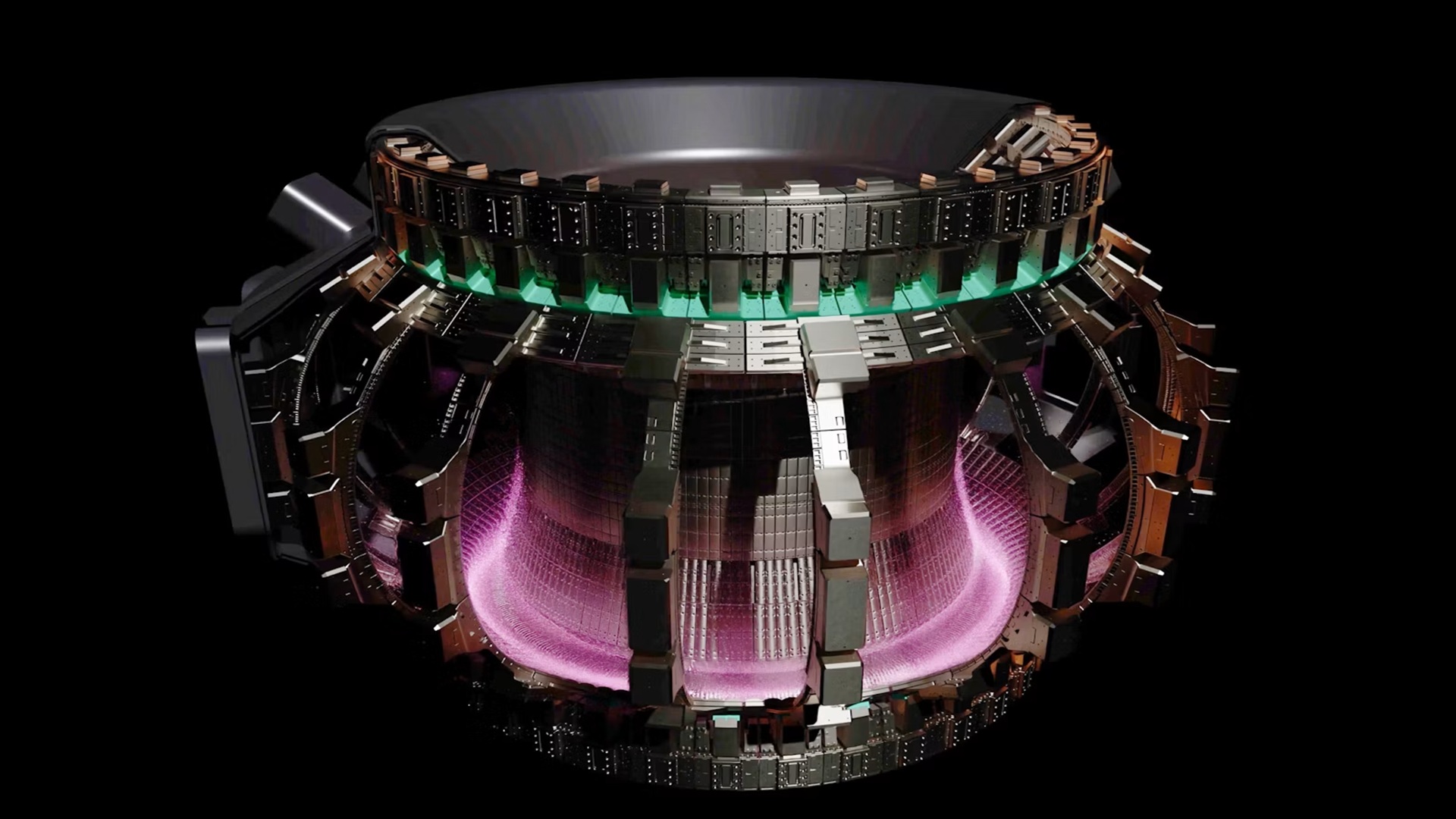
A new US Department of Energy-backed project aims to predict the behavior of plasma inside a fusion reactor in less than 20 minutes, using a digital replica of Commonwealth Fusion Systems’ (CFS) SPARC device. The project, led by the American fusion energy company, brings together four DOE national laboratories, NVIDIA, Google DeepMind and university researchers. It will develop a digital twin that uses physics simulations, experimental data and advanced computing to predict how SPARC will operate. The initiative is part of the DOE’s Genesis Mission, which announced its Phase II awards on October 8. Princeton Plasma Physics Laboratory (PPPL) will contribute simulation software, experimental data and computing resources to the project. Unlike conventional simulations, the planned digital twin will be connected to the physical SPARC device, which is currently under construction. As experimental data becomes available, researchers intend to update the virtual model to improve its predictions and guide future experiments. Predicting plasma between experiments SPARC is a tokamak, a fusion device that uses powerful magnetic fields to confine extremely hot plasma. Researchers must understand how the plasma behaves under different operating conditions to improve reactor performance. The digital twin is intended to predict a complete plasma pulse, or one experimental operating cycle, in under 20 minutes. That would allow scientists to analyze results and prepare adjustments between successive experiments. PPPL will contribute three established physics simulation codes: M3D-C1, TRANSP and XGC. These tools model different aspects of plasma behavior and will be combined with other software to generate predictions. The project will also use faster computational models trained on large simulation datasets. Known as surrogate models, they approximate the results of more complex calculations while requiring less computing time. “PPPL will play a central role in this project, contributing foundational software engineering and SI models, core physics models, historical tokamak data and high-performance compute resources,” said Michael Churchill, head of PPPL’s AI for Science Group. The planned 20-minute turnaround is a development target, not a demonstrated performance result. Researchers must still verify that the predictions remain accurate under actual operating conditions. Testing models before deployment Before applying the technology to SPARC, researchers will test and validate digital twin workflows using PPPL’s National Spherical Torus Experiment-Upgrade (NSTX-U). The experimental platform will allow scientists to assess how well their models reproduce plasma behavior and whether they can reliably support decisions during fusion experiments. Data from NSTX-U and earlier PPPL experiments will also help train and evaluate the models. Some of these datasets will be made available to the wider fusion research community. Beyond PPPL, the collaboration includes Oak Ridge National Laboratory, Lawrence Livermore National Laboratory and SLAC National Accelerator Laboratory. Massachusetts Institute of Technology, Carnegie Mellon University, General Atomics, NVIDIA, Google DeepMind and Synopsys will also participate. The project builds on CFS’ existing digital twin development efforts, expanding the work through DOE-supported research and collaboration. Its longer-term objective is to support ARC, the commercial fusion power plant CFS plans to develop after SPARC. Researchers hope the digital twin will help them evaluate operating conditions, refine reactor designs, and reduce the time needed to develop future fusion systems. However, SPARC remains under construction, and the new platform has not yet demonstrated its proposed prediction speed or accuracy. Its eventual contribution to commercial fusion power will depend on successful testing and validation. Get the latest in engineering, tech, space & science - delivered daily to your inbox.With over a decade-long career in journalism, Neetika Walter has worked with The Economic Times, ANI, and Hindustan Times, covering politics, business, technology, and the clean energy sector. Passionate about contemporary culture, books, poetry, and storytelling, she brings depth and insight to her writing. When she isn’t chasing stories, she’s likely lost in a book or enjoying the company of her dogs.
US Genesis Mission backs digital twin to predict fusion plasma in under 20 minutes
Full Article
Original Source
Read the full article at Interestingengineering →KhanList aggregates and links to publicly available news content. We do not host full articles from third-party sources. Always verify important information with original sources.