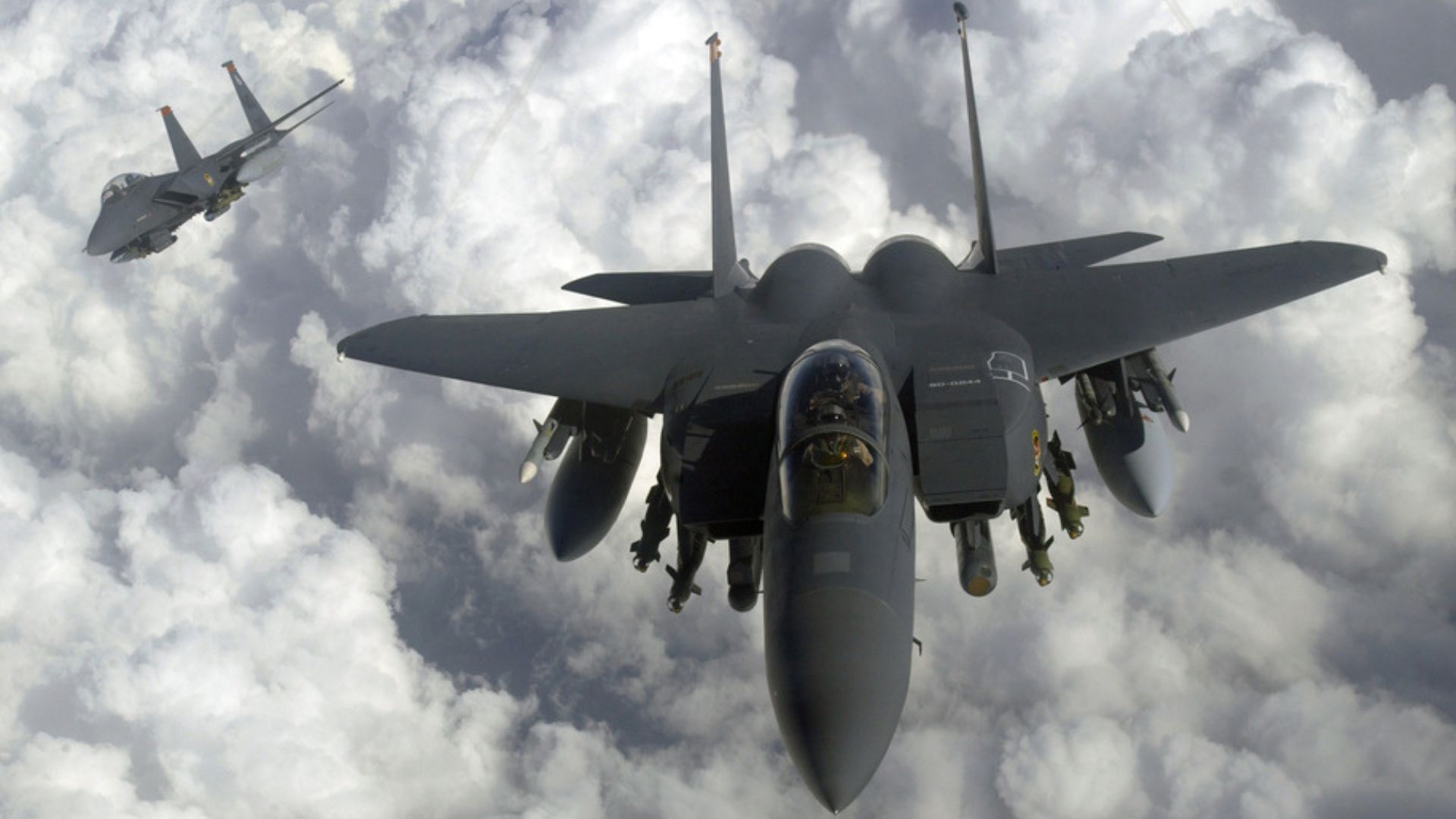
A new account of the April shootdown of a U.S. Air Force F-15E Strike Eagle over Iran suggests that drones may have played a role in locating and tracking the fighter before it was engaged, potentially giving Iranian forces information they needed to cue an air-defense weapon. The claim, reported by The New York Times and subsequently discussed by other outlets, comes from a U.S. military official familiar with the assessment. According to the official, Iranian drones provided commanders with the F-15E’s location, speed and direction, helping them target the aircraft. The account has not been independently confirmed in public by the Pentagon. The possibility is significant because it would demonstrate how relatively inexpensive unmanned systems could supplement a degraded conventional air-defense network. How drones could help shoot down a fighter A drone does not necessarily need sophisticated radar to contribute to an air-defense engagement. A small unmanned aircraft equipped with an electro-optical or infrared camera could potentially detect an aircraft and report its approximate position and movement. Several drones operating across an area could provide multiple observations, allowing a command network to build a more useful track. More sophisticated drones could potentially carry electronic-support sensors capable of detecting an aircraft’s radar or other radio-frequency emissions. That could provide another way of locating an aircraft without relying entirely on a conventional ground-based radar. This distinction matters. The available reporting does not establish exactly what sensors Iran’s drones carried or how the tracking information was passed to the missile unit. The War Zone’s analysis similarly cautioned that even a relatively simple network of airborne spotters could provide useful situational awareness, particularly if Iran’s more expensive fixed and mobile sensors had been heavily attacked. The “jellyfish” drone mystery The new account is particularly interesting because it follows an earlier report about what the F-15E pilot saw shortly before the aircraft was lost. In June, CNN reported that the pilot described encountering what appeared to be a “jellyfish-like” formation of drones, with multiple aircraft apparently moving together and smaller drones positioned beneath larger ones. Sources familiar with the pilot’s account described it as a kind of airborne “minefield.” That description generated speculation about a sophisticated Iranian drone swarm using mesh networking, potentially allowing multiple drones to operate cooperatively. But there is an important caveat. There is no public evidence establishing that the reported drone formation was the same system that provided targeting information for the F-15E. The pilot had also suffered a concussion during the incident, and U.S. intelligence reportedly had not previously assessed Iran as possessing the particular coordinated capability described in the account. CNN reported that officials were therefore still trying to determine exactly what the pilot had encountered. A cheap sensor network could be enough The more mundane explanation may actually be more interesting. Iran would not necessarily need a sophisticated autonomous swarm to exploit drones in this way. A network of relatively inexpensive aircraft, each acting as a disposable airborne sensor, could provide an additional layer of warning after conventional air-defense infrastructure had been damaged. This concept has been demonstrated repeatedly in Ukraine, where drones have become essential for reconnaissance, artillery spotting, target tracking and battle-damage assessment. The lesson is that a military does not always need an exquisite sensor to find a target. It needs enough sensors, communications and weapons working together to create a useful kill chain. The Iranian approach could therefore involve a simple sequence: a drone spots or detects an aircraft, transmits its position to a command element, and that information helps cue a shooter already positioned along the aircraft’s route. Why the F-15E’s defenses may not have been enough The F-15E is a highly capable multirole fighter equipped with sophisticated electronic warfare and defensive systems. But those systems do not make the aircraft immune to short-range threats. The War Zone reported that the missile involved may have been a shoulder-launched infrared-guided weapon, although the exact weapon has not been publicly established. The same analysis noted that the aircraft reportedly received only a very short warning before being hit. That would make early detection particularly important. If a drone or another sensor can reveal an aircraft’s position before the missile is launched, the shooter does not necessarily need an elaborate radar system of its own. The April 3 shootdown remains an unusual incident. Both F-15E crew members ultimately survived after ejecting, although recovering them required a major U.S. search-and-rescue operation deep inside Iran. Contemporary reporting from Business Standard and CNN confirms the scale and complexity of that recovery effort. What remains uncertain is exactly how Iran found the F-15E, which sensor detected it, what weapon ultimately struck it, and whether the reported drones were directly involved.If the latest account is accurate, however, the incident offers another example of a radically changing aerial warfare. A fighter does not necessarily have to be detected by the radar of the weapon that shoots it. A network of cheap, distributed sensors may provide enough information to reveal where it is, and let a much simpler weapon do the rest.Get the latest in engineering, tech, space & science - delivered daily to your inbox.Kaif Shaikh is a journalist and writer passionate about turning complex information into clear, impactful stories. His writing covers technology, sustainability, geopolitics, and occasionally fiction. A graduate in Journalism and Mass Communication, his work has appeared in the Times of India and beyond. After a near-fatal experience, Kaif began seeing both stories and silences differently. Outside work, he juggles far too many projects and passions, but always makes time to read, reflect, and hold onto the thread of wonder.
US F-15E may have been tracked by Iranian drones before being shot down: Reports
Full Article
Original Source
Read the full article at Interestingengineering →KhanList aggregates and links to publicly available news content. We do not host full articles from third-party sources. Always verify important information with original sources.