
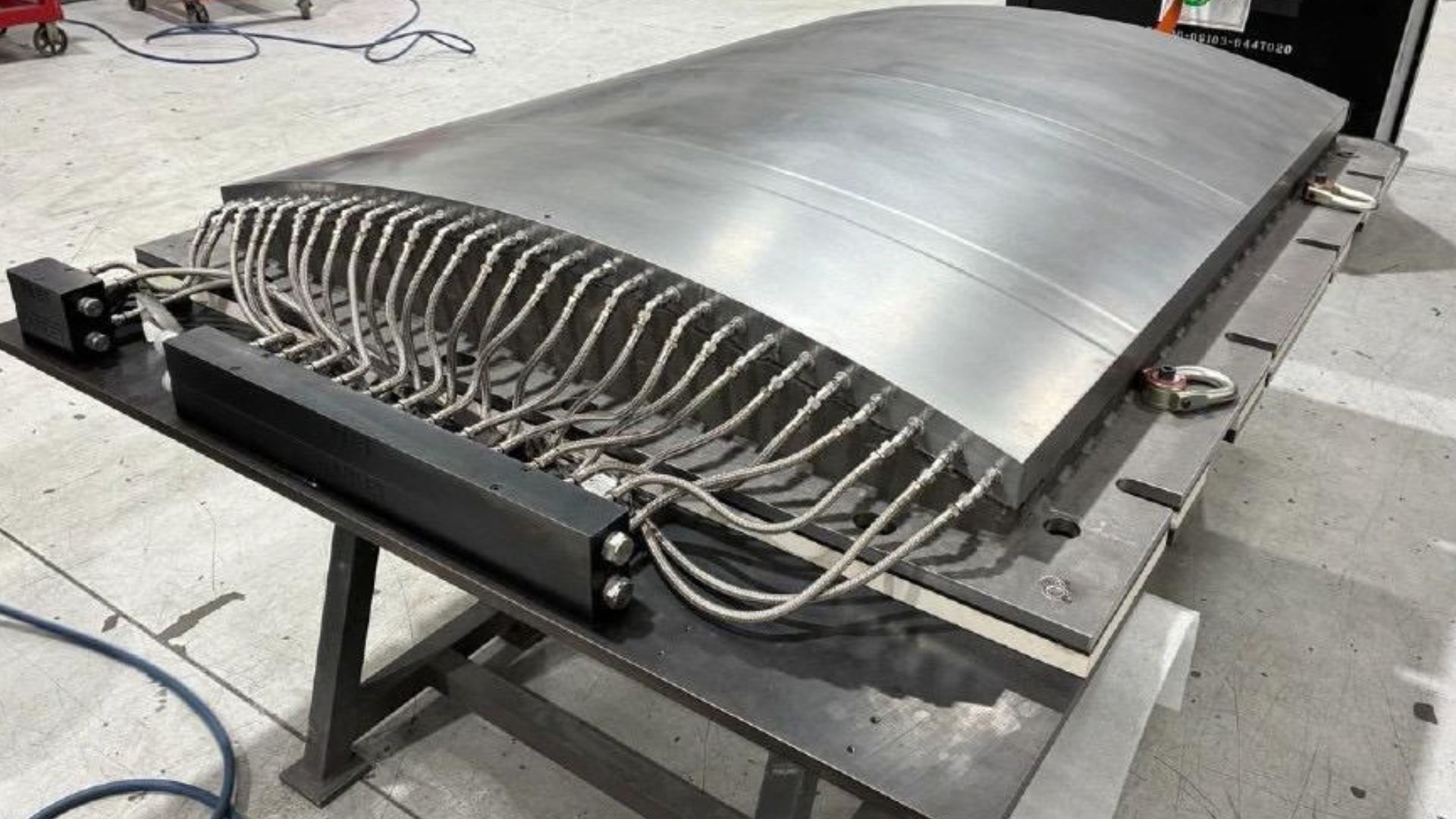
Inside a Tennessee laboratory, a robotic arm spent eight weeks 3D-printing a two-ton, six-foot-tall block of molten steel. Though the massive structure resembles an industrial sculpture, it is actually a cutting-edge piece of aviation equipment. Known as a Stamp Form Die (SFD) mold, the tool is designed to shape lightweight, high-performance thermoplastic composite doors for next-generation aircraft. Engineers from Oak Ridge National Laboratory and Boeing 3D-printed this metal mold using advanced wire-arc additive manufacturing. It combines mild and stainless steel alongside internal curved cooling channels to optimize strength, durability, and thermal control. It is designed to support NASA’s Hi-Rate Composite Aircraft Manufacturing (HiCAM) project, which aims to make commercial planes lighter and more fuel-efficient. “NASA and its industry partners are working to increase the production rate of composite aircraft to meet the growing demand for air travel and to reduce aircraft weight, which improves fuel efficiency, lowering costs for aircraft operators,” said Richard Young, NASA HiCAM project manager. “Doing so is essential to maintaining U.S. competitive advantage in the commercial aircraft industry.” Normally, manufacturing a mold this size takes months of traditional metalworking—casting, forging, and heavy drilling. But researchers wanted to push technical boundaries. The project tested whether additive manufacturing can produce thermally controlled molds faster and cheaper than standard metalworking techniques. To replace standard manufacturing methods like machining and casting, Boeing partnered with small and large American businesses and ORNL to 3D-print a Stamp Form Die tool. This metal punch press mold functions like slices of bread in a sandwich, stamping hot plastic sheets into lightweight thermoplastic aircraft doors. ORNL executed the project using its specialized Arc-1 system, a robotic welding setup capable of wire-arc additive manufacturing. Compared to typical printers, Arc-1 feeds multiple wire types simultaneously to melt and layer different metals together. This multi-material capability gives greater design flexibility to tailor the performance, versatility, and shape of complex components. “Multi-material WAAM allows for the realization of completely new designs, combining fine-tuned mechanical performance with time and cost savings,” said Andrzej Nycz, ORNL senior robotics engineer. The Boeing mold uses mild steel for internal strength and stainless steel at the surface for durability and corrosion resistance. 3D printing enabled built-in curved channels that mirror the mold shape to optimize heating and cooling efficiency. To prevent heat-induced warping during cooling, engineers added temporary support ribs and ran 32 computer simulations to ensure precise shaping. Baker Industries finalized the tool in Michigan through stress-relief annealing, rib removal, and final fabrication. 3D-printing the future of aviation Although certain components required traditional fabrication, the 3D-printing process can be readily applied to create similar large-scale tools. This successful test case paves the way for wider commercial adoption across key manufacturing sectors. “We used this as a test case,” said Ahmed Arabi Hassen, ORNL’s group leader for Composites Innovation. “Its success means the technology could be used to make large thermoplastic structures for other sectors of U.S. industry, such as energy and automotive.” Thermoplastic composites are lighter than typical aluminum aircraft bodies. Lighter planes consume less jet fuel, which directly cuts carbon emissions and operating expenses for commercial airlines. This multi-material wire-arc additive manufacturing process offers applications well beyond commercial aircraft. Electric vehicle manufacturers can adapt the technology to stamp lightweight body panels that improve battery range and efficiency. Clean energy producers can print large-scale tooling to mold massive composite wind turbine blades. Also, space exploration companies can use the same rapid-tooling method to fabricate durable molds for rocket fairings and capsule structures.Get the latest in engineering, tech, space & science - delivered daily to your inbox.Mrigakshi is a science journalist who enjoys writing about space exploration, biology, and technological innovations. Her work has been featured in well-known publications including Nature India, Supercluster, The Weather Channel and Astronomy magazine. If you have pitches in mind, please do not hesitate to email her.
US engineers 3D-print giant two-ton steel mold to make lighter aircraft doors
Full Article
Original Source
Read the full article at Interestingengineering →KhanList aggregates and links to publicly available news content. We do not host full articles from third-party sources. Always verify important information with original sources.