
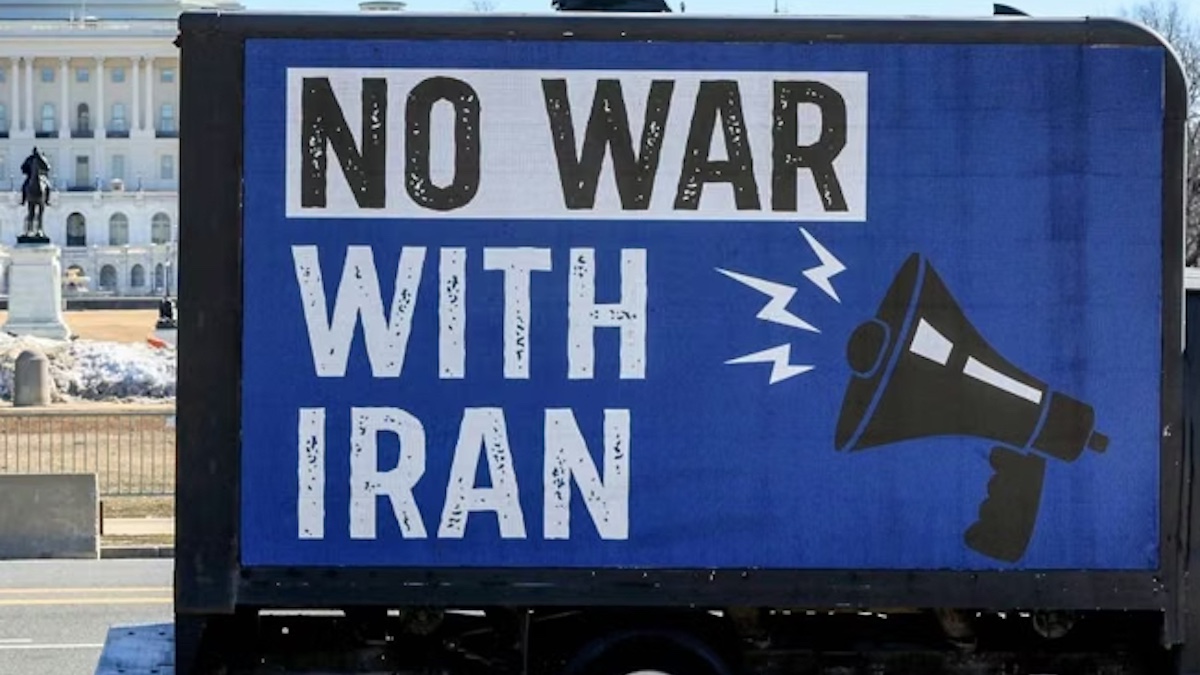
Voters across the United States were loud and clear on Tuesday in their historic drubbing of Trumpism. The election was a decisive rejection of Trump’s war on Iran and its staggering costs at home. While savoring their victory and the historic opportunity to restore America’s constitutional order, the Democrats should take the anti-war message of the election to heart, because they suffered the same verdict two years ago, when voters rejected the Biden administration’s wars in Ukraine and Gaza. Last week Israeli voters rejected Netanyahu’s reckless wars, and European voters are also rejecting parties that prolong the Ukraine War. The message of voters is the same everywhere: diplomacy is safer, more effective, and trillions of dollars cheaper than war. On election night Trump conceded to Fox News, “I think a part of it was Iran.” The next day Vice President JD Vance was far blunter, posting on X: “The reason we lost is the war. The president himself said so last night…. everyone knows why we lost.” In the AP Voter Poll, about 60% of voters said the decision to use military force against Iran was wrong, and about 90% called the cost of living a crucial or major factor in their vote. The war and the cost of living were, of course, utterly intertwined. Gasoline prices, around US$2.80 per gallon before the war began on February 28, had risen by about 55% by mid-May and reached a monthly average of $4.43 in September. The 10-year Treasury yield climbed from below 4% before the war to above 5% in the autumn, and the Pentagon sought more than $200 billion in supplemental war funding. Every family with a mortgage, a car loan or a credit card balance suffered from the war. The first duty of the new Congress is to restore its constitutional authority over war and its power of the purse to ensure that US forces are not sent back into combat in Iran or anywhere else on the whim of a president and the behest of domestic or foreign lobbies. Trump must of course refrain from restarting the war, which was never remotely necessary or justified. Remember that on February 28, the day the US and Israel launched the war, Oman’s foreign minister, who was mediating the US-Iran talks, had said that a deal was within reach. The Democrats should not imagine that the anti-war lesson applies only to Republicans. Kamala Harris lost in 2024 because voters held the Biden administration responsible for the costs of its own wars. The energy shock that followed the escalation of the Ukraine war in 2022 drove up inflation, and gasoline topped $5 per gallon for the first time in June 2022. Biden twice rejected negotiations that could have ended the conflict: in December 2021, when his administration refused to negotiate on NATO enlargement in response to Russia’s draft security treaty, and in April 2022, when the Istanbul talks were abandoned at the behest of the US and UK. The Gaza genocide also cost the Democrats directly. Among Americans who voted for Joe Biden in 2020 but not for Harris in 2024, 29% named ending Israel’s violence in Gaza as the main factor in their decision, the most frequently cited issue. The party’s voters have moved far ahead of its leaders. A New York Times/Siena poll in May 2026 found that roughly three-quarters of Democratic voters oppose US military and economic assistance to Israel. Voters everywhere are sending the same message: peace through diplomacy. On October 27, after Israeli wars in Gaza, Lebanon and Iran, Netanyahu lost his majority. Similarly, European leaders who have tied themselves to open-ended war in Ukraine are being rejected by the voters. Only 10% of Germans are satisfied with Chancellor Friedrich Merz, the lowest rating ever recorded for a German chancellor. Emmanuel Macron’s approval fell to 15% in October. In Bulgaria, Iliana Iotova, who favors dialogue with Moscow, won the presidency on November 1 with more than 58% of the vote. A key upcoming key test for the Democrats will be Ukraine. They must stop their party’s typical Russia-bashing and instead support a diplomatic end to the war. As a start, the Democrats should remember why the war started. In 1990 the United States assured Mikhail Gorbachev that NATO would not move “one inch eastward.” The Clinton administration broke that promise. In 2008 the Bush administration pushed through the Bucharest declaration that Ukraine and Georgia “will become members of NATO,” despite Ambassador William Burns’s warning that this was the brightest of all red lines for Russia. In 2014 , the United States backed the coup against Ukraine’s elected president, Viktor Yanukovych, as the leaked Nuland-Pyatt call made clear. In April 2022, when negotiators in Istanbul came close to a peace agreement based on Ukrainian neutrality, the US and UK actually intervened to block the agreement. Today, 75% of Ukrainians support negotiations with Russia to end the war. In view of these causes of the war, I have recently set out a straightforward diplomatic framework for peace in Ukraine that would end the war. NATO would end its eastward expansion. Ukraine would adopt permanent neutrality on the model of Austria in 1955. An armistice line would be drawn, with both sides renouncing the use of force to change it. Ukraine would pursue membership in the European Union as a permanently neutral state. The Democrats should support such a diplomatic approach. It’s what can end the war, save Ukraine, and win the backing of both the Ukrainian and American people. Most importantly, the Democrats should not mistake their victory for a mandate to pursue their own wars. The new Democratic majority should quickly reassert the constitutional authority of Congress over war and peace, champion a negotiated peace in Ukraine, end support for Israel’s wars, cut the military budget, and redirect the savings toward lowering the cost of living and repairing the public finances. These positions are not only right but are good politics. For the Democrats to win the White House in 2028, they should become the party of peace. Better yet, both parties should become parties of peace and conduct the 2028 campaign on which party will best address America’s needs for decent jobs, affordability, healthcare, housing, a safe environment and quality education. Jeffrey D. Sachs is a university professor and director of the Center for Sustainable Development at Columbia University, where he directed The Earth Institute from 2002 until 2016. He is also president of the UN Sustainable Development Solutions Network and a commissioner of the UN Broadband Commission for Development. He has been an advisor to three United Nations Secretaries-General and currently serves as an SDG Advocate under Secretary-General Antonio Guterres. – Common Dreams
US Democrats, please take note: peace is good politics
Full Article
Original Source
Read the full article at Asiatimes →KhanList aggregates and links to publicly available news content. We do not host full articles from third-party sources. Always verify important information with original sources.