
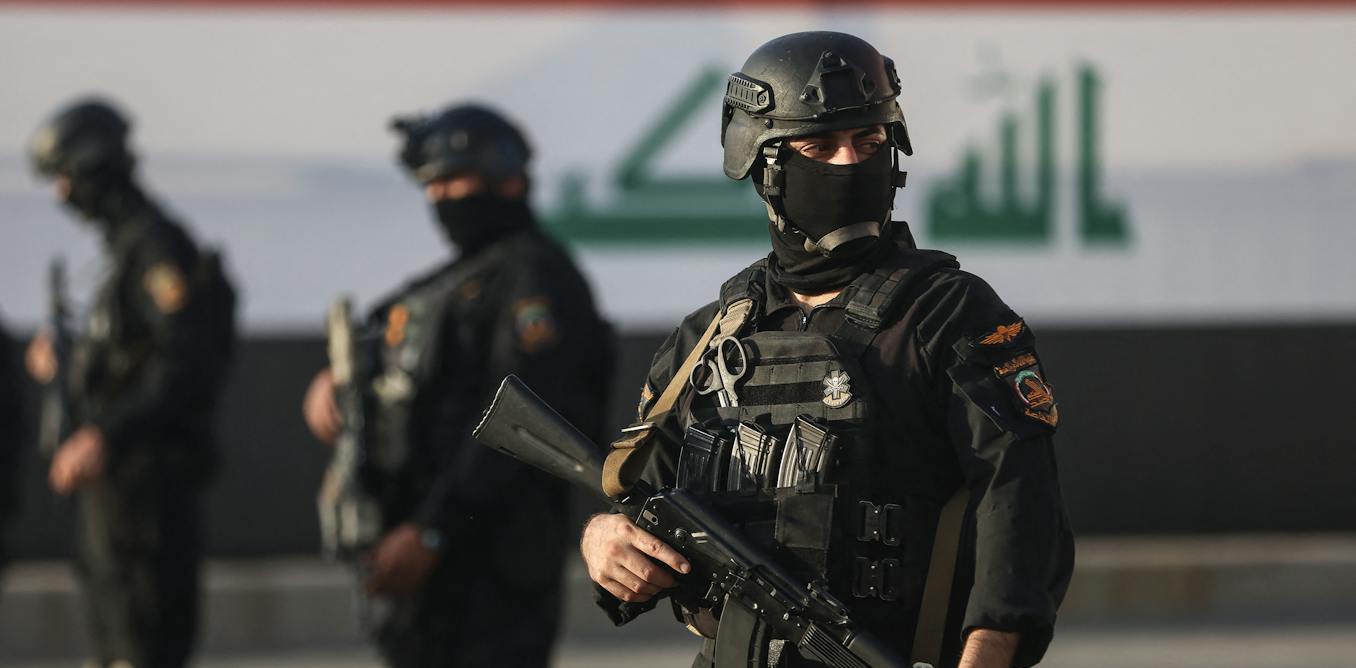
Iraq marked Sovereignty Day on Sept. 30, 2026, by holding a four-day national holiday in celebration of the departure of U.S-led international forces. American troops, by far the largest contingent, had been stationed there since 2014 as part of an 87-member coalition that provided Baghdad with military and intelligence assistance. Their leaving was seen as a vital step in Iraq’s transition to sovereign security. The day was also set to mark another development toward that end: the establishment of a “state monopoly” on arms aimed at neutering, in particular, Iranian-backed armed groups that have proliferated since the U.S invasion of Iraq in 2003. But the Iraqi government missed its target date. Instead, the deadline has now been pushed back to June 2027. As an expert on Iraqi politics and security, I fear that this initial delay portends a wider problem. The Iraqi government is facing increasing pressure from the U.S. to bring Iranian-aligned armed actors under control. As recently as early November 2026, President Donald Trump reportedly warned Iraqi Prime Minister Ali al-Zaidi of consequences – financial penalties or potential direct strikes against such groups – should disarmament not happen. But Washington and Baghdad appear to be on different pages when it comes to establishing a so-called state monopoly on the arms. For Iraq’s government, it means pulling some armed groups further within the orbit of the Popular Mobilization Forces, or PMF – a state-sponsored umbrella of armed actors. The U.S, meanwhile, clearly envisions something very different: the demilitarization of armed groups and likely a fundamental reorganization of the PMF itself. Behind that disconnect is a seemingly irreconcilable difference of how both see the role of the Iraqi state. Blurred lines Dozens of armed groups, including those that are Iranian-aligned, currently make up the patchwork of security forces across Iraq’s decentralized political landscape. Some of these have a relationship with the Iraqi state that is complicated and subject to change. Since 2014, many have operated under the umbrella of the PMF. Formed largely in response to the threat from the Islamic State group, the PMF consists of around 60-70 brigades, mainly Shiite Muslim groups but with some representing the country’s significant Sunni Muslim minority as well as other ethnic groups. The PMF is formally and legally affiliated with the state and is seen as an Iraq-centered entity – that is to say, it is answerable to the Iraqi prime minister and tasked with providing national defense and regional security as a legal part of the nation’s security apparatus. But in reality, some elements of the PMF operate with a degree of independence. The PMF exists alongside so-called resistance groups – armed groups that are ideologically allied with Iran and often support the aims of Tehran beyond the goals of the Iraqi nation. These include, among others, the Hezbollah Brigades and al-Nujaba Movement – both of which trace their lineage to the Mahdi Army formed, with Iran’s assistance, during the U.S. invasion in 2003. The aims of the PMF and those of the resistance groups are not always synonymous. Some resistance groups operate outside of the PMF, while others, such as Asab Ahl al Haq Brigades, have units both in the PMF and the outside resistance. It’s a complex picture, and the line demarcating the resistance and the PMF is often blurred. Demands from Washington The U.S. has long protested the presence of all resistance groups in Iraq. In October 2025, then-U.S. Special Envoy to Iraq Mark Savaya warned that “there is no place for armed groups operating outside the authority of the Iraqi state.” U.S. President Donald Trump welcomes Iraqi Prime Minister Ali al-Zaidi to the White House on July 14, 2026. Li Yuanqing/Xinhua via Getty Images Part of Washington’s concern is the role that some resistance groups have played in attacks on U.S. assets in Iraq and the region. Since hostilities broke out between the U.S. and Iran in February 2026, Iraqi-based resistance factions have launched hundreds of rocket strikes against American forces in Iraq. They have also attacked infrastructure in Arab Gulf states and targets within Israel. Such attacks prompted the U.S in April to criticize Baghdad for failing to “prevent terrorist attacks in or from Iraqi territory” by “Iran-aligned terrorist militia groups [who] claim to be associated with the Iraqi government.” Iraq under al-Zaidi, too, wants an end to groups on its soil joining Iran in retaliation strikes against the United States and its allies. But the U.S. and Iraqi governments seemingly differ on how. Washington appears to want the dismantling or meaningful restructuring of armed groups writ large. But al-Zaidi’s plan simply seeks to bring the resistance factions into the state-sanctioned PMF. And on this front, some progress has been made. On Oct. 6, al-Zaidi marked the halfway milestone of this “state monopoly of arms” by announcing that he had convinced three out of the five main resistance factions sitting outside the PMF to surrender their weapons to the state, with negotiations ongoing with the other two. By the “state,” al-Zaidi almost certainly means the PMF Commission – the official state body that administers, funds and oversees the PMF. The messy business of state formation In Washington, that may not be sufficient. More than a century ago, sociologist Max Weber famously defined the state primarily as a means to centralize rulemaking and monopolize the use of legitimate violence – and this view prevails in Western nations. But in Baghdad, the state is deliberately a communalized entity in which armed groups operate within the legal framework, if often nominally, to carry out the work of security forces. It reflects the nation’s multiethnic and sectarian makeup. Herein lies much of the problem in reconciling the U.S. and Iraqi governments’ view of what a “state monopoly of arms” means. To Washington, al-Zaidi’s idea of refashioning the resistance more firmly under the auspices of the PMF, while leaving the underlying arms and effective command structures intact, appears insufficient. But anything more would be a tall order. Individual armed groups within the PMF are deeply embedded in the structure of the nation’s political order; members sit in and dominate parliament, hold cabinet positions and control state bureaucracy. Asking the government to disarm these groups would first require that Iraq’s leaders conceive of the state in an entirely different way. Some observers have warned that it could lead to civil war, while the leader of at least one of the armed groups has already accused al-Zaidi of “implementing an American agenda.” Not many modern nations possess the communal security apparatus that defines Iraq today. But this security landscape is a fact of post-2003 Iraq, and it is unlikely to be going away anytime soon.
US demands that Iraq disarms brigades misread the nation’s complicated security landscape
Full Article
Original Source
Read the full article at Theconversation →KhanList aggregates and links to publicly available news content. We do not host full articles from third-party sources. Always verify important information with original sources.