
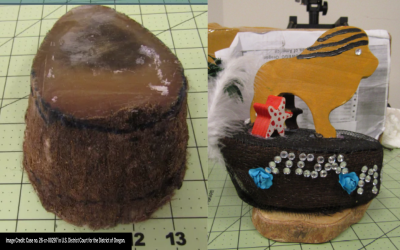
A federal court in the U.S. has sentenced two residents of the state of California for their roles as financial facilitators in a scheme trafficking wildlife body parts between the U.S. and Vietnam. Linh Luu and Kevin Le, a married couple from Anaheim, were sentenced on Oct. 23 to three years of probation and fined $10,000 each after pleading guilty to violating the Lacey Act, according to the U.S. Department of Justice. Between September 2019 and May 2021, the couple processed $51,100 in payments for a Vietnam-based individual importing American black bear gall bladders and puma bones, while exporting to the U.S. lion teeth, black and white rhino horn pieces, and even a tiger pelt. Trade in all the species involved is restricted under CITES, the global wildlife trade treaty. Rhinos, tigers, and lions are also listed under the U.S. Endangered Species Act. Federal authorities uncovered the operation through an undercover sting. According to the Justice Department, Luu and Le met an undercover agent in a parking lot in December 2020 and accepted a $12,000 down payment in cash for a piece of rhino horn while discussing ways to evade U.S. banking regulations. The horn was later shipped to the state of Oregon disguised as a household decoration to thwart customs inspectors. Law enforcement officials said dismantling financial facilitators is essential to curbing wildlife crime. “Wildlife trafficking threatens some of the world’s most vulnerable species and fuels criminal networks that profit from their destruction,” Scott Bradford, U.S. attorney for the district of Oregon, said in a statement. “This case demonstrates that our office will hold accountable not only the poachers, but also the financial facilitators who keep these markets alive.” The investigation was led by the U.S. Fish and Wildlife Service’s Office of Law Enforcement, alongside Homeland Security Investigations and Oregon State Police. “This investigation clearly illustrates that wildlife trafficking isn’t a victimless, white-collar crime. It’s the financial engine behind the slaughter of species like rhinos, tigers, and black bears,” Dougles Ault, assistant director of the USFWS Office of Law Enforcement, said in a news release. “Poachers take the wildlife, but organizers and financial facilitators make the killing profitable.” Mongabay previously reported that states along the U.S. West Coast face escalating challenges from trafficking networks as understaffed enforcement agencies struggle to police millions of tons of cargo moving through high-traffic land border crossings, busy international airports, and seaports, allowing criminal syndicates to hide illicit shipments and launder payments for domestic and global markets. Banner image: A piece of rhino horn, left, and the same part disguised as a house good to thwart customs, right. Image courtesy of the U.S. Office of Public Affairs. Credits Topics
US couple sentenced for helping finance trade in rhino horn, puma bones, other wildlife parts
Full Article
Original Source
Read the full article at News →KhanList aggregates and links to publicly available news content. We do not host full articles from third-party sources. Always verify important information with original sources.