
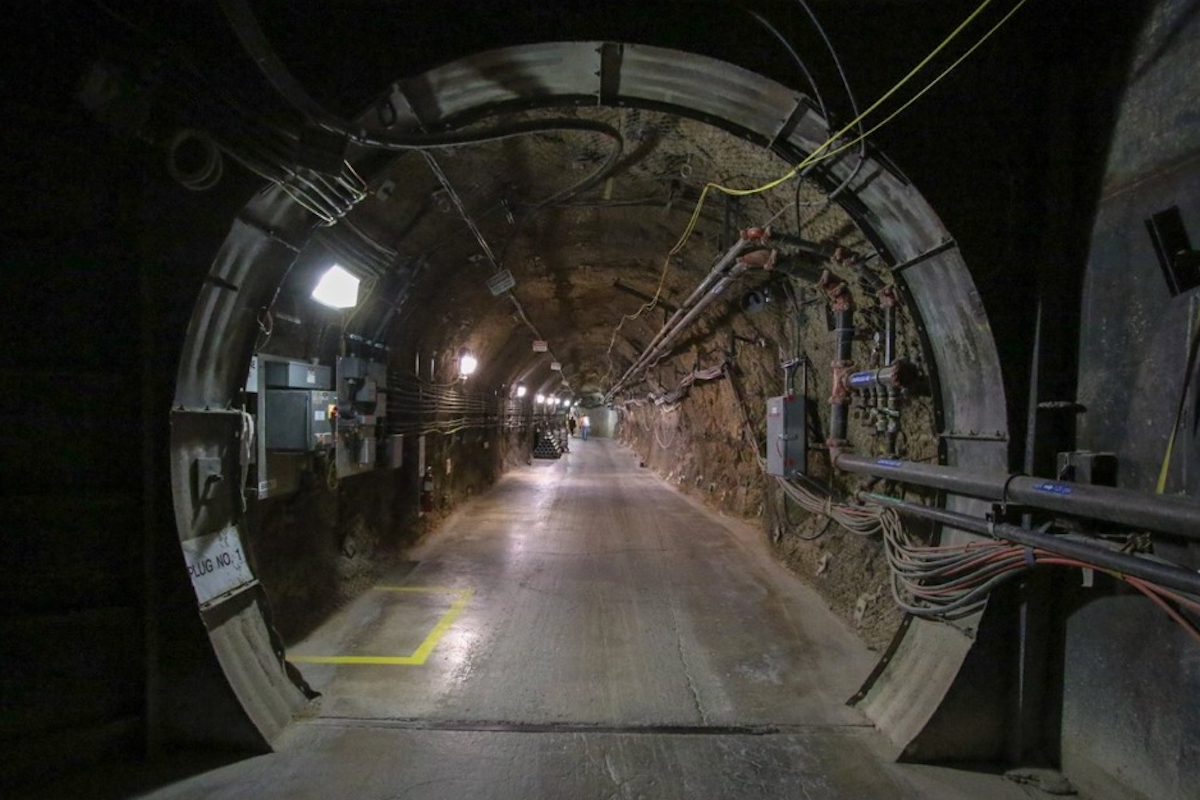
Faced with rising great-power suspicions and the challenge of verifying clandestine, cavity-muffled detonations, the US is turning to high-precision subterranean blast experiments in the Nevada desert to strip covert nuclear testing of its technical cover. Last month, the US Department of Energy (DOE) reported that the National Nuclear Security Administration (NNSA) conducted an underground, non-nuclear explosion experiment at the Nevada National Security Site to improve US capabilities to detect low-yield and concealed foreign nuclear tests. Carried out in the site’s P Tunnel within Area 12, the test utilized chemical high explosives alongside radiotracers to replicate the physics of clandestine detonations without nuclear material. Scientists deployed an array of instrumentation — including seismometers, accelerometers, electromagnetic detectors, infrasound devices, meteorological monitors, and radiotracer samplers — to capture comprehensive signature data. Officials stated the primary objective is to validate physics-based models and refine detection algorithms targeting “decoupled” nuclear explosions, in which a device is detonated inside an underground cavity to muffle its seismic shockwaves and mimic a far smaller blast. The administration framed the initiative as a countermeasure against evasive foreign testing techniques, citing findings that China utilized decoupling during a June 2020 event at its Lop Nur test grounds. By gathering empirical multi-physics data, this non-nuclear experiment addresses critical capability gaps in low-yield test detection. A March 2024 US Congressional Justification Report explicitly notes that the DOE is developing new methods to discriminate between evasively conducted underground explosions and natural earthquakes — capabilities NNSA administrator Brandon Williams has championed as essential to maintaining unmatched technical verification over muffled foreign nuclear weapons development. The institutional push highlights an implicit shortfall in the US’s ability to definitively verify foreign micro-yield testing through standoff observation alone. While the Comprehensive Nuclear-Test-Ban Treaty Organization’s (CTBTO) International Monitoring System reliably flags uncontained blasts exceeding 500 tons of TNT equivalent, its global network struggles to resolve sub-kiloton decoupled explosions. Compounding the challenge, the US guards its raw sensor telemetry and proprietary classification algorithms as classified national security assets, preventing independent third-party corroboration. Bridging these verification gaps through empirical blast modeling is seen as an essential technical prerequisite for any future trilateral arms control agreement. Detailing the technology possibly deployed to detect these simulated decoupled blasts, a May 2024 Lawrence Livermore National Laboratory technical report notes that the Nevada P-Tunnel tests—operating under the Physics Experiment 1 program—pair subterranean fiber-optic Distributed Acoustic Sensing (DAS) and high-g accelerometers with surface infrasound arrays and induction magnetometers. At the same time, automated gas circulation systems track explosive byproducts and isotopic tracers like radioxenon and tritium. These systems evaluate particulate migration through damaged rock to capture elusive chemical signatures that bypass muffled seismic profiles. To manage this complex data, an October 2024 Pacific Northwest National Laboratory (PNNL) report details how the Integrated Data Acquisition system at P-Tunnel relies on a redundant fiber-optic loop governed by Precision Time Protocol and rubidium master clocks. By pairing shock-isolated enclosures with high-frequency digitizers recording up to 20 million samples per second, the synchronized network captures transient elastic waves, electromagnetic pulses, and early aftershocks, isolating decoupled explosions from ambient subterranean noise. Further enhancing this forensic baseline, a June 2025 article in the peer-reviewed AIP Advances journal by Andrew Wright and colleagues details how national laboratory researchers fielded sheathed, low-hydroxide optical fibers coupled to high-speed spectrometers. These instruments measured initial fireball temperatures exceeding 3,000 degrees Celsius before vaporizing, capturing the early-time thermal and compressional parameters required to calibrate simulations of cavity-muffled blasts. By translating these complex hydrodynamic and seismic datasets into predictive algorithms, the US aims to remove the plausible deniability that has long shielded low-yield evasion. China maintains robust deniability at Lop Nur because low-yield activities can be framed as benign safety evaluations or proliferation research, Joseph Rodgers and Joseph Bermudez Jr. note in a February 2026 Center for Strategic and International Studies (CSIS) report. Suspected detonations may represent one-point safety experiments designed to prevent accidental warhead initiation, or intentional efforts to map evasion signatures. Historical testing precedents demonstrate that subcritical safety trials occasionally produce unanticipated micro-yields without malicious intent. Geologically muffled within Lop Nur’s natural salt formations, these ambiguous sub-kiloton events allow China to credibly dismiss noncompliance claims as routine, peaceful stockpile stewardship. This technical opacity feeds a persistent diplomatic deadlock. While subcritical experiments are widely considered permissible for weapons safety and stockpile stewardship, the Comprehensive Nuclear-Test-Ban Treaty’s (CTBT) strict zero-yield standard means any micro-explosion producing a nuclear yield is a violation. To break the cycle of deniability, the US, China, and Russia could establish a transparency regime to openly exchange diagnostic information on these safety tests. Yet to date, the three nuclear powers have held no formal technical discussions on subcritical nuclear confidence-building measures. Without an agreed technical standard separating permissible hydrodynamic experiments from illicit supercritical chain reactions, compliance determinations remain hostage to classified intelligence assessments that rival powers cannot independently audit. By removing the technical ambiguity of decoupling, these multi-physics models could theoretically serve as the baseline for a future verification annex. An established scientific framework that reliably isolates cavity-decoupled shockwaves and volatile tracer seepage from natural geological noise would strip clandestine testing of its strategic utility and establish an objective, shared threshold for treaty enforcement. Yet translating these laboratory breakthroughs into an enforceable diplomatic regime faces formidable structural hurdles. Advanced detection modalities, particularly fiber-optic distributed acoustic sensing and near-source isotopic sniffing, depend heavily on proximal placement within kilometers of potential detonation cavities to capture faint, high-frequency signatures before they attenuate in surrounding rock. Neither China nor Russia is likely to grant US or international monitoring networks the physical access required to place such equipment near sovereign, heavily fortified military reservations such as Lop Nur or Novaya Zemlya, making unilateral proximal detection a geopolitical non-starter. Compounding the challenge, China has shown little interest in accepting formal testing constraints or trilateral stockpile caps while it remains focused on building its arsenal toward strategic parity with the US and Russia. Ultimately, while advanced multi-physics diagnostics can eliminate scientific ambiguity surrounding cavity decoupling, sensor technology alone cannot resolve geopolitical distrust. Developing unmatched explosion-detection techniques may deny adversaries confidence in clandestine testing, but relying solely on unilateral tech is a structural dead end. Converting technical forensic capability into durable trilateral arms control will require the US, China, and Russia to accept that transparency underpins trust, trading perpetual deniability for mutually agreed data exchange on what constitutes a verifiable, non-explosive safety test.
US blast simulation targets China’s alleged secret nuke testing
Full Article
Original Source
Read the full article at Asiatimes →KhanList aggregates and links to publicly available news content. We do not host full articles from third-party sources. Always verify important information with original sources.